




Bathroom Tapware Sets: The Complete Australian Buying Guide
by Shivam Tayal 20 Aug 2026 0 Comments
Most people choose bathroom tapware sets backwards. They begin with brushed brass, matte black or chrome, then ask whether the mixer suits the basin. In Australia, that order creates avoidable risk. WELS performance, WaterMark compliance, lead-free construction, water pressure and cartridge quality should decide the shortlist before colour enters the conversation.
A tap can look perfect in a showroom and still be wrong for your installation. It may deliver too much or too little flow, require a rough-in your wall can't accommodate, or carry a certification claim that doesn't survive a check in the official database. The finish matters, but it comes after the parts that keep the tap legal, reliable and sensible to own.
Why Tapware Selection Is More Than a Style Decision
A bathroom tap isn't a decorative handle attached to a basin. It controls water delivery, connects to regulated plumbing components and must work within the conditions of an Australian home. The national WELS scheme uses a one-to-six-star scale and publishes flow in litres per minute, allowing buyers to compare efficiency rather than relying on vague “water-saving” language. Roca's WELS guidance shows that six-star taps use less than 4.5 L/min, while older conventional taps can use around 15 to 18 L/min.
That difference affects everyday consumption and the suitability of the fitting for a Victorian renovation. A low-flow or aerating model may use about 2 L/min, so a properly specified set can reduce water use by more than 70% compared with conventional fittings, as documented in the same Australian WELS reference. I wouldn't choose a tapware set without checking its actual WELS flow figure.
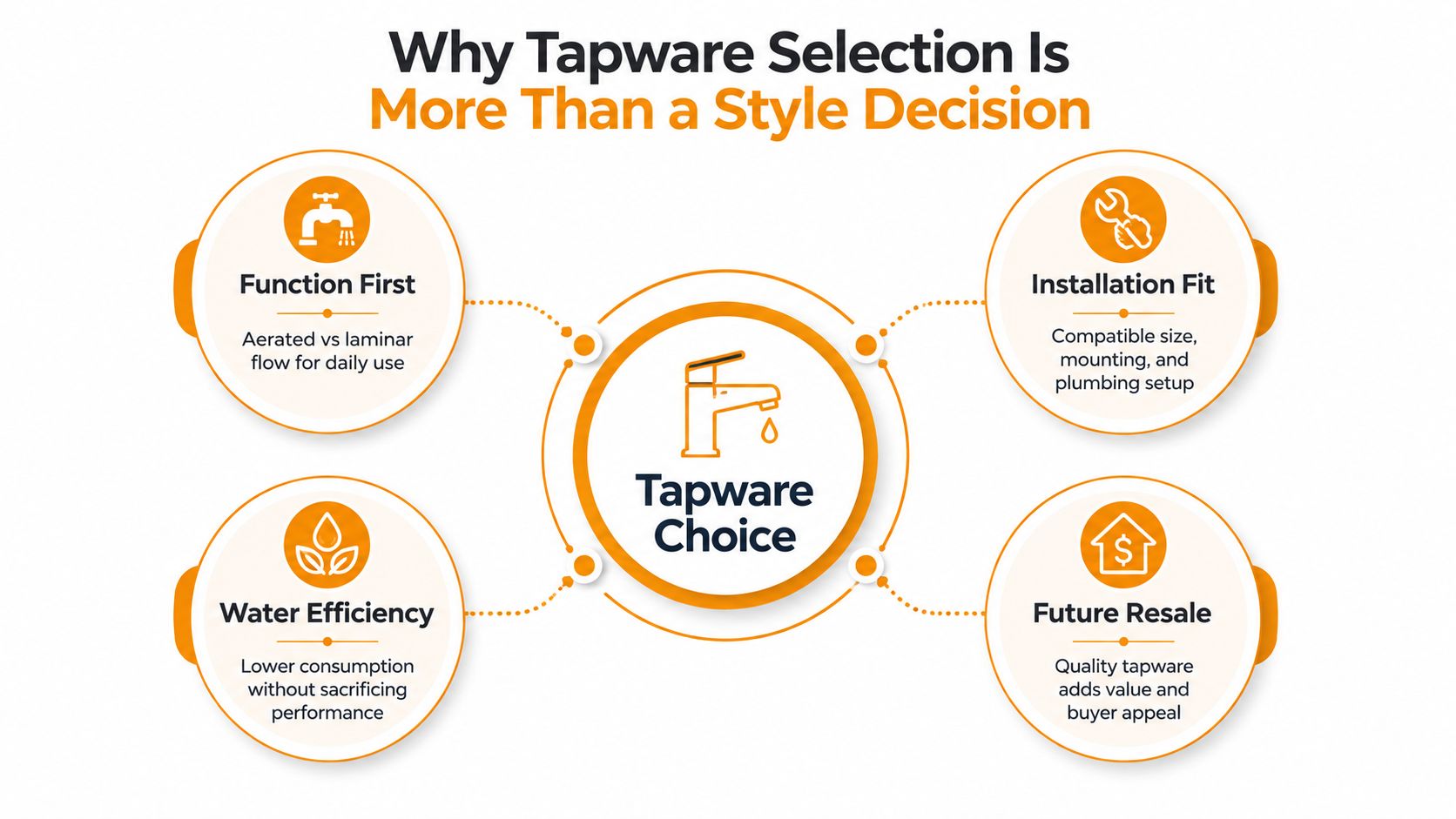
The three checks I treat as non-negotiable
Compliance comes first. The Australian Building Codes Board lists tapware under AS 3718 Water supply, Tap ware. The 2021 specification covers metallic and plastic taps, mixing taps, sensor taps, lever taps, timed-flow taps and tapsets, including common bathroom fittings such as pillar taps, self-closing taps and tapware with integral pop-up wastes. The ABCB tapware schedule is the right starting point for understanding the technical framework.
Hydraulic performance comes next. Your plumber needs to match the fitting to the home's pressure and pipework. A beautifully finished mixer that bangs, whistles or struggles to blend hot and cold water isn't a successful specification.
The cartridge determines daily feel. Smooth movement, stable temperature control and dependable shut-off matter more than a fashionable coating. Ask for the cartridge details, installation requirements and warranty terms, not just the finish name.
Practical rule: Spend the extra time verifying the product record before you spend money on the finish. A tapware set should be attractive because it works well, not used to distract from uncertainty about compliance.
Types of Bathroom Tapware Sets Explained
Start by listing each water outlet in the room. A basin, bath and shower may need completely different tapware, even when you want one consistent finish across all three.
Basin mixers and three-piece sets
A basin mixer combines hot and cold water through one spout and one control. Deck-mounted mixers suit standard basins and vanity tops, while tall mixers are designed for vessel basins with a raised rim. The spout must reach the basin's usable area without directing water against the front wall.
Three-piece sets still make sense where the basin has separate holes or the design calls for distinct hot, cold and spout controls. They suit traditional bathrooms, but they need accurate hole spacing and enough bench or basin clearance. Don't buy a three-piece set for a single-hole basin and assume an adaptor will make the problem disappear.
Bath mixers and fillers
A bath mixer needs a spout with enough projection to clear the tub edge and direct water into the bath. A bath shower mixer adds a diverter and shower outlet, allowing one wall fitting to feed a handset or rail shower.
Freestanding bath fillers are a different proposition. They rise from the floor and require carefully positioned plumbing, a stable finished floor and suitable drainage planning. If the bath sits away from a wall, a standard wall-mounted spout won't solve the installation. Confirm the bath position, floor waste and pipe route before ordering.
Shower sets and concealed controls
A basic rail shower provides a handset on an adjustable rail. A more elaborate system can combine an overhead outlet, handset and additional body outlets, but every extra outlet increases the importance of pressure, flow and valve compatibility.
Wall-mounted tapware conceals its body inside the wall cavity. That gives a clean result, but the plumber must set the rough-in before waterproofing and tiling. Tile thickness, adhesive depth and the finished face of the wall all affect the final position. For product comparisons and shower configuration ideas, use this guide to shower sets for Australian bathrooms.
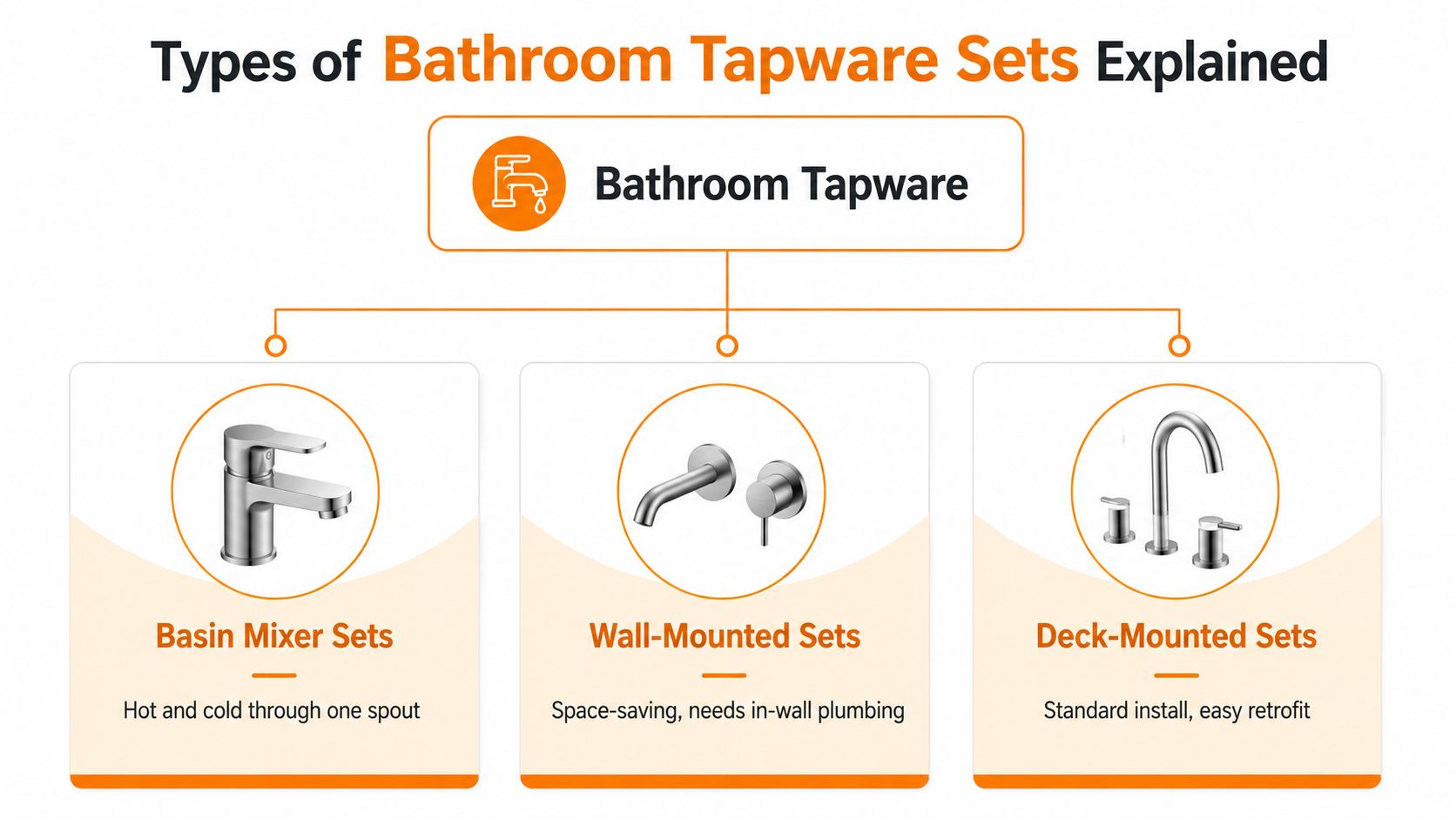
Before you compare handles and finishes, confirm the functional category, mounting method, outlet count and service access. A set only looks coordinated after each component has been specified for the job it must perform.
Understanding WELS Ratings and Australian Compliance
WELS is the label that tells you how efficiently a tap uses water. It isn't a substitute for technical compliance, and it isn't something to check only after the design has been finalised. Australian guidance tells consumers to verify products in the official database rather than trusting packaging or an online listing alone. Use the Water Rating comparison guidance to check the product record and its stated flow.
For taps, the rating bands are clear:
| Tapware Type | WELS Stars | Max Flow Rate (L/min) | Annual Water Use (kL) |
|---|---|---|---|
| Bathroom tap | 6 stars | Less than 4.5 | Depends on use |
| Bathroom tap | 5 stars | 4.5 to 6 | Depends on use |
| Bathroom tap | 4 stars | 6 to 7.5 | Depends on use |
| Bathroom tap | 3 stars | 7.5 to 9 | Depends on use |
| Lower-rated tap | Lower rating | More than 9 | Depends on use |
The table needs one important qualification. WELS publishes flow performance, not a universal annual household-use figure for every bathroom tap, because annual consumption depends on how often and how long the tap runs. Don't accept a retailer's annual estimate without checking the assumptions behind it.
WELS and WaterMark do different jobs
WELS helps you compare water efficiency. WaterMark and AS 3718 address product suitability and technical compliance within Australia's plumbing framework. The ABCB schedule includes tapsets across nominal sizes from DN 6 to DN 50 and generally covers continuous operating temperatures not exceeding 80°C, as set out in the ABCB technical schedule.
For a 2026 installation, lead-free construction also belongs on the checklist. Australian coverage reports that, by May 2026, rules require lead-free copper alloy plumbing products that contact drinking water, making lead-free certification an important differentiator for basin and mixer tapware. Read the manufacturer's certificate and verify the listing. A logo printed on a product page isn't proof on its own.
A star rating tells you about flow. It doesn't tell you whether the entire installation is suitable.
Regional procurement policies are also moving towards tighter minimum efficiency expectations for taps and flow controllers. That direction makes higher-rated products the safer choice for new work, especially where a property may later be assessed by a purchaser, certifier or project manager.
Choosing Finishes That Last in Australian Conditions
Finish selection is where style becomes maintenance. Melbourne bathrooms deal with condensation, cleaning chemicals, splashback and variable water quality, so the coating must suit the way the room will be used.
Chrome remains the dependable benchmark. It hides small water marks better than many dark finishes, cleans easily and has a long-established place in Australian bathrooms. It also pairs comfortably with cool porcelain, concrete-look tile and white sanitaryware. If the bathroom is a rental, family ensuite or high-use main bathroom, chrome is still a sensible recommendation.
Brushed nickel is more forgiving than a mirror finish when fingerprints and light marks are common. Gunmetal gives a stronger architectural look, but its darker surface makes mineral residue more noticeable. Brass and brushed brass bring warmth, particularly beside terracotta, stone and warm terrazzo, although they demand careful product verification because the body material and coating specification matter.
Coating quality matters more than the colour name
PVD, or Physical Vapour Deposition, can offer a durable finish when the product is manufactured and tested to a suitable specification. Cheap products sometimes use “PVD” as a marketing label without giving clear construction or testing information. Ask how the finish is applied, what cleaning products are permitted and whether corrosion testing is documented.
Electroplated products should be supported by information relevant to AS/NZS 3718 corrosion resistance expectations. If the supplier won't provide a technical sheet, treat that silence as a buying risk.
| Finish | Corrosion Resistance | Maintenance Level | Water-Spot Visibility | Lead-Free Ready | Typical Price Premium |
|---|---|---|---|---|---|
| Chrome | Generally reliable when properly plated | Low | Low to moderate | Verify product record | Usually lower |
| Brushed nickel | Good with suitable coating | Low to moderate | Moderate | Verify product record | Moderate |
| Gunmetal | Depends heavily on coating quality | Moderate | High | Verify product record | Moderate to high |
| Matte black | Coating-dependent | High in hard-water areas | High | Verify product record | Moderate |
| Brushed brass | Depends on finish and body | Moderate to high | Moderate | Confirm lead-free certification | Moderate to high |
Matte black is the finish I specify cautiously. Calcium deposits can build on the surface in hard-water areas and become difficult to remove without damaging the coating. Never scrub it with an abrasive pad, and don't assume a premium price guarantees resistance to discolouration or delamination.
The 2026 lead-free requirements make brass-body products worth checking particularly carefully. The finish can be fashionable, but lead-free certification is the performance and compliance detail that protects the purchase.
Sizing and Water Pressure Checks Before You Buy
A tapware catalogue can't tell you whether a spout will land correctly in your basin. Measure the installation first, then shortlist products that fit.
For a basin mixer, measure from the centre of the tap hole to the point where the water should fall. Check the basin's internal length, depth and slope, not only its external dimensions. A short spout can leave the stream too close to the rear wall, while an overlong spout can send water towards the front edge and create splash.
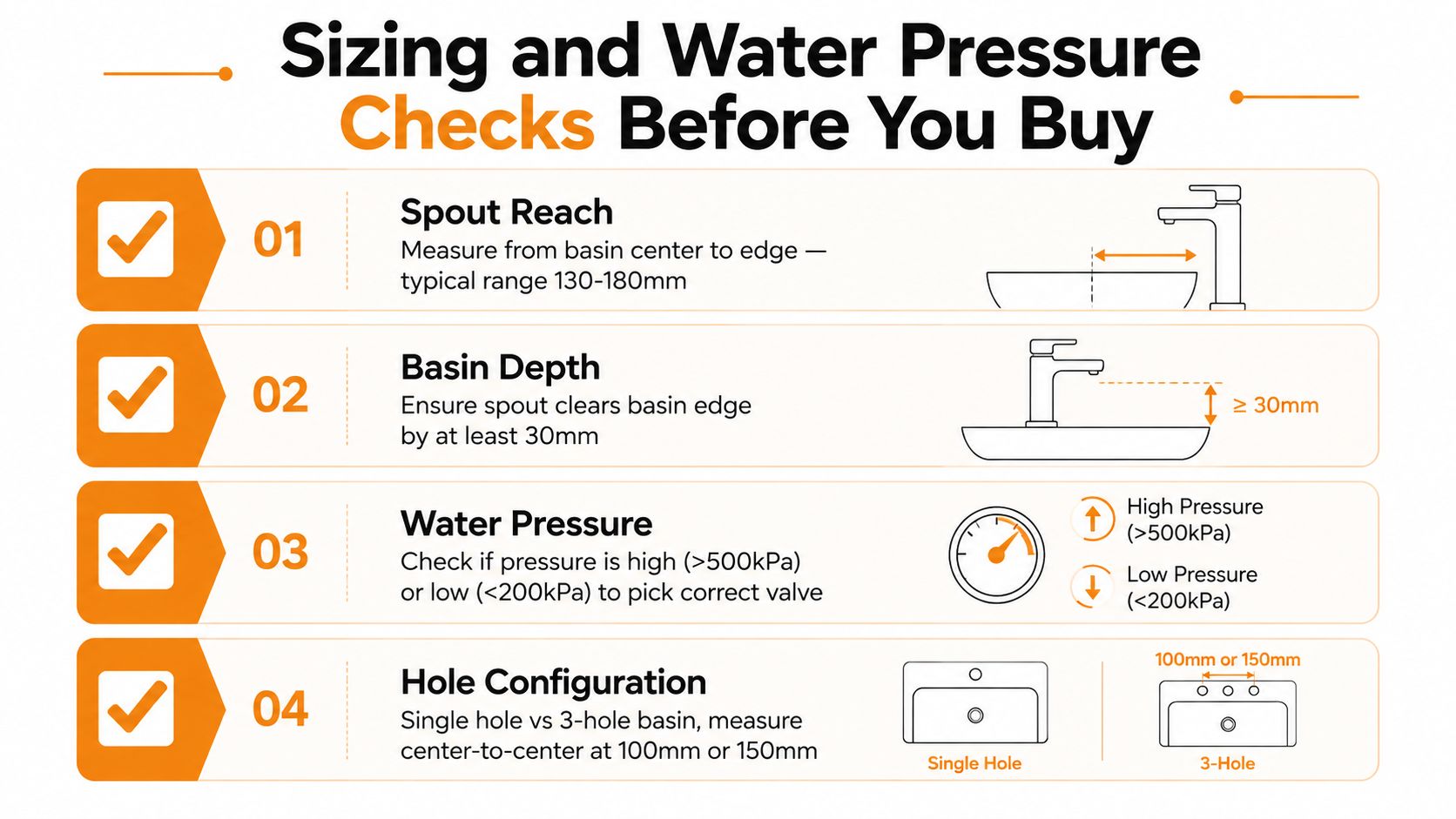
Four checks before ordering
- Confirm the hole configuration. A single-hole mixer, three-hole set and wall-mounted fitting aren't interchangeable. Measure existing centres where you're retaining the basin or vanity.
- Check the spout height. Tall mixers need enough clearance above a vessel basin, but excessive height can increase splash. The aerator should direct water into the bowl, not onto the rim.
- Test pressure at the property. Use a pressure gauge at an appropriate outlet and have the plumber assess the result. The product's own operating range takes priority over generic renovation advice.
- Plan the wall cavity. Concealed mixers need accurate rough-in depth, finished tile allowance and access to service components. Confirm these dimensions before waterproofing.
For shower mixers, pressure affects the feel of the handset, overhead outlet and temperature control. A low-pressure home may not suit a multi-outlet system, while excessive pressure can stress valves, connections and cartridges. A shower mixer buying guide can help you compare configurations, but the final selection should follow a site check by the plumber.
Bath spouts need separate attention. A back-to-wall bath may suit a wall projection that would be too short for a freestanding tub. Mark the finished bath edge on the wall or floor before you order, then check the spout's projection against that mark.
Matching Tapware to Your Bathroom Tiles and Style
Tapware should relate to the tile palette, but it shouldn't compete with it. I usually select the dominant tile temperature first, then choose a tapware finish that reinforces the room rather than introducing an unrelated metallic.
Warm metallics, including brushed brass and aged bronze, sit naturally with terracotta, zellige-style surfaces and warm-toned terrazzo. They also soften bathrooms with cream grout, timber-look cabinetry and stone with golden movement. Use them when the room needs warmth, but avoid adding several competing brass tones across the same space.
Chrome and gunmetal work comfortably with large-format porcelain, concrete-look tiles and monochromatic schemes. Chrome keeps a compact room bright and visually clean. Gunmetal creates stronger contrast, which can look excellent against pale tiles but may make a small powder room feel busier.
Proportion matters as much as colour
A chunky industrial mixer needs visual room around it. It can anchor a generous ensuite with a feature wall, substantial vanity and large-format tile. In a compact powder room, a slimline profile usually gives the basin more breathing space.
Handle design affects use as well as appearance. Cross-top handles reinforce a traditional scheme, but levers are generally easier for people with limited grip strength. Choose the control style around the household first, then coordinate the profile with the basin and shower fittings.
Cohesion doesn't require every item to come from one supplier. Match the visible finish across the basin mixer, shower hardware, bath spout, towel rails and drain cover, while checking each product's certification separately. A beautifully matched set is still a poor result if one component has no verifiable compliance record.
Use a tile sample beside the actual tapware finish, not a phone image. The bathroom tile selection guide is useful for narrowing colour, surface and format choices before you commit to a metallic.
Budgeting for Quality Tapware Without Overspending
Don't allocate the tapware budget by finish alone. Put money into the cartridge, body construction, certification, spare parts availability and warranty support before paying extra for a colour.
The price bands below are practical buying categories rather than a promise that every product in a tier has the same specification. Always inspect the product documentation.
| Price Tier | Typical Cost Per Set | Body Material | Cartridge Type | Warranty | Best For |
|---|---|---|---|---|---|
| Entry | $80 to $200 | Verify carefully | Branded details should be confirmed | Read exclusions | Simple, value-led renovations |
| Mid-range | $200 to $500 | Usually documented | Replaceable quality cartridge | Clear written terms | Most owner-occupied bathrooms |
| Premium | $500+ | Detailed specification expected | High-quality serviceable cartridge | Comprehensive terms | Feature bathrooms and demanding installations |
These amounts are the supplied budgeting tiers, not a guarantee of market pricing. A premium finish on a basic body doesn't automatically create a premium tap. Conversely, a restrained chrome mixer with a well-supported cartridge may outperform a fashionable product with weak documentation.
Where I would spend and where I wouldn't
Spend on a mixer that gets used constantly, a shower valve that must control temperature reliably and a bath filler that will be difficult to replace after tiling. Don't overspend on decorative extras that don't improve operation, and don't buy an unbranded cartridge because the body looks substantial.
Ask the retailer for:
- The WELS record: Confirm the star rating and flow figure in the official database.
- The compliance documents: Check WaterMark and relevant AS 3718 information.
- The cartridge details: Find out whether replacement parts are available.
- The installation limits: Confirm pressure, temperature and rough-in requirements.
- The warranty exclusions: Look for cleaning, pressure, installation and limescale clauses.
A broader 10-step bathroom remodel guide can help sequence product selection alongside waterproofing, plumbing and tiling. That sequence matters because a late tapware change can force expensive rework.
Maintenance Routines and Warranty Protection
The first maintenance mistake usually happens during cleaning. Someone sees scale on a dark mixer, reaches for a strong chemical or scourer, and creates a finish problem that the warranty may exclude.
Use a soft cloth and mild soap for routine cleaning, then rinse and dry the surface. Avoid abrasive products and check the manufacturer's instructions before using any descaler. The correct method varies between chrome, electroplated surfaces and PVD finishes, so keep the manual rather than relying on a generic bathroom cleaner.
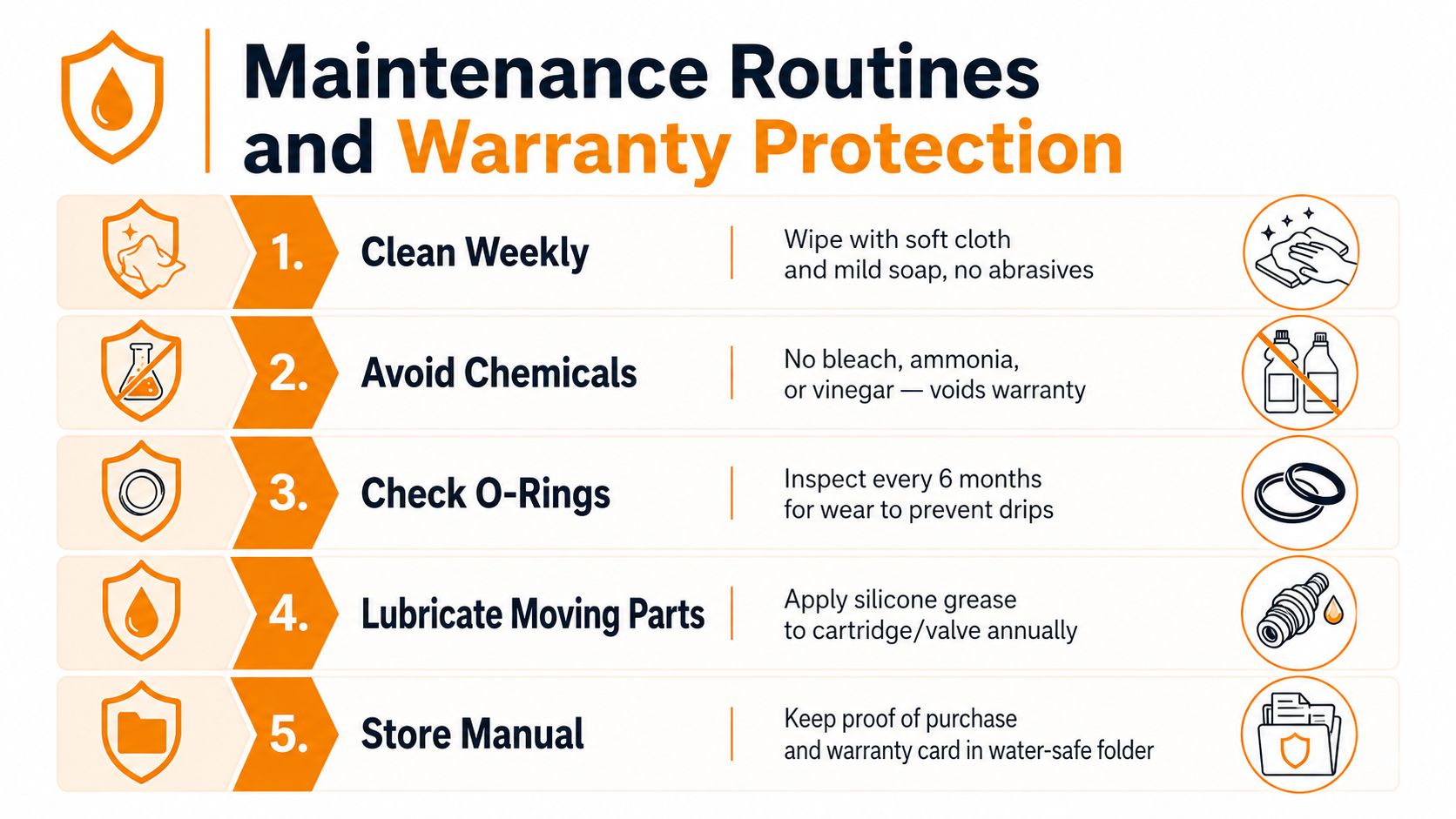
A practical service routine
Every week, wipe the tap, aerator area and handles. Drying the surface removes residue before it hardens.
Every six months, inspect the connections, visible seals and handle movement. A stiff handle, delayed shut-off or small drip is an early warning, not a cosmetic nuisance. Record the date and keep photos if the issue continues.
In hard-water areas, remove and inspect aerators according to the manufacturer's instructions. Don't force a concealed aerator with an unsuitable tool, because damaged threads can turn a simple clean into a replacement job.
Before making a warranty claim, gather the invoice, product model, installation date, plumber's details and photos of the fault. Warranties commonly distinguish between cartridge function and finish integrity, while excluding damage caused by limescale, incorrect installation, unsuitable pressure or aggressive cleaning.
Keep the installation paperwork in a water-safe folder. It saves time when a replacement part is needed years after the renovation.
A Melbourne bathroom should be easy to maintain, not treated like a display cabinet. Choose a finish the household will clean correctly, then follow the manufacturer's care instructions from the day the tapware is installed.
Tiles Mate Pty Ltd can help you coordinate bathroom tile selections with compatible finishes and renovation materials, while its Truganina team provides samples and design guidance for Melbourne projects. Visit Tiles Mate Pty Ltd to compare tile options, request samples and plan a bathroom scheme that supports your tapware choice rather than competing with it.