




Kitchen Tiles Guide for Melbourne Homes: Styles, Costs, Care
by Shivam Tayal 29 Sep 2026 0 Comments
You're standing in a Melbourne showroom with a handful of kitchen tile samples, and each one looks right under the display lights. The warm beige feels calm, the handmade-look green adds character, and the large-format porcelain looks continuous and gap-free. The difficult question starts after the colour choice: which surface will still suit your kitchen once cooking grease, muddy shoes, dropped utensils and daily cleaning become part of the picture?
Good kitchen tiles need to balance appearance, slip resistance, installation requirements and maintenance. A glossy splashback may wipe clean easily, while a heavily textured floor can collect residue. A large slab-style wall may reduce grout, but it can demand more from the substrate, handling and installer. In Melbourne homes, the practical specification matters just as much as the design.
Setting the Foundation for Your Kitchen Tile Choice
A typical renovation begins with a visual decision. The homeowner chooses a soft neutral floor, a feature splashback and perhaps a textured tile behind the cooktop. Only later does someone ask whether the floor becomes slippery when wet, whether the grout will show around the island, or whether the chosen wall tile can be cut neatly around power points.
Those questions should come first. A kitchen isn't a showroom vignette. It has traffic paths, splash zones, heat, food residue and cleaning routines. The right tile depends on how your household uses the room, not only on the colour palette.
Start with the working zones
Separate the kitchen into practical areas before comparing samples:
- Main floor: This needs reliable wet-slip performance, comfortable walking texture and resistance to everyday wear.
- General splashback: A smooth, sealed surface usually makes wiping easier, particularly behind preparation benches.
- Cooktop wall: Grease and heat make cleanability more important than delicate surface detail.
- Island and entry paths: These areas often receive the most foot traffic and should be assessed for visible marking and edge durability.
- Low-use feature areas: Decorative mosaics or handmade-look tiles can work well where the cleaning burden is limited.
A busy family kitchen may benefit from a matt porcelain floor and a relatively smooth glazed wall tile. A low-use entertainer's kitchen may tolerate a more expressive mosaic or textured feature surface. Neither choice is universally right.
Judge samples in your own light
Showroom lighting can hide variation in colour, sheen and texture. Take samples home and view them beside the benchtop, cabinetry, handles and flooring. Check them in daylight, under warm evening lighting and beside the area where cooking happens.
Practical rule: Choose the finish only after you've considered how often you'll wipe it, mop it and inspect it.
Grout deserves the same attention as the tile itself. A strong contrast can define a pattern, but it also makes alignment and discolouration more visible. A close-toned grout creates a quieter field and may be more forgiving around a floor that sees constant use. The joint width, tile edges and installation quality all affect the final result.
Australia's ceramic tile market gives useful context for this decision. Ceramic tile consumption reached 43 million square metres in 2024, and market value reached about $399 million, up 16% from the previous year, according to Australia's 2024 ceramic tile market overview. Kitchen finishes sit within this broader wall and floor demand base, so tile remains a mainstream renovation material rather than a niche choice.
Exploring Different Types of Kitchen Tiles
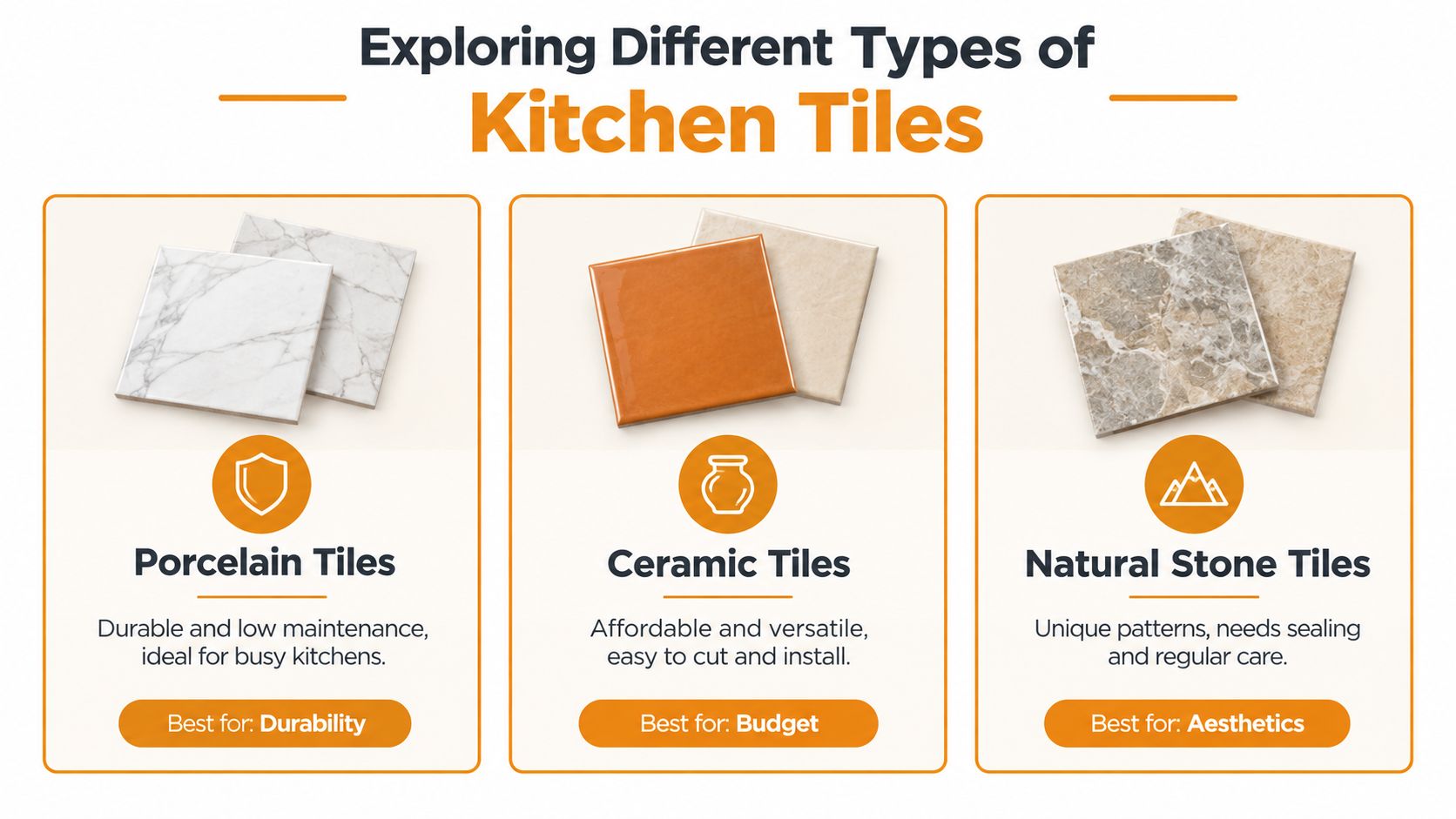
The material changes how a tile behaves. Porcelain, ceramic and natural stone can all produce an excellent kitchen, but they don't offer the same tolerance for moisture, staining, impact or maintenance.
Porcelain for demanding surfaces
Porcelain is a strong starting point for busy floors and practical splashbacks. Its dense body and low-maintenance character make it suitable where spills and regular cleaning are expected. Matt and textured porcelain can also provide a more useful underfoot surface than highly polished alternatives.
Stone-look porcelain is particularly versatile. It can create the visual effect of marble, limestone or concrete without requiring the same sealing routine as many natural stones. That doesn't make every porcelain tile maintenance-free. Grout still needs care, textured finishes can hold residue, and a polished surface may not be the sensible choice for a wet-prone floor.
For product-specific guidance, Tiles Mate's porcelain tile guide for kitchen applications is a useful place to compare practical characteristics before ordering samples.
Ceramic for walls and controlled budgets
Ceramic tile offers broad design flexibility and is often easier to cut than denser porcelain. It works well on splashbacks and walls where impact demands are lower than on a heavily used floor. Glazed ceramic can provide a wipeable surface in the cooking zone, provided the tile, grout and installation are specified appropriately.
Ceramic isn't automatically unsuitable for floors, but the product must be selected for that application. A wall-only tile shouldn't be placed underfoot just because its colour matches the scheme. Always check the manufacturer's application guidance, surface rating and care instructions.
Natural stone for character
Natural stone brings variation that manufactured surfaces imitate but can't perfectly reproduce. Marble, granite, quartzite and other stones can create a distinctive bench-adjacent wall or feature floor, yet they require a homeowner who accepts ongoing care.
Porous or reactive stone may need sealing and prompt cleaning of oil, acidic food and coloured liquids. Honed surfaces can disguise some reflections and scratches, while polished surfaces create a sharper look but can show marks and behave differently when wet. For a Melbourne kitchen, consider the whole routine. If you want to wipe the surface quickly after cooking and rarely think about maintenance, a suitable porcelain may be more practical.
Mosaics add detail through small pieces, but they also introduce more grout and more joints. They're effective on a contained splashback or feature panel, particularly where the pattern matters more than uninterrupted cleaning speed. A dense mosaic around a cooktop can become laborious if the grout colour, joint profile and surface texture aren't chosen carefully.
The Australian Tile Council records a significant historical shift from wall-focused tile use to substantial floor-tile sales from 1974, while Jobs and Skills Australia estimates about 21,800 employed wall and floor tilers nationally. That history helps explain today's expectation that kitchen tiles should perform across both walls and floors, not just decorate them. For planning the area behind a cooktop, this 2026 backsplash installation guide offers useful context on protection and installation considerations.
Choosing the Right Size, Shape, and Pattern
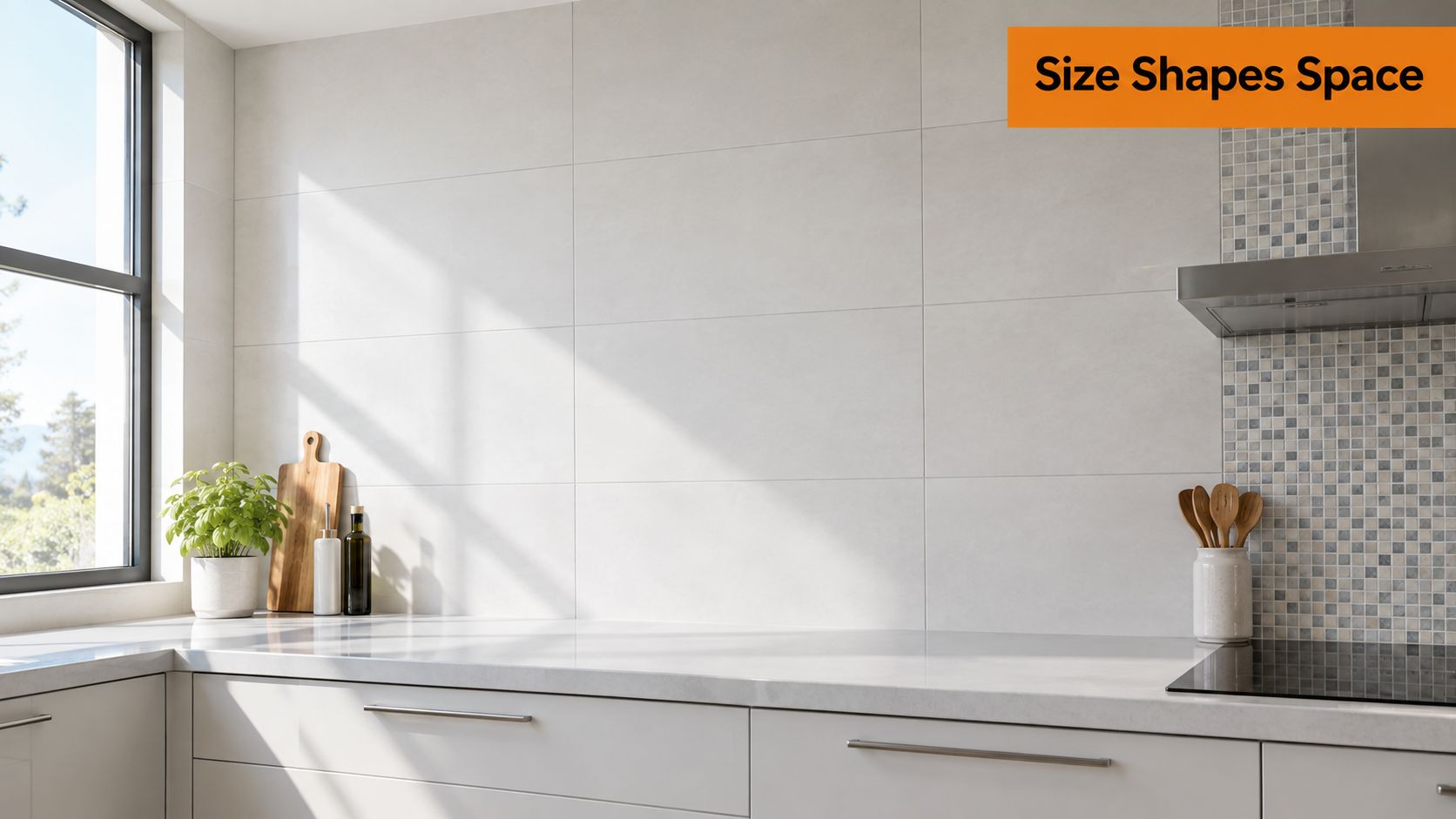
Tile format changes both the appearance and the labour. Large-format tiles can make a compact kitchen feel calmer because fewer grout lines interrupt the surface. Smaller tiles create rhythm and texture, but they give grease and discoloured grout more places to settle.
Large format versus smaller pieces
A large wall tile suits a clean-lined kitchen with broad, uninterrupted areas. It can reduce visual noise and simplify wiping, especially when the surface is smooth and the joints are carefully aligned. The trade-off is installation precision. Walls must be sufficiently flat, cuts need planning, and large pieces require careful handling around cabinetry, windows and outlets.
Smaller formats are more forgiving around irregular walls and complex edges. Subway tiles, kit-kat profiles and compact mosaics can follow a kitchen's proportions more naturally, but their additional grout lines increase the cleaning surface. A heavily textured small tile may look excellent in a sample and become frustrating behind a cooktop.
Shape and pattern change the mood
A rectangular tile laid horizontally can make a wall feel wider. A vertical layout draws attention upwards and can suit a full-height splashback. Herringbone introduces movement and works well as a contained feature, though its many cuts and alignment points demand a patient installer.
Hexagons, kit-kat tiles, feather shapes and penny rounds all bring a stronger design signature. Use them where you want the pattern to do the work, rather than covering every surface with competing detail. A restrained floor paired with a patterned splashback often remains easier to live with than a patterned floor, patterned wall and statement benchtop together.
| Choice | What it does well | What to check |
|---|---|---|
| Large format | Creates a quieter field with fewer joints | Wall flatness, handling, cuts and access |
| Subway or rectangular | Offers flexible layouts and familiar proportions | Joint alignment and grout visibility |
| Mosaic | Adds fine detail to a contained area | Cleaning load and labour |
| Herringbone | Creates direction and a feature effect | Extra cuts, waste and installation time |
| Textured or handmade-look | Adds tactile depth and variation | Grease removal and surface consistency |
The visual effect should serve the room. Dark or glossy wall tiles can add depth and reflect available light, while pale matt finishes reduce glare and may create a softer backdrop. Before ordering, draw the splashback elevations and mark power points, rangehoods, windows and end returns. That small planning step can prevent awkward slivers and misplaced pattern centres.
Ensuring Slip Resistance and Durability
A kitchen floor should be selected with wet use in mind, even if the room isn't a bathroom. Water from the sink, cleaning solution, food oil and damp footwear can all change how the surface behaves underfoot.
Australian specifiers commonly refer to AS/NZS 4586 slip-resistance classes. Pendulum ratings run from P0 to P5, while ramp ratings run from R9 to R13. For kitchen floors, typical minimum guidance sits around P2 to P3 or R9 to R10, with higher ratings considered where grease, spills or cleaning water increase risk, as outlined in this Australian tile slip-resistance guidance.
Specify the floor in practical steps
- Tell the supplier where the tile will be used. A floor, splashback and feature wall have different performance requirements.
- Request the tested rating. Don't rely on words such as "grip", "safe" or "textured" without checking the relevant classification.
- Compare the finish when wet. A polished tile may look refined but can be a poor fit for a spill-prone floor.
- Consider cleaning. Deep texture can improve traction while holding flour, grease or detergent residue.
- Confirm the grout system. The joint material, width and sealing requirements affect long-term maintenance.
Safety comes from tested performance, not from a tile's appearance.
Durability has several parts. The tile body must tolerate the expected traffic, the glaze must suit the application, and the edges must survive delivery and installation. A hard tile can still chip if the substrate moves, the adhesive coverage is poor or the installer forces an uneven piece into place.
For floors, matt porcelain with a verified wet-slip rating is often a sensible combination of durability and maintainability. For walls, glazed ceramic or porcelain may be easier to wipe, while natural stone requires a more deliberate sealing and cleaning routine. Don't use a highly textured decorative tile behind the cooktop unless you're prepared to clean around its relief.
Maintenance also depends on the product's instructions. Use a compatible, non-abrasive cleaner, remove oily residue rather than allowing it to build up, and avoid assuming that a household chemical is suitable for every stone or grout. Ask for the care sheet before purchase, not after the first mark appears.
Understanding Costs and Installation Tips
Tile budgeting fails when homeowners compare only the price per square metre. The final figure also reflects the substrate, layout, cuts, access, adhesive, grout, trims, sealing and the time required to protect finished cabinetry and benchtops.
Australian full kitchen renovations are commonly estimated at about A$8,179 to A$20,443, while tiling alone is estimated at A$36 to A$92 per square metre, according to Home Beautiful's 2026 renovation and tiling cost guidance. Melbourne tiling is reported at roughly A$37 to A$94 per square metre in local coverage of kitchen tiling ideas, so the specification deserves attention before the renovation budget is committed.
Separate the visible price from the real cost
A standard rectangular splashback on a sound wall is relatively straightforward. A slab-like porcelain installation, full-height return, herringbone pattern or small mosaic can involve more setting out, cutting and handling. The tile may be only one part of the quote.
Ask each installer to identify:
- Preparation: Removal of old tile, flattening, patching and priming.
- Materials: Adhesive, grout, trims, silicone and sealing products.
- Layout: Straight lay, stacked joints, brick bond, herringbone or another pattern.
- Cutting: Openings for power points, window reveals, cabinetry and plumbing.
- Protection: Covering adjacent surfaces and managing access through the home.
- Completion: Cleaning, silicone joints and care instructions.
For a broader comparison of surface systems and flooring expenditure, the Painters North Shore flooring cost guide can help frame the difference between tile-based and alternative flooring approaches, although your installer still needs to quote for the actual Melbourne conditions.
Reduce expensive surprises
Large-format tiles can reduce grout and create a premium appearance, but they aren't automatically the economical choice. A wall that isn't flat may require preparation, and a difficult access route can affect handling. Slab-style splashbacks also need careful templating and coordination with cabinetry, cut-outs and electrical work.
A good quote should follow a site inspection or detailed measurements. Provide the installer with the tile name, dimensions, finish, intended location and layout. If you're comparing design options, this kitchen tile price guide can help organise choices from restrained finishes to more detailed feature systems.
Order samples before committing, then confirm batch, shade and availability. Keep the installation area accessible, and don't schedule tiling before other trades have finished dusty or wet work. The cleanest design can still fail if the wall preparation, movement joints or silicone detailing are treated as afterthoughts.
Leveraging Tiles Mate Services for Success
Choosing samples at home is more useful than judging them under showroom lighting. Place the tile beside the benchtop, cabinet fronts, tapware and flooring, then test how the surface looks in morning and evening light. Run your hand over textured options and ask whether you'd be comfortable wiping that texture after a cooking session.
A practical selection process should answer four questions:
- Where will the tile go? Floor, splashback, cooktop wall and feature areas need different specifications.
- What will touch it? Shoes, water, oil, utensils and cleaning products create different demands.
- How much variation can you accept? Handmade-look and natural materials may vary from piece to piece.
- Who will install it? The layout and format should match the installer's experience and the site conditions.
Tiles Mate Pty Ltd provides a Melbourne-based online and wholesale tile service with a Truganina location. Its range includes porcelain, natural stone, mosaics and other flooring products, with browsing options based on colour, finish, size and shape. Homeowners can order a $15 pack of five samples and book a free 15-minute design consultation from home, while trade buyers can access the TilesMate Pro service for B2B pricing and sourcing.
Use advice before you order
A design consultation is most useful when you arrive with measurements, photographs and a clear maintenance preference. Say whether you want minimal grout, a forgiving floor, a feature splashback or a stone surface you're prepared to seal and care for. That makes the conversation about suitability rather than just matching colours.
You should also ask for product-specific installation and cleaning information. A professional tiler can advise on substrate preparation, setting out, edge trims and joint treatment, while a retailer can confirm the intended application and availability. Tiles Mate's professional tiling services guide provides further context on why installation quality belongs in the tile decision, not at the end of it.
The best selection process leaves you with more than a tile name. You should know the finish, slip classification where relevant, grout approach, cleaning routine, installation method and likely cost drivers. That information gives your Melbourne renovation a better chance of looking right and working properly after the showroom samples are packed away.
For practical help choosing kitchen tiles, Tiles Mate Pty Ltd offers sample packs, a free home design consultation, Melbourne delivery and trade sourcing through its Truganina-based service. Visit Tiles Mate Pty Ltd with your measurements and preferred style, then compare finishes with the maintenance and installation demands of your kitchen.