




600x1200 Tiles Melbourne: A Complete 2026 Guide
by Shivam Tayal 10 Oct 2026 0 Comments
One 600x1200 mm tile covers 0.72 square metres, twice the area of a 600x600 mm tile. That changes the job from simple laying to careful substrate preparation, drainage planning and layout control.
That's the part most showroom advice leaves out. A large porcelain tile can give a Melbourne renovation a calm, continuous surface with fewer grout joints, but it won't hide a crooked slab, a poorly planned shower fall or an awkward doorway cut. In some bathrooms, a smaller format is the more sensible choice because it follows the room instead of forcing the room to suit the tile.
Why 600x1200 Tiles Feel Like the Easy Choice Until They Are Not
A homeowner walks into a Melbourne showroom, sees a soft marble-look 600x1200 tile and makes a reasonable decision. Fewer grout lines should mean a cleaner finish, less maintenance and a faster installation. The design works on the display wall, so the homeowner orders enough for the bathroom and expects the tiler to get started once demolition is finished.
Then the old floor comes up.
The slab has a hump near the doorway, the shower waste needs a fall from several directions, and the wall behind the vanity isn't in the same plane as the adjacent wall. The tile hasn't caused those problems, but its size makes them harder to ignore. A 600x1200 tile bridges across high and low points instead of bending with them, and a small error at one end can become a visible lip at the other.
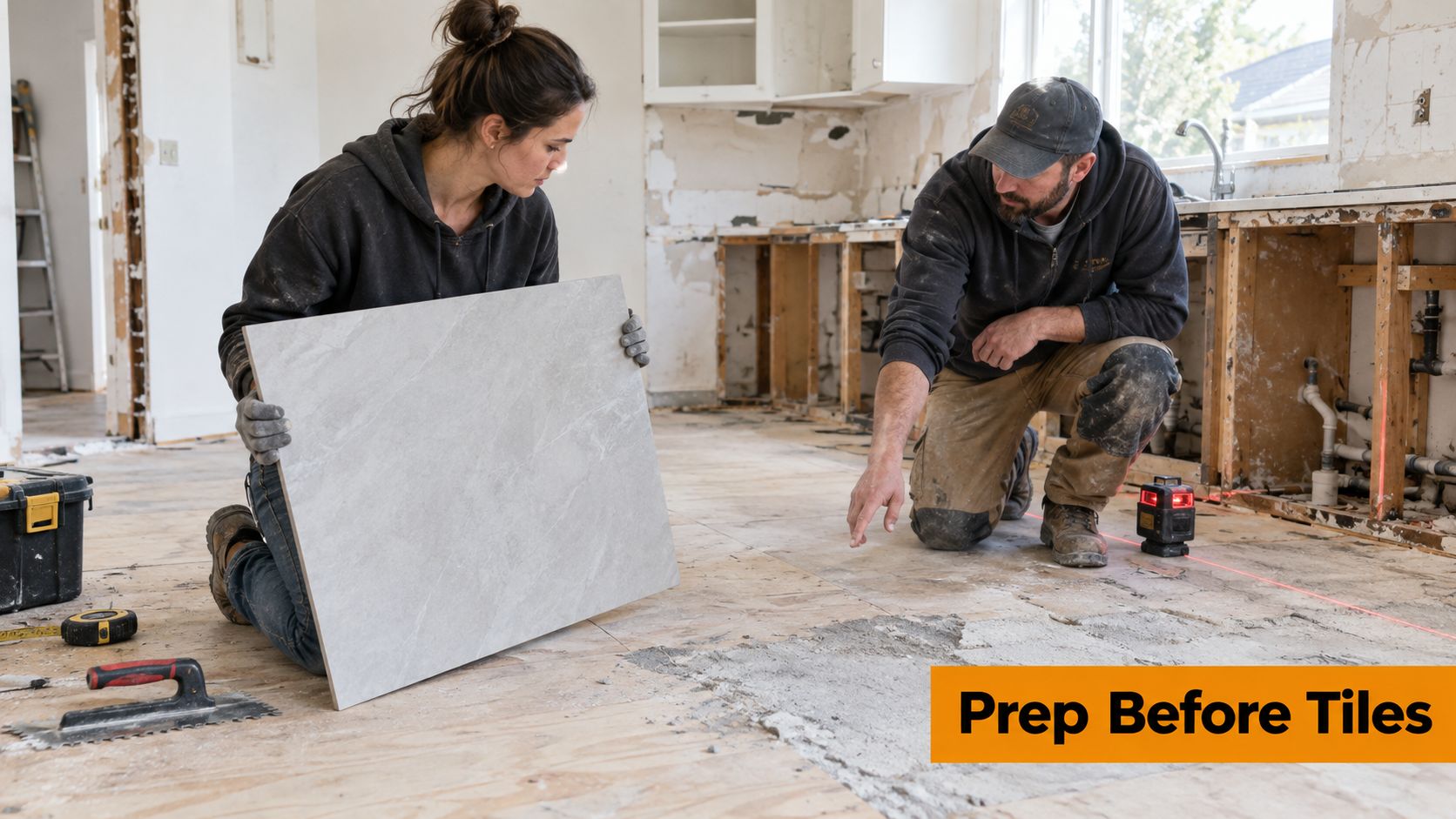
The catalogue shows the surface, not the preparation
Australian large-format guidance places 600x1200 mm tiles in the large-format category and identifies them for living areas, open-plan floors and contemporary bathrooms. One tile covers 0.72 square metres, while a 600x600 mm tile covers half that area, so the larger format can reduce the number of pieces needed for the same surface. The visual benefit is straightforward, fewer interruptions and a broader field of colour or stone pattern, as outlined in Australian large-format tile guidance.
The installation benefit is more conditional. Large tiles need a flatter base, careful adhesive transfer and a layout that accounts for every edge, penetration and change in direction. If the substrate needs extensive grinding or levelling, the apparent saving in tile count can disappear before the first box is opened.
Practical rule: Choose the tile after the tiler has inspected the substrate, not before.
That doesn't mean 600x1200 tiles are a poor product. It means they're a system decision. The tile, adhesive, waterproofing, drainage, substrate and cutting plan all need to work together. A polished image may sell the style, but the finished result depends on what happens underneath it.
What 600x1200 Tiles Actually Are and Why Porcelain Dominates
The size describes the face of the tile, not what it's made from. A 600x1200 product may be porcelain, ceramic or natural stone, and those materials behave differently during cutting, handling, sealing and installation.
Porcelain is the common choice for this format because its dense body suits areas exposed to moisture, wear and regular cleaning. That doesn't make every porcelain tile interchangeable. Thickness, rectification, surface texture, edge quality and the manufacturer's installation instructions still matter, particularly when the tile is being used on a floor or in a wet area.
Ceramic can be suitable for selected indoor wall applications, but it shouldn't automatically be treated as a floor equivalent. Natural stone brings its own maintenance requirements, including sealing and ongoing attention to staining or surface wear. A marble-look porcelain may offer a different care routine from genuine marble, even when the printed pattern looks similar.
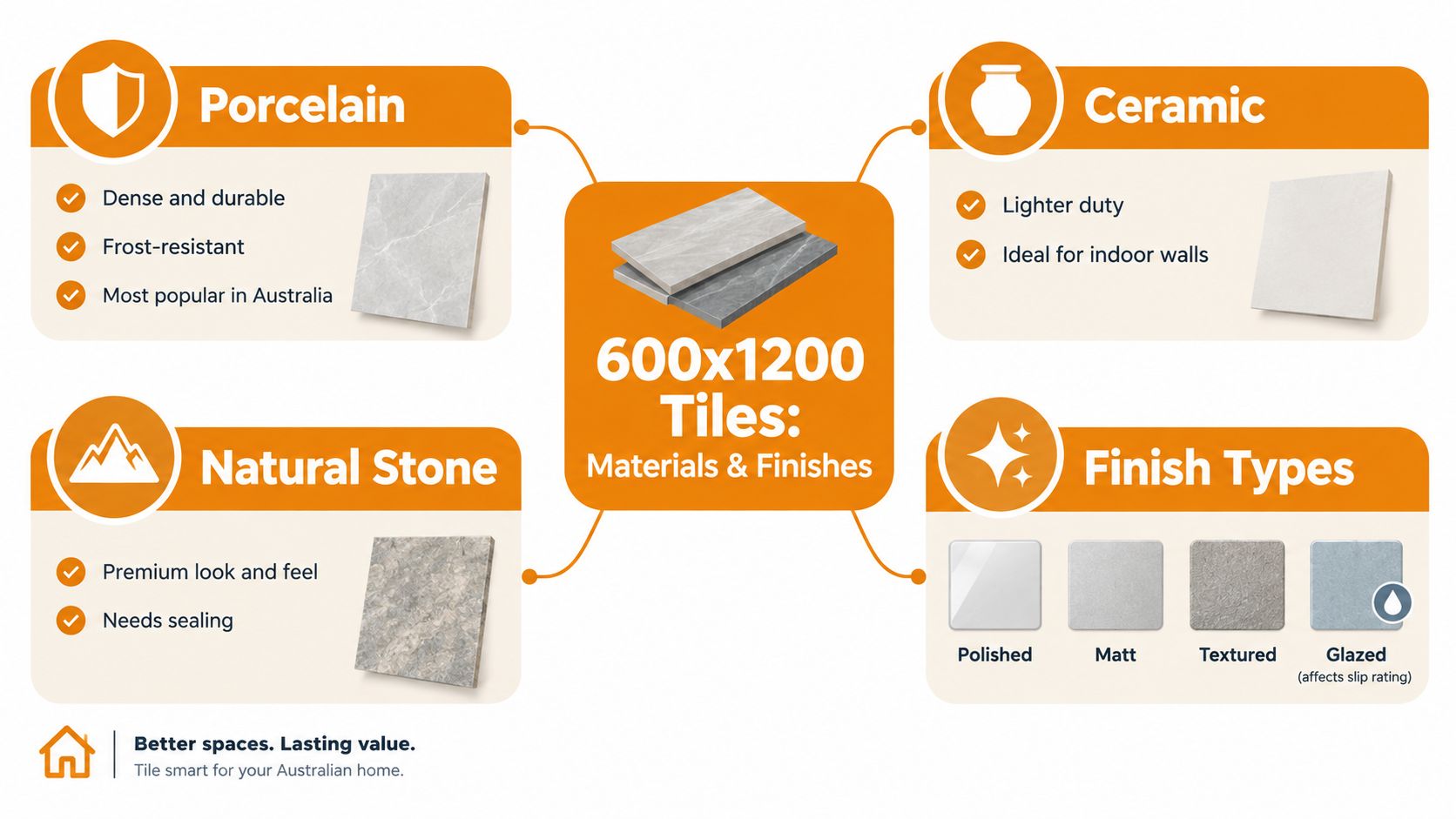
Material is only half the specification
The finish affects how the tile performs in the room.
- Matt surfaces generally create a softer reflection and can be easier to live with in busy areas, but the actual slip classification still needs checking.
- Textured finishes can provide additional surface grip, while their texture may hold more residue and require more deliberate cleaning.
- Polished finishes reflect more light and can suit walls or selected dry areas, but they aren't automatically appropriate for a wet floor.
- Honed natural stone needs product-specific sealing and maintenance advice rather than assumptions based on appearance.
For an Australian project, ask for the technical sheet, not just the sample board. Confirm whether the product is approved for the intended floor or wall, whether it's rectified, what slip information is supplied, and whether the colour and shade are consistent across the quantity you're ordering.
Porcelain's commercial position helps explain why so many 600x1200 products are porcelain. One market estimate puts porcelain at 56.27% of Australian ceramic-tile revenue in 2025, making it the largest product segment in that estimate. The same source estimates Australia's ceramic-tile market at US$2,649.6 million in 2025 and projects US$4,166.0 million by 2033, with a forecast compound annual growth rate of 5.6% from 2026 to 2033. These are market-research estimates, not government statistics, but they provide context for the availability of large-format porcelain in Australia's ceramic-tile market outlook.
For more background on the format, see this guide to large-format tiles. The useful question isn't whether porcelain is popular. It's whether the particular product, finish and rating suit your room.
Layout Strategies That Keep 600x1200 Tiles Looking Intentional
A large tile doesn't automatically create a premium layout. Poor alignment is more noticeable because each joint travels a long distance across the room. The installer needs to decide where those lines finish before adhesive is mixed.
Start by measuring the room, but don't stop at the overall length and width. Record door openings, nib walls, vanity projections, shower screens, floor wastes, wall niches and any change in wall direction. A drawing that includes only the room perimeter won't reveal where a narrow sliver will appear beside a doorway.
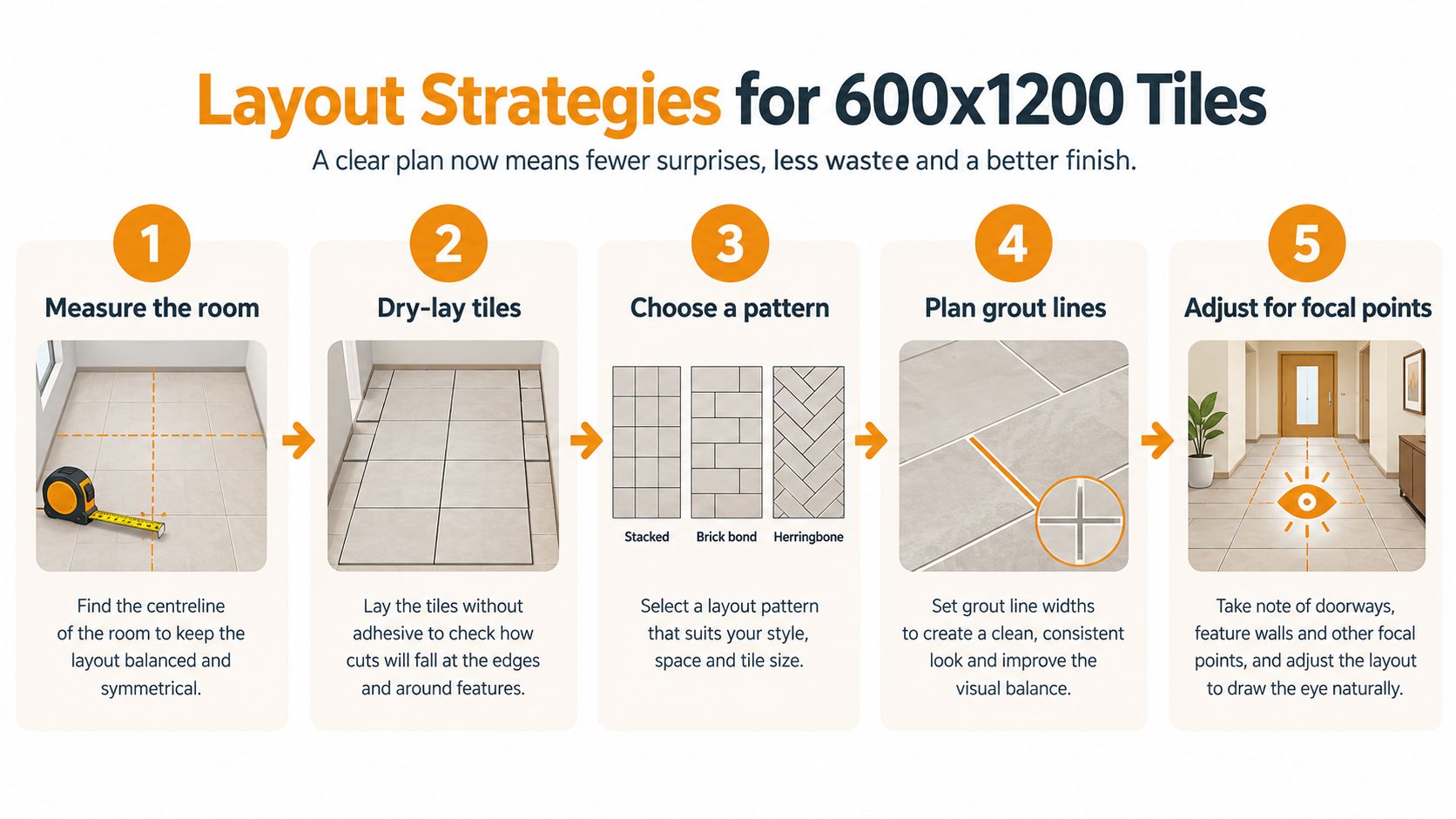
Five decisions to make before cutting
- Find the visual centre. In a bathroom, the centre of the main wall may matter more than the geometric centre of the room. A full or balanced tile at the vanity can look better than a mathematically centred joint hidden behind cabinetry.
- Dry-lay the critical areas. Place tiles without adhesive around the doorway, shower entry and waste. This reveals whether the final cuts will be usable pieces or thin strips that make the room look forced.
- Choose the direction deliberately. A vertical arrangement can emphasise wall height, while a horizontal arrangement can broaden a narrow wall. On floors, the direction should relate to the room's longest sightline and the transition into adjoining areas.
- Set the joint pattern. A stacked layout gives a controlled architectural grid. A brick bond introduces movement but needs careful alignment, especially with a long rectangular tile. Herringbone can work as a feature, but it creates more cuts and demands a very disciplined centreline.
- Protect focal points. Keep important joints aligned with the vanity, shower niche or door opening where possible. Don't let a decorative idea produce an awkward cut directly in the first place visitors see.
Why the layout changes the order quantity
A nominally efficient grid can waste material when the room is narrow or heavily interrupted. A tile that fits neatly across an open living area may produce poor yield around a bathroom niche, a raised hob or a multi-directional shower fall.
The tiler should mark the proposed joints on the substrate or prepare a scaled drawing before the order is finalised. That plan also lets the homeowner approve the appearance of cuts before the product is permanently installed. A layout that looks balanced on paper is cheaper to change than one that has already been bonded to the floor.
Installation Realities, Substrate Flatness, Adhesive Coverage and Slip Ratings
The most persistent misunderstanding about large-format tile is that fewer pieces make installation easier. Fewer pieces can mean fewer joints, but each piece places greater demands on the surface beneath it. The tile has limited ability to bridge unevenness without rocking, lipping or leaving voids.
For 600x1200 mm porcelain or ceramic tiles, Australian installation guidance commonly targets about 3 mm maximum deviation under a 2 m straightedge for large-format work, as described in this Australian tile installation guidance. That's a preparation benchmark, not a promise that every existing Melbourne slab will meet it.
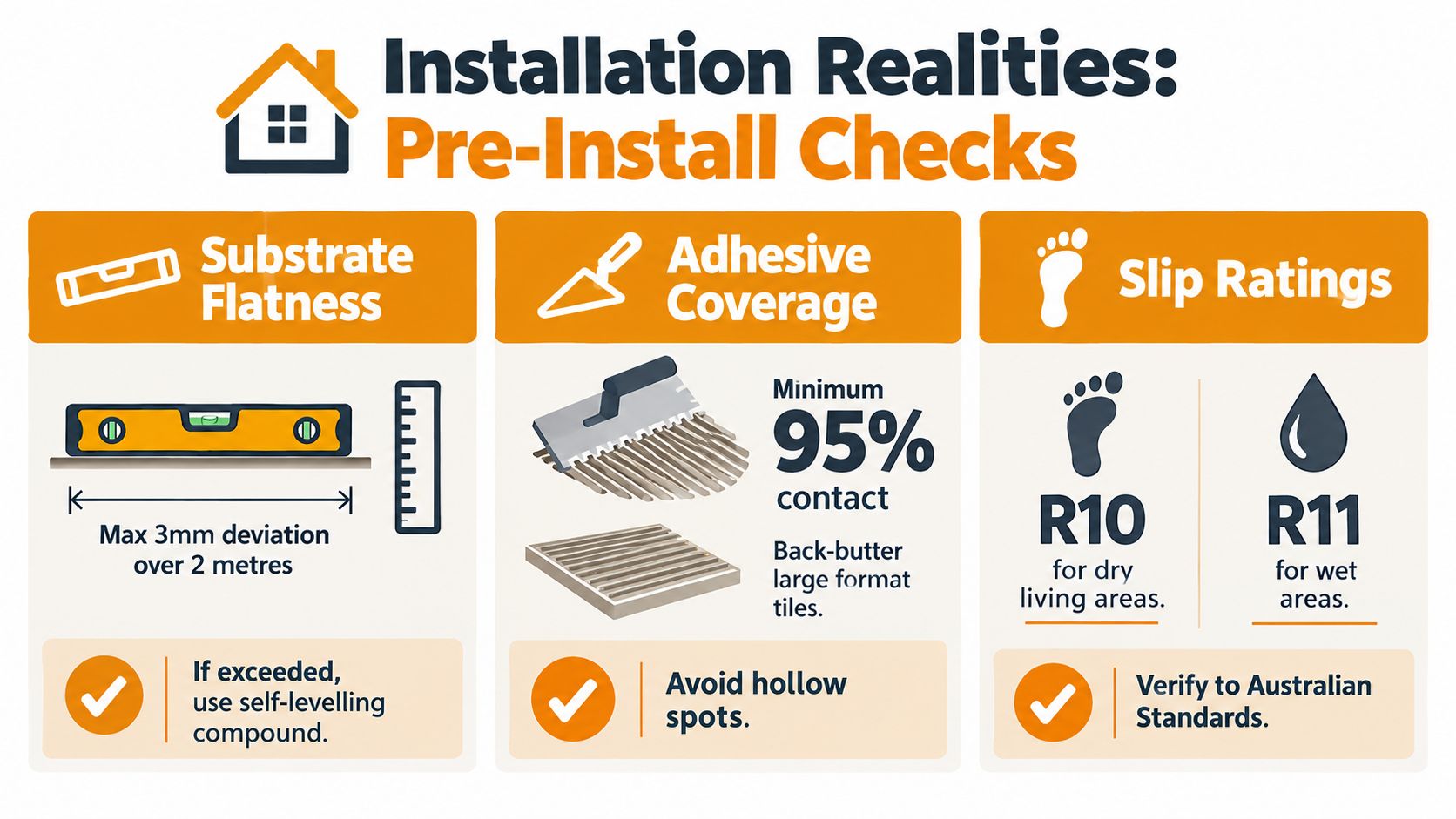
Flatness comes before adhesive
A tiler should survey the floor or wall with a straightedge and identify both high spots and depressions. High points may need grinding. Low areas may require a compatible levelling compound, patching product or screed, depending on the substrate and the installation system.
Adding adhesive to compensate for a badly uneven surface isn't a sound correction. It can produce inconsistent bed thickness, poor transfer and movement beneath the tile. The finished face may look acceptable immediately, then show lippage or hollow areas after the room is in service.
Substrate flatness is also different from level. A shower floor needs controlled falls to the waste, so forcing the whole room perfectly level can be the wrong objective. The surface needs to be flat enough for the tile while still directing water where the waterproofing and drainage design require it.
Coverage is a workmanship control
Large-format guidance recommends back-buttering tiles 600x600 mm and larger to improve adhesive coverage. The installer combs adhesive onto the substrate and applies a suitable layer to the back of the tile, then beds the tile with a controlled sliding motion rather than relying on isolated dabs.
In wet areas, practical Australian guidance targets 95 to 100% adhesive coverage with no perimeter voids. Voids can become places where water collects or where impact loads concentrate. They also make the tile more vulnerable to cracking or movement when the substrate changes.
The adhesive needs to match the tile, substrate and location. A suitably deformable, polymer-modified adhesive is commonly selected for large-format work, but the product data sheet and the installer's system should determine the final specification.
Bathrooms add drainage and slip constraints
A 600x1200 tile may be excellent on a bathroom wall and inconvenient on a shower floor. The floor has to follow falls to the waste, and a large rigid rectangle may require complex cuts or joint positioning to avoid creating a rocking edge. A smaller module can sometimes follow the geometry more cleanly and reduce the risk of pooling.
The selected finish also needs an appropriate slip classification for its intended use. Don't assume that a matt appearance equals safe wet-area performance. Ask for the manufacturer's tested rating and confirm that it suits the actual floor, particularly inside the shower.
Waterproofing coordination matters just as much. Australian wet-area guidance discussed for Melbourne bathrooms requires waterproofing to extend up shower walls to at least 1,800 mm or 50 mm above the shower rose, whichever is higher, as outlined in this Melbourne large-format bathroom tiling guidance. The waterproofing, waste, screen, threshold and tile joints need to be coordinated before installation.
Cutting and grinding porcelain also require appropriate dust controls. Anyone planning work should understand the risks and follow practical guidance on controlling respirable crystalline silica, particularly when dry cutting or chasing hard tile products.
For additional product-specific considerations, this resource on porcelain tile installation tips is useful, but it shouldn't replace a site assessment or the manufacturer's instructions.
Waste, Cuts and Ordering Calculations That Protect Your Budget
Fewer grout joints don't guarantee less waste. The answer depends on the room's dimensions, the direction of the layout and how many times the tile has to be interrupted.
A simple open-plan floor may use the long rectangle efficiently. A compact Melbourne bathroom can do the opposite. Doorways, shower screens, niches, vanity legs, floor wastes and changing falls all create cuts. Some offcuts can be reused on another wall, but a narrow strip or a piece with several penetrations may have little practical value.
Recent Australian construction-waste data puts the issue in context. The 2025 Australia's waste[d] Opportunity report found that the average building project wastes 141 kg of material per square metre, and identifies concrete, masonry and tiles among the largest-volume discarded materials, as reported in this Australian construction-waste resource. That figure covers building projects broadly, so it isn't a prediction for an individual bathroom, but it shows why material yield deserves attention.
Build the order from a cutting plan
Don't calculate the order by multiplying floor area and adding an unexplained allowance. Instead:
- Measure each plane separately. Record the floor, each wall, shower returns and any feature section rather than treating the room as one rectangle.
- Draw the actual grid. Place full tiles first, then mark edge cuts, penetrations and the direction of the pattern.
- Sort usable offcuts. A large clean piece may work on a short return wall. A piece cut around a waste may not.
- Keep batch information. Shade, calibre and batch details should stay with the order so replacement pieces can be matched as closely as possible.
- Price preparation separately. Grinding, patching, levelling and screeding are not tile waste, but they affect the installed cost and the decision about format.
The point isn't to promise a universal waste allowance. There isn't one. A measured cutting schedule gives a more honest order quantity than a generic percentage applied to every room.
A cheaper price per square metre can become the more expensive choice after unusable offcuts, replacement tiles and substrate correction are included.
For larger building or renovation programs, a digital Exayard AI-powered takeoff and estimating workflow can help organise measured quantities and cutting information. It still needs a human review of the layout, because software won't know whether a particular offcut is acceptable beside a doorway or whether a grout joint conflicts with a shower screen.
The format also carries a handling risk. One broken tile can affect the sequence if there are no matching pieces available, so ordering should consider supply continuity as well as the calculated surface area. For practical cutting considerations, see this guide to a tile cutter for 600 mm tiles.
Where to Buy 600x1200 Tiles in Melbourne as a Homeowner or Builder
Homeowners and builders need different kinds of purchasing support. A homeowner may need help comparing colour, finish and samples in a real bathroom palette. A builder or tiler may care more about batch availability, predictable delivery, technical documentation and a repeatable price for several rooms.
Retail purchasing works well when the product range is easy to compare and the supplier can provide physical samples. A sample should be viewed in the actual room because Melbourne daylight, downlights, vanity colours and paint can change how a grey, beige or marble-look surface reads. Check the finish from standing height and from the angle at which water or cleaning light will hit it.
Ask for clear pricing by square metre and box, then confirm what happens if the required quantity spans different batches. Also ask about lead time, delivery access, damaged cartons and whether additional pieces can be sourced later. Those questions matter more than a catalogue image when the tile will be installed across several connected spaces.
Trade supply has a different priority
Builders, tilers, designers and project managers may benefit from trade accounts or sourcing assistance when the job needs coordinated quantities and repeat orders. Tiles Mate Pty Ltd operates from Melbourne with online retail and wholesale supply, offering porcelain and natural stone tiles alongside other flooring and outdoor products. Its trade option, TilesMate Pro, provides B2B pricing and personalised sourcing for professional buyers.
A homeowner doesn't necessarily need a trade account. A sample pack and a short design consultation may be more useful at the selection stage, especially when the decision involves matching a 600x1200 wall tile with floor grip, cabinetry and trims. The right supplier is the one that gives you enough product information to make a site-appropriate decision, not the one with the largest display.
When 600x1200 Tiles Are the Right Call for Melbourne Renovations
Choose 600x1200 tiles when the substrate can be prepared properly, the room offers a sensible cutting pattern and the installer is comfortable with large-format handling and coverage. They're particularly effective on broad walls and open floors where long joints can run cleanly through the space.
Be cautious in older Victorian bathrooms with uneven surfaces, complicated shower falls, many penetrations or tight thresholds. A smaller tile may deliver better yield, easier drainage and less rework, even if it introduces more grout joints. That isn't a design failure. It's often the better response to the room's geometry.
Make the decision with the tiler and waterproofer before ordering. Confirm the substrate correction, waste position, finished floor height, door clearance, screen location, slip rating and batch availability. If you're also comparing service providers for a building business, practical trade marketing resources such as marketing support for electricians illustrate why specialist advice should match the audience and project rather than rely on generic claims.
For Melbourne homeowners, renovators and trade buyers, Tiles Mate Pty Ltd offers 600x1200 porcelain options, samples, design guidance, transparent per-square-metre and per-box pricing, and trade sourcing through TilesMate Pro. Visit Tiles Mate before ordering, bring your room measurements and proposed layout, and use the product information to confirm that the tile suits your substrate, drainage and installation plan.