




Bathroom Tapware in Australia: A Complete Guide for 2026
by Shivam Tayal 22 Sep 2026 0 Comments
You've chosen the Melbourne tiles, ordered the vanity and probably spent more time comparing basin shapes than you expected. Then the showroom asks which tapware you want, and suddenly one small decision affects the wall plumbing, water use, finish, installation and compliance.
That's why bathroom tapware in Australia deserves more attention than a quick style choice. From the 1 May 2026 lead-free requirements to the WELS star rating, the right tap needs to look appropriate, work with your home's water pressure and be legal to install. This guide walks through those decisions in the order I'd use with a homeowner during a Victorian renovation.
What Bathroom Tapware Actually Covers and Why It Matters
During a Melbourne bathroom renovation, “tapware” covers far more than the basin tap. It includes basin mixers, pillar taps, bath spouts, shower mixers, diverters, wall outlets, stop cocks and the handles or sensors that operate them. Each fitting controls, directs or shuts off water somewhere in the room.
A basin mixer combines hot and cold water through one body and lever. A bath spout sends water into the bath, while a diverter switches the flow between the bath spout and shower outlet. Shower mixers set temperature and flow, and wall outlets connect a shower arm or hand shower to plumbing concealed behind the wall.
These fittings matter because you use them every day, and their tested flow rate affects water consumption each time they run. In Australia, regulated taps are tested and labelled under the Australian WELS water-efficiency scheme. Its zero-to-six-star scale gives you a consistent way to compare water efficiency before buying.
The decision affects more than the finish
A tap can suit the photograph yet fail in the room. A wall-mounted mixer may require pipework to move inside a tiled wall. A tall mixer may miss the right area of an above-counter basin. A low-flow fitting can also feel different from a higher-flow model, particularly in a home with a low-pressure system.
The plumbing configuration should be settled before the wall is closed. The finish is visible and replaceable. Concealed pipework is expensive to alter after waterproofing and tiling.
Compliance belongs in that same early decision. Copper-alloy components that contact drinking water must meet the lead-content requirements described in the National Construction Code. The permitted weighted average is no more than 0.25% lead, and the supplied Australian guidance identifies 1 May 2026 as the practical installation deadline. From that date, only Lead Free WaterMark-certified products can be installed, as explained in Australian bathroom tapware compliance guidance.
Practical rule: Confirm the tap's connection type, WELS rating and compliance documents before the tiler closes the wall. Choose the style around those requirements, rather than discovering them after installation begins.
A suitable tapware set brings together appearance, water efficiency, serviceability and future sale appeal. It also gives your plumber a clear specification, reducing the chance of a last-minute product substitution in a Victorian bathroom.
The Main Types of Bathroom Tapware Explained
Start with the fitting that suits the way you use the bathroom, then check how it connects to the wall or vanity. The visible shape is only half the decision. The concealed connection determines whether the product works on your existing rough-in.
Basin mixers and pillar taps
A basin mixer is the single-lever workhorse found in many contemporary bathrooms. Moving the lever from side to side usually changes the balance between hot and cold water, while lifting it controls the flow. It keeps the basin area visually simple and is easy to operate with one hand.
Separate pillar taps have independent hot and cold controls. They suit older homes, traditional bathrooms and heritage renovations where the existing basin has two tap holes. They can also be useful when you want a more classic look, but the basin and pipe positions must match the selected set.
A tall mixer is designed for a vessel or above-counter basin. Check the spout height and reach carefully. The outlet should direct water into the bowl rather than onto its rim or too close to the drain.
Wall-mounted and deck-mounted mixers
A deck-mounted mixer sits on the vanity, basin or bath deck. It's generally straightforward when the existing pipework already rises through that surface. A wall-mounted mixer hides the body and connections behind the tiles, leaving only the trim and handle visible.
Wall mounting can make a compact bathroom feel less crowded and simplifies cleaning around the basin. It also demands accurate installation depth and pipe positioning. If you're retrofitting an existing bathroom, moving those connections may increase labour and involve opening finished walls.
Bath spouts and diverters
A bath spout fills the bath, but a combined bath and shower arrangement also needs a diverter. A diverter is the small control that sends water either to the spout or to the shower outlet.
For more complex layouts, a three-way diverter can direct water between multiple outlets, such as a fixed shower, hand shower and bath spout. The plumber needs to know the intended outlet arrangement before rough-in because the diverter body sits behind the finished surface.
Shower mixers and outlets
A shower mixer controls temperature and flow, while a wall shower, hand shower or overhead shower delivers the water. Some products combine controls and outlets in a coordinated set, while others use separate trim components.
| Tap Type | Best Suited To | Plumbing Note |
|---|---|---|
| Basin mixer | Modern vanities and single-hole basins | Confirm basin hole size, spout reach and mounting clearance |
| Pillar taps | Heritage basins and two-hole layouts | Hot and cold positions must align with the basin |
| Wall-mounted mixer | Minimal, space-conscious bathrooms | Requires accurate concealed rough-in before tiling |
| Bath spout | Freestanding or built-in baths | Check projection and bath position |
| Diverter | Bath and shower combinations | Concealed body and outlet arrangement must be planned early |
| Shower mixer | Showers with controlled temperature and flow | Confirm pressure, outlet type and servicing access |
Lock in the tap type before waterproofing and tiling. A small change from deck-mounted to wall-mounted can affect the wall framing, pipework, waterproofing details and tile layout.
Popular Tapware Finishes and How to Compare Them
Finish selection should begin with maintenance and tile undertones, not a trend photograph. A bathroom with hard-to-clean corners, frequent family use or visible water deposits may reward a different surface from a rarely used ensuite.
Chrome remains the practical all-rounder. Its reflective surface works with white sanitaryware, stone-look tiles and traditional details, and it's widely available across different product ranges. The trade-off is visibility. Water spots and fingerprints show readily, although a quick wipe usually restores the shine.
Brushed nickel and stainless-style finishes bring a softer, warmer silver tone. Their brushed texture can disguise fingerprints and minor marks better than polished chrome, which makes them a sensible match for contemporary Melbourne bathrooms where the design needs warmth without moving into yellow metal tones.
Dark and warm finishes need a deliberate setting
Matt black creates strong contrast against pale tiles, white basins and timber details. It suits monochrome, industrial and Hamptons-inspired rooms, but deposits can stand out against the dark surface. Harsh cleaners can also mark some coatings, so the manufacturer's care instructions matter.
Brushed or aged brass adds warmth and works naturally with cream tiles, timber-look surfaces and heritage details. It can look disconnected beside cool grey tiles unless the contrast is intentional. Aged or unlacquered finishes may also change character over time, which is part of their appeal rather than a defect.
| Finish | Durability | Maintenance | Style Fit |
|---|---|---|---|
| Chrome | Reliable plated surface when properly manufactured | Frequent soft-cloth wiping keeps spots under control | Classic, compact, contemporary and traditional rooms |
| Brushed nickel | Brushed texture helps reduce the appearance of marks | Use gentle cleaning because the surface can scratch | Warm contemporary, coastal and transitional schemes |
| Matt black | Depends heavily on the coating process and product quality | Avoid abrasives, bleach and aggressive sprays | Industrial, monochrome, Scandi and modern farmhouse rooms |
| Brushed or aged brass | Quality finishes can provide a durable, substantial surface | Follow the care instructions and accept possible patina | Heritage, boutique, coastal and warm neutral bathrooms |
Look at how the finish is made, not just what the sample looks like. Solid brass bodies with PVD or electroplated finishes generally offer a more considered construction than low-cost fittings that rely on a thin sprayed surface. Ask the supplier what the body material, coating process and finish warranty cover.
WELS Ratings, Lead-Free Rules and Plumbing Standards
For a Victorian bathroom being specified from 2026 onward, tapware decisions need to answer three practical questions. How much water does the fitting use? Does it meet the lead-free installation requirement? Can it operate safely with the home's pressure, temperature and plumbing arrangement?
WELS measures water use, not overall product quality
The Water Efficiency Labelling and Standards scheme rates tap flow from zero to six stars. It measures water efficiency, not the quality of the cartridge, finish, materials or installation. A high rating therefore does not automatically mean a fitting will suit every bathroom.
For taps, the published bands run from less than 4.5 litres per minute for six stars to more than 12 litres per minute for one star. The Australian Government WELS information provides the comparison framework. NSW guidance explains that tap flow is tested under high-pressure conditions, at or above 150 kPa, and low-pressure conditions, under 150 kPa. The label records laboratory-tested performance, as outlined in the NSW WELS and standards fixture guidance.
A higher star rating can reduce expected water demand, while a lower-flow fitting may feel different in a home with limited pressure. Check the tested flow rate alongside your plumber's assessment. The highest rating is not automatically the most comfortable choice for every basin or bathroom.
Lead-free compliance becomes a purchasing requirement
From 1 May 2026, the supplied guidance states that only Lead Free WaterMark-certified products can be installed for the relevant copper-alloy drinking-water applications. The benchmark is a weighted average lead content of no more than 0.25% across wetted surfaces.
This affects new bathrooms, renovations, replacement work and projects where installation is delayed beyond the deadline. A product description saying “safe” or “lead free” is not enough on its own. Ask the supplier for certification and compliance evidence, then check the complete fitting. Components that contact drinking water and specified replacement parts also need to be considered.
Mixed-metal ranges can make this less obvious, because the visible handle or spout may not represent every wetted component. Keep the documentation with the renovation records so your plumber can verify the selected product before installation.
Standards, pressure and temperature belong on the specification
The current Australian tapware product standard, AS/NZS 3718:2021, covers metallic and plastic taps, mixing taps, sensor taps, lever taps, timed-flow taps and tapsets from DN6 to DN50. Its referenced operating parameters include continuous temperatures not exceeding 80°C and maximum dynamic operating pressure of 500 kPa, as detailed in the AS/NZS 3718:2021 product standard reference.
Your plumber should compare the fitting with the home's mains, gravity-fed or instantaneous hot-water system. Ceramic disc cartridges are common in modern mixers and provide smooth control, but cartridge quality, access for replacement and pressure compatibility still affect long-term use.
For a coordinated shower option, browse the shower sets collection, then have a licensed Victorian plumber confirm the installation requirements. Replacing a tap differs from altering concealed pipework, adding outlets or changing the bathroom layout. Those broader plumbing tasks require a licensed practitioner, with the relevant compliance documentation retained.
| Standard | What It Covers | What It Means For You | Effective Date |
|---|---|---|---|
| WELS | Tested tap flow and water-efficiency labelling | Compare star ratings and tested performance | Applies to regulated products sold in Australia |
| Lead-free requirements | Lead content in relevant copper-alloy wetted surfaces | Confirm Lead Free WaterMark certification before installation | 1 May 2026 installation requirement |
| AS/NZS 3718:2021 | Tapware construction and operating parameters | Match the product to pressure, temperature and fitting conditions | Current referenced tapware standard |
Matching Tapware to Your Tiles and Bathroom Style
A tap finish should make sense beside the tile, not compete with it. I usually place the tile sample, tap sample, vanity colour and one nearby metal fitting together under the bathroom's actual lighting before making a final decision.
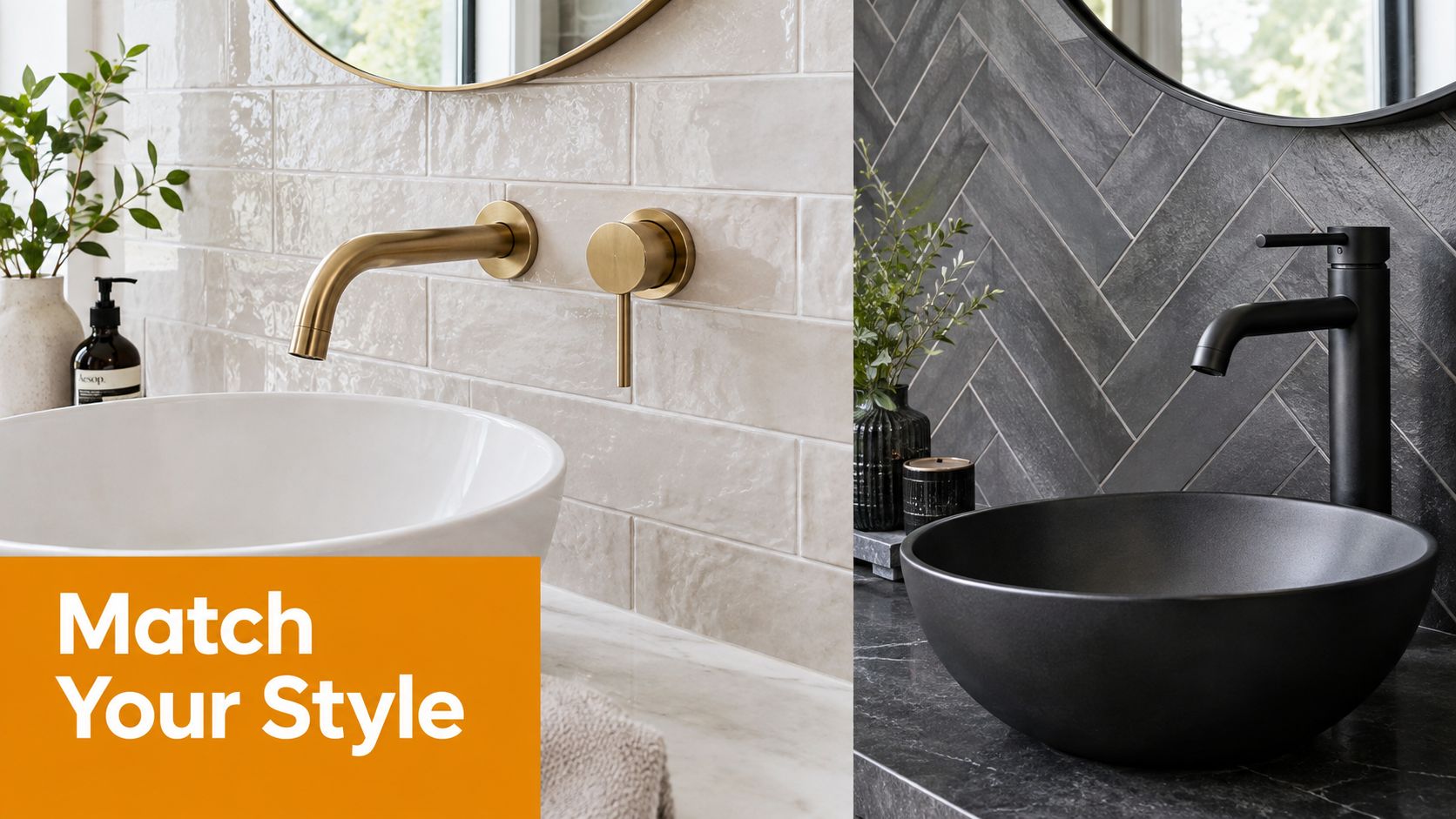
Three combinations that work in Melbourne homes
Cool grey porcelain or white subway tiles pair comfortably with chrome or brushed nickel. Chrome keeps the scheme crisp and reflective, while brushed nickel softens the contrast and suits a contemporary or Hamptons-inspired renovation. This pairing is forgiving if the room is compact or receives limited natural light.
Terrazzo or honed stone flooring creates a useful base for matt black tapware. The dark fitting can echo grout, mirror frames or cabinetry details, giving an industrial or modern farmhouse bathroom a clear visual line. Keep the surrounding materials warm enough that the room doesn't feel overly stark.
Warm cream zellige-style tiles and timber-look surfaces suit brushed brass or aged copper. These finishes reinforce the room's softer, coastal or heritage character. If your tiles have strong yellow or orange undertones, view the tap sample beside them because brass tones vary considerably.
For further tile selection guidance, use this practical resource on how to choose bathroom tiles.
Coordinate by function, not by accident
Match the main plumbing fittings, such as the basin mixer, shower trim and bath spout, unless you have a clear design reason to introduce contrast. Then check the shower frame, heated towel rail, mirror frame and cabinetry hardware. A room can mix metals successfully, but the combination should look deliberate rather than like separate purchases made at different times.
Wall-mounted mixers suit clean tile compositions, but the outlet must align with the basin and provide adequate reach. Deck-mounted mixers give you more flexibility where the plumbing already rises through the vanity. Curved spouts soften square basins, while angular mixers add definition to round or gently curved bowls.
For broader planning ideas, a guide to bathroom design Premier Builders can help you think about how tapware relates to the rest of the room, even though your installation requirements remain specific to Victoria and Australia.
Use the video below as a visual prompt while comparing profiles, proportions and bathroom layouts.
Maintenance That Keeps Tapware Looking New
Most tapware problems begin with small habits. A wet surface dries, deposits build around the outlet, and someone reaches for a strong bathroom spray that damages the finish. A simple routine is safer and usually easier.
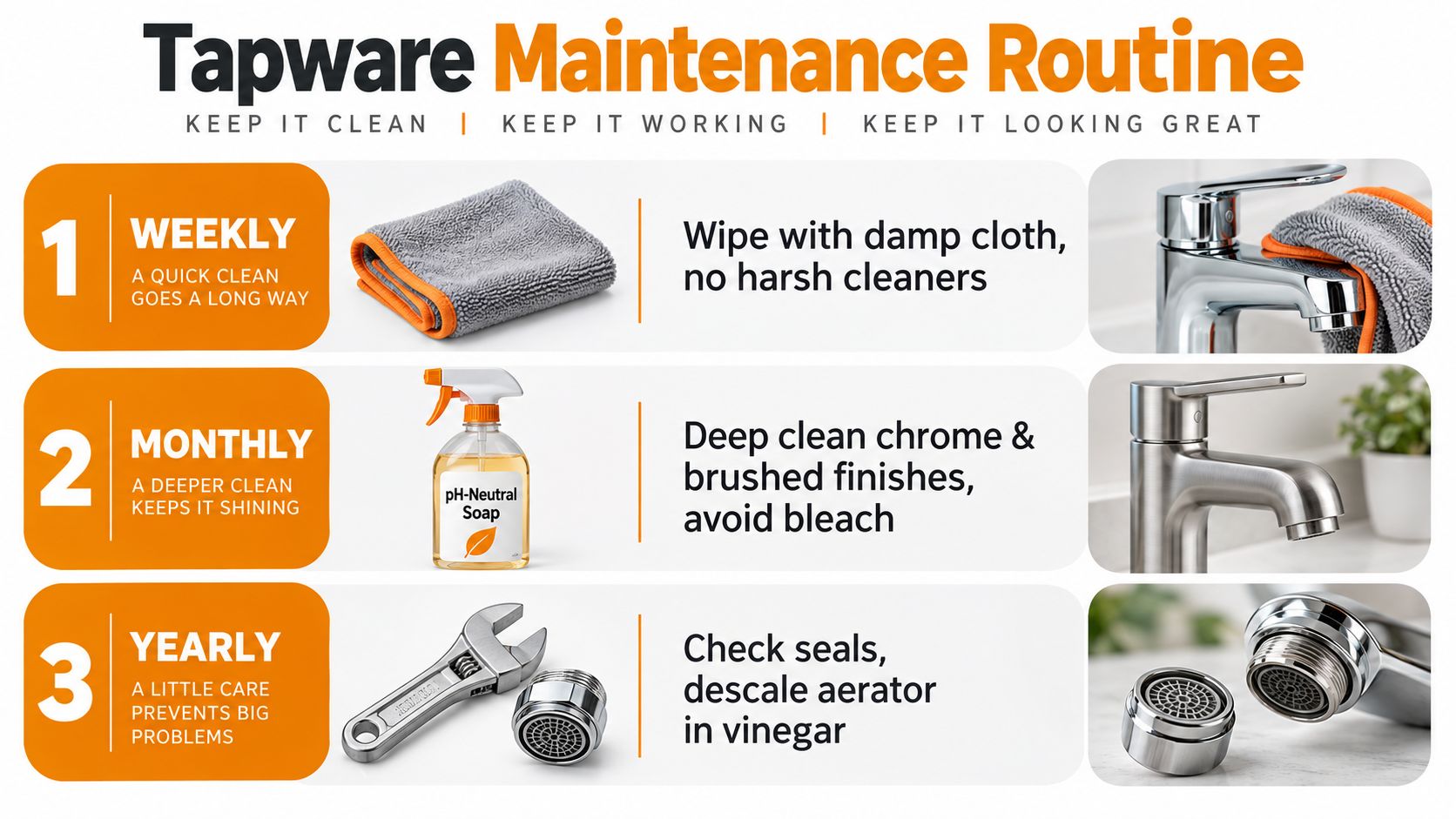
A weekly reset
Wipe the mixer, spout and handles with a soft microfibre cloth and mild soapy water. Rinse away residue and dry the surface, especially around the base of the spout and the handle joint.
Chrome generally tolerates everyday cleaning well, but it still benefits from drying. Matt black needs a gentle, non-abrasive cloth because fingerprints and deposits can show against the dark finish. Brushed nickel can disguise water marks, yet its brushed grain can be scratched if you scrub across it with a rough pad.
A monthly detail clean
Remove and inspect the aerator if the flow becomes uneven. Soaking a removable aerator or shower component in vinegar can help loosen mineral deposits, provided the manufacturer permits it and the part is rinsed thoroughly afterwards.
Check the diverter outlet as well. A partially blocked outlet can make the shower feel inconsistent even when the mixer itself is operating correctly.
A yearly check
Test the mixer handle for smooth movement and look for a loose grub screw, worn seal or persistent drip. Don't force a stiff cartridge. Have a plumber assess it before a minor fault becomes damage inside the vanity or wall.
Avoid bleach, ammonia-based sprays, cream cleansers and abrasive pads. These products can mark PVD coatings, strip matt surfaces and affect finish warranties. Unlacquered brass is a separate choice altogether. It may develop a patina, so choose it only if you're comfortable with the surface changing over time.
Cost Ranges and Melbourne-Specific Considerations
I can't responsibly give you reliable price bands from the supplied verified information, so treat the following as a budgeting method rather than a quoted market schedule. Ask for a written price that separates the fitting, delivery, installation, additional valves, access work and any certification required.
The visible tap is only one part of the cost. A standard basin mixer may be simpler to replace than a wall-mounted set because the concealed body and finished-wall access are different. Bath fillers, diverters and multi-outlet shower systems can involve more coordination, particularly if the layout is changing rather than replacing like for like.
Build the quote around the installation conditions
Before approving a product, ask the supplier and plumber:
- What's included: Confirm whether the price covers the mixer body, trim, spout, handles, mounting hardware and connection components.
- What's concealed: Identify whether a wall-mounted product needs a new rough-in body or changes to existing pipework.
- What happens if access is poor: Clarify the cost implications if the plumber finds incompatible connections, damaged pipework or an unsuitable wall cavity.
- What arrives with the product: Check whether aerators, isolation valves and other required components are included or must be sourced separately.
- What documentation you receive: Keep the invoice, product instructions, certification evidence and plumbing compliance records together.
Melbourne renovations also need practical planning around trades and delivery. Specialty finishes may have different availability from standard chrome, and a delayed tap can hold up the final installation if the vanity, wall penetrations or tile cuts depend on it. Order only after confirming the exact model, finish, mounting method and compliance status.
For broader budgeting context, compare the project stages in this guide to bathroom renovation cost in Melbourne. The most useful figure for your own bathroom will still come from a licensed plumber who has inspected the existing connections and understands the planned layout.
DIY rules also need care. A homeowner may be able to handle cosmetic tasks, but altering water services, concealed pipework or bathroom plumbing should be discussed with a licensed Victorian plumber. Don't assume that a fitting described as an easy replacement makes every installation step legal for an unlicensed person.
| Tap Type | Chrome Budget | Brushed Nickel / Matt Black Mid | Brass / Specialty Premium |
|---|---|---|---|
| Basin mixer | Ask for a written product and installation quote | Compare coating, cartridge and warranty details | Confirm body material, certification and delivery |
| Pillar taps | Check compatibility with the existing basin holes | Review handle operation and finish care | Confirm heritage styling does not compromise fit |
| Wall-mounted mixer | Allow for concealed installation assessment | Check rough-in body and wall depth | Coordinate premium trim with tile layout |
| Bath spout and filler | Confirm projection and connection type | Compare diverter requirements | Allow for more detailed layout coordination |
| Shower set | Match mixer, outlet and pressure conditions | Check all components are supplied | Confirm multi-outlet controls and servicing access |
Your Bathroom Tapware Decision Checklist
Take this list into a Melbourne showroom, trade counter or supplier appointment. The aim is to leave with a product that fits your bathroom physically and legally, not merely one that looks good on a display wall.
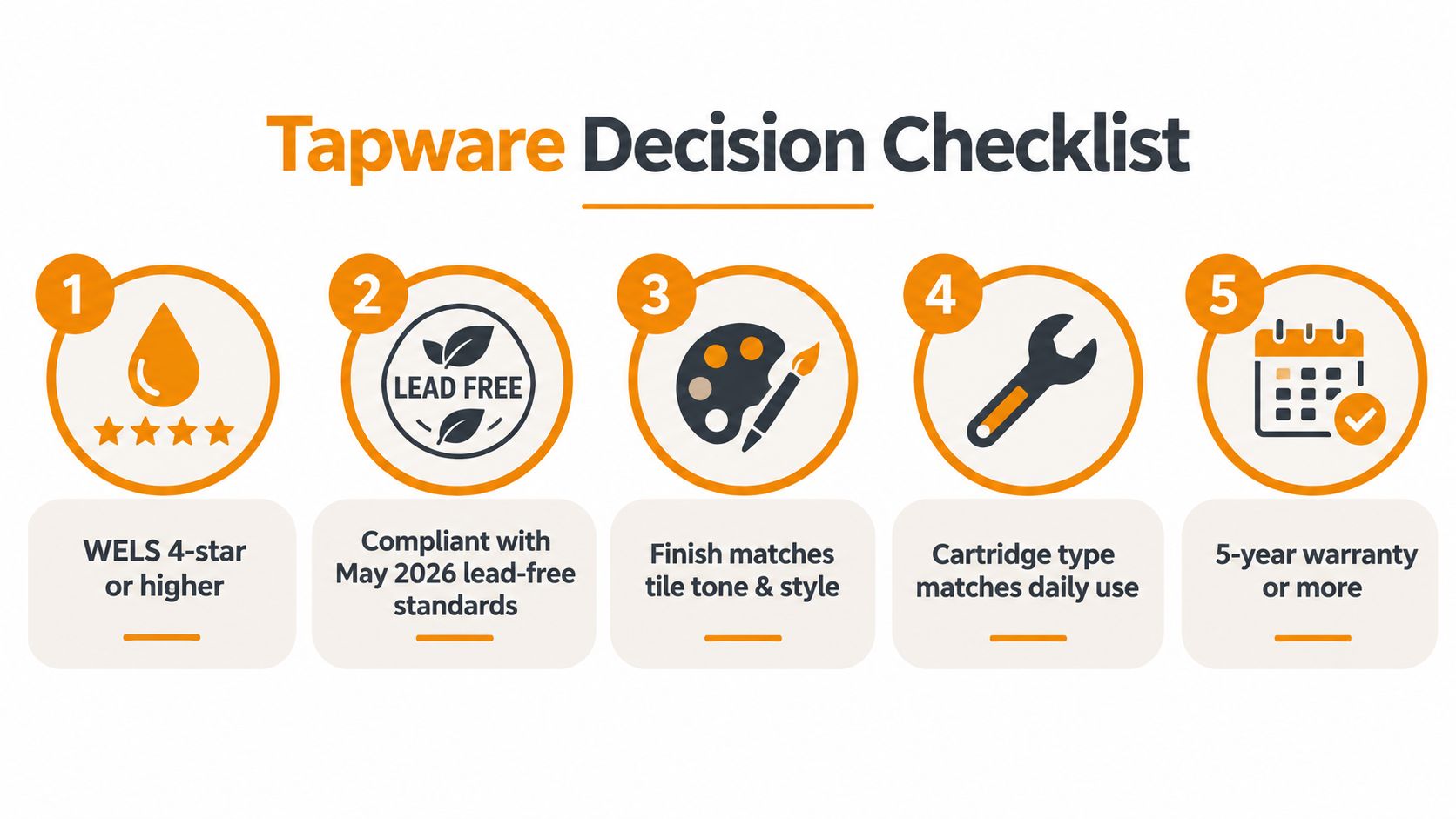
- Confirm the WELS rating: Record the star rating and tested flow rate. Remember that WELS measures water efficiency, not overall product quality.
- Verify lead-free status: For installations from 1 May 2026, ask for Lead Free WaterMark certification and confirmation of the 0.25% weighted-average lead limit.
- Match the mounting type: Decide whether the fitting is deck-mounted or wall-mounted before waterproofing and tiling.
- Check pressure and temperature: Give the product details to your plumber so the fitting suits the home's hot-water and pressure system.
- Compare the construction: Ask about the body material, cartridge, coating process, spare parts and warranty.
- Coordinate the room: Place the tap sample beside your tiles, basin, shower frame, towel rail and cabinetry hardware.
- Plan maintenance: Confirm which cleaners the manufacturer allows, then keep a soft cloth available for regular wiping.
- Budget installation properly: Obtain a written quote from a licensed Victorian plumber and keep the compliance documents with your renovation records.
The best bathroom tapware decision balances four things at once: legal compliance, controlled water use, reliable operation and a finish you're prepared to maintain. If one of those is missing, the product isn't ready for the order.
Tiles Mate Pty Ltd offers curated bathroom tiles, natural stone mosaics, flooring and samples that can be compared with your tapware finish and bathroom palette. Visit Tiles Mate Pty Ltd to explore tile options, arrange a design consultation or plan your Melbourne renovation with the right materials selected together.