




Tapware Guide for Stylish Water Smart Bathrooms
by Shivam Tayal 21 Sep 2026 0 Comments
You're probably standing in the middle of a renovation decision that feels oddly bigger than it should. The tiles are nearly chosen, the vanity's locked in, and then you get to the tapware wall. Suddenly every option looks slightly different, everyone uses different words, and one small fitting now seems capable of affecting the whole room.
That feeling is normal. Tapware sits right at the intersection of style, plumbing, comfort and compliance. It's one of the few things in a bathroom you see up close, touch every day, and rely on without thinking. When it's chosen well, the basin works properly, the shower feels easy to use, and the room looks resolved. When it's chosen badly, you notice splashing, awkward handle placement, a finish that fights the tiles, or a product that becomes a problem at installation.
Introduction to Tapware That Looks Good and Works Hard
A lot of Melbourne renovators walk into a showroom thinking tapware is mainly a finish decision. Chrome or brushed brass. Round or square. Modern or classic. Then the practical questions start. Will that wall mixer line up with the basin? Does that black finish mark easily? Can this be installed legally in Victoria? Why does one tap have a star label and another doesn't?

The easiest way to think about tapware is this. It isn't jewellery for the bathroom. It's more like the steering wheel in a car. It has to look right, yes, but its real job is to give you control. It controls where water lands, how easily temperature changes, how simple cleaning feels, and whether the product suits the plumbing setup behind the wall.
Why this choice matters more in Victoria
In Victoria, tapware now sits inside a tighter framework of safety and efficiency requirements. That matters because what looks good on a shelf still has to meet the rules for products used with drinking water and household plumbing. If you're also thinking about the quality of water throughout the house, broader whole-house filtration advice can help connect fixture choices with water treatment decisions.
A beautiful mixer can still be the wrong choice if it clashes with your basin depth, your wall set-out, or your compliance needs.
Style still matters. It always will. A brushed finish can soften a hard-lined vanity. A wall-mounted spout can make a compact ensuite feel cleaner and calmer. If you're pairing tapware with surfaces, these bathroom wall and floor tile ideas are useful because the tapware and tile finish should read as one conversation, not two separate purchases.
The showroom mindset that helps
When I walk renovators through displays, I ask them to decide three things in this order:
- How the tap will work: mixer, separate taps, wall-mounted, hob-mounted, sensor
- How it must fit: basin size, splash zone, wall depth, vanity top
- How it should look: finish, shape, pairing with tile and cabinetry
That order saves people from falling in love with the wrong item first.
By the time you finish reading, you should be able to look at a piece of tapware and judge more than its shape. You'll know how it operates, where it suits, what it asks of your plumber and tiler, and how to match it with the room around it.
What Tapware Is and How It Controls Water
At its simplest, tapware is a controlled opening in your plumbing system. Water sits behind the wall or under the benchtop under pressure. The tap is the gatekeeper that decides when that water flows, how much comes out, and in many cases whether it comes through hot, cold, or a mix of both.
That's why the handle shape isn't the heart of the product. The work happens inside.
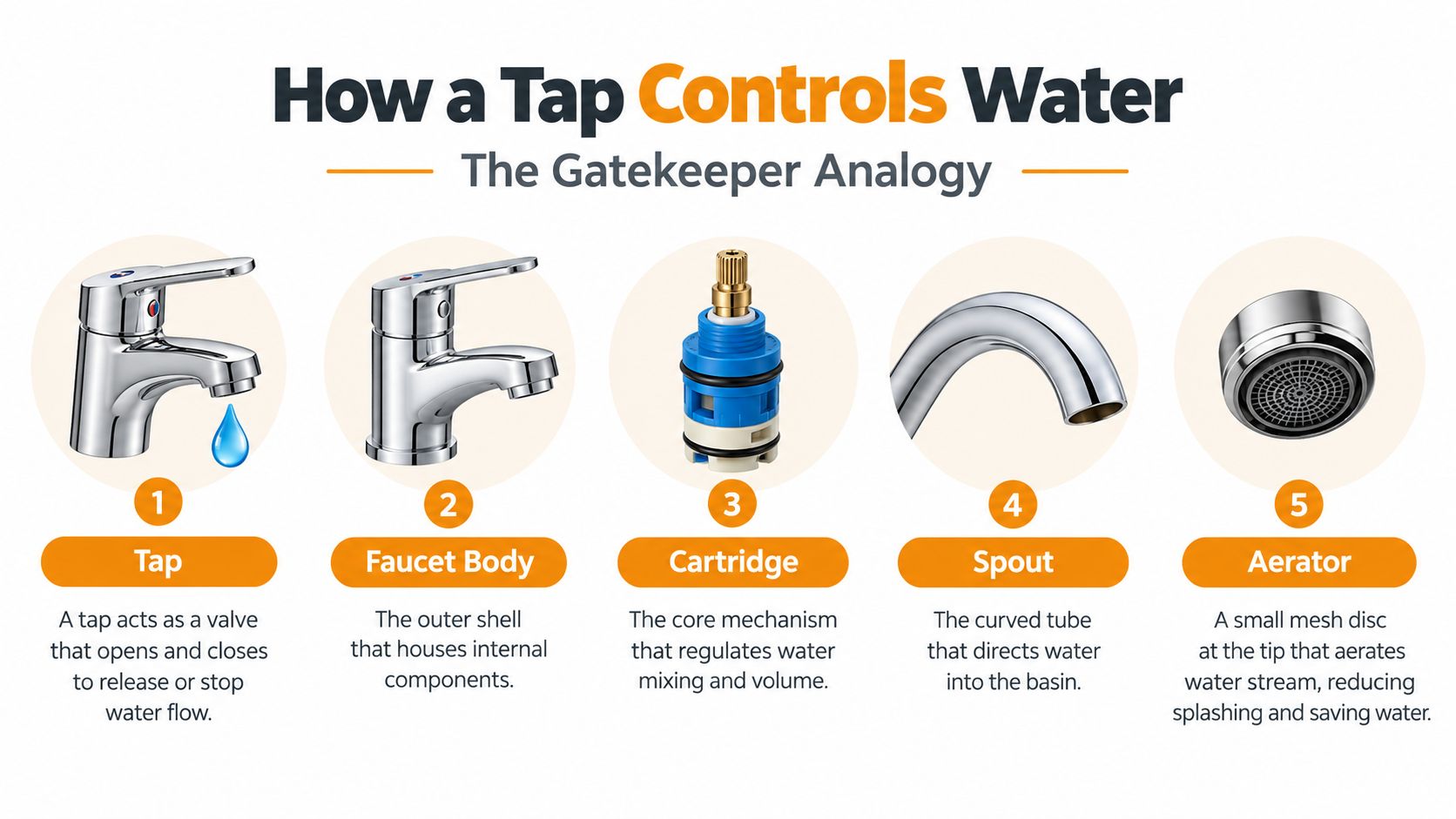
The four parts worth knowing
Think of a tap like a well-dressed machine with a simple job.
- Body: This is the outer shell you see. It gives the tap its shape and finish, and it houses the working parts.
- Cartridge or valve mechanism: This is the engine room. It opens and closes the water path and, in a mixer, blends hot and cold water.
- Spout: This directs water into the basin, bath or sink.
- Aerator: This small fitting at the end of the spout shapes the water stream and helps reduce splashing.
If you only remember one thing, remember the cartridge. Two taps may look nearly identical from the front, but the feel of turning them on and adjusting temperature comes from the internal mechanism, not the silhouette.
Mixer versus separate taps
A mixer combines hot and cold control into one fitting. You move a single lever or turn one integrated control to adjust both temperature and flow. That's why mixers feel intuitive in family bathrooms and ensuites.
Separate hot and cold taps do the same basic job but ask you to balance temperature manually. Some people choose them for heritage styling or symmetry, especially in older-style renovations.
Here's the useful test. If you want quick, one-handed use while brushing teeth or rinsing skincare products, a mixer usually feels easier. If the room is leaning traditional and the basin design suits a more classic setup, separate taps can make visual sense.
For readers comparing broader bathroom fittings, this guide to shower heads and bathroom water delivery helps because showers and basin tapware often need to work as a visual family.
Where the water actually travels
Water comes through supply lines into the body of the tap. The valve or cartridge opens that path. In a mixer, the internal mechanism balances hot and cold before the water reaches the spout. The spout then delivers it where you need it.
Practical rule: If a tap looks delicate outside but feels rough, loose or vague to operate, the issue usually isn't the design language. It's the quality of the internal control.
Mounting changes how the whole setup behaves
A tap can sit on the basin, on the vanity top, on the bath hob, in the wall, or on the floor beside a freestanding bath. The water control principle stays the same, but the installation method changes everything around it. Wall-mounted options need pipework positioned earlier. Deck-mounted options use the horizontal surface for support and access.
That's why good tapware selection starts with understanding the plumbing path, not just the catalogue photo.
Common Tapware Types and Where Each Works Best
Once you understand tapware as a water-control system, the product families start to make sense. In a showroom, people aren't really choosing between fifty taps. They're choosing between a handful of formats that solve different room problems.
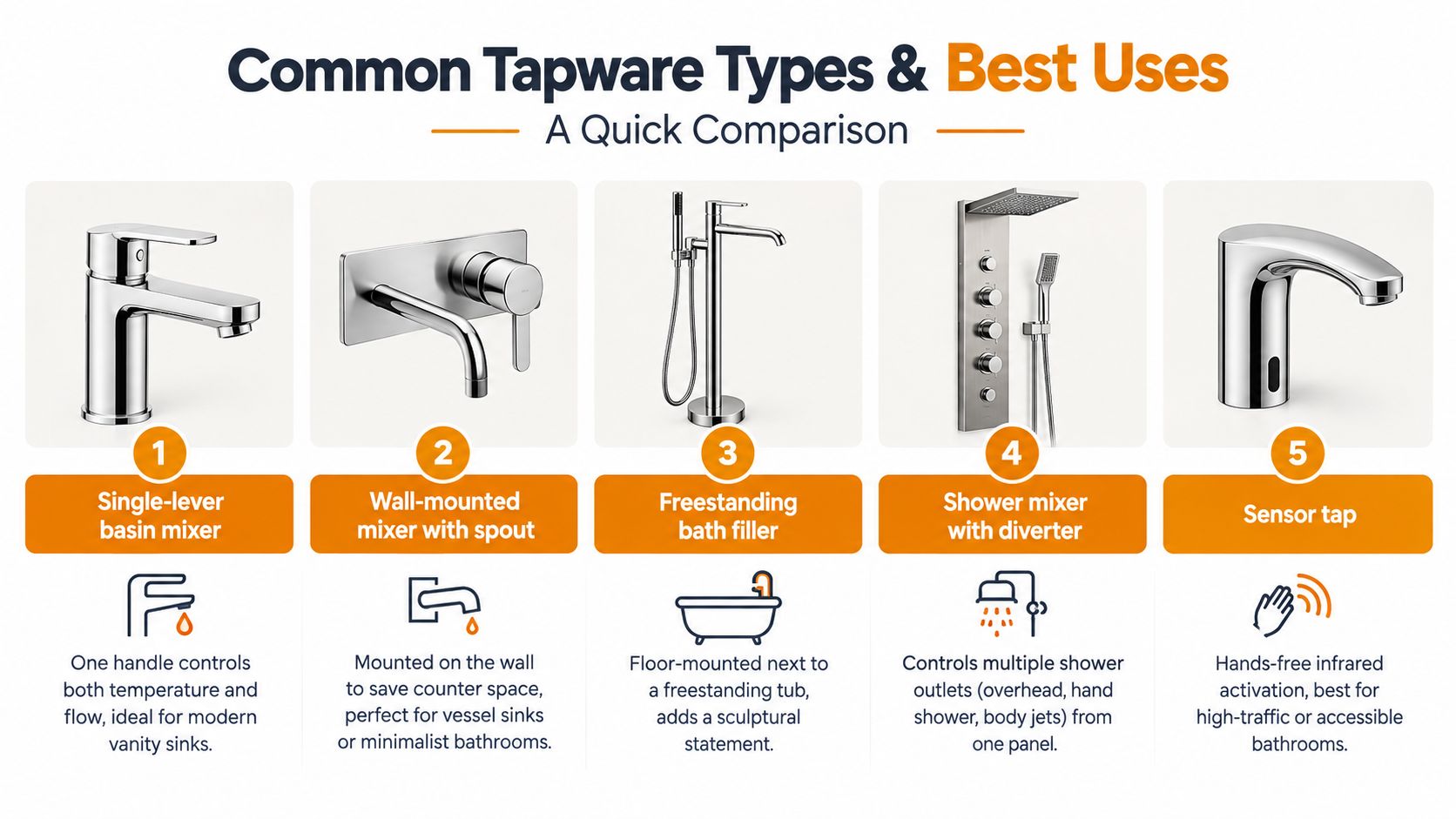
This visual comparison helps narrow the field.
Basin mixers and wall mixers
A single-lever basin mixer is the standard all-rounder. It works well on vanity tops where you want straightforward control and a neat footprint. In a family bathroom, it's often the least fussy option because guests can use it without needing instructions.
A wall-mounted mixer with spout shifts the plumbing into the wall and frees up bench space. That makes it useful with vessel basins or narrower vanities. It also changes the visual rhythm of the room because the wall, not the benchtop, becomes the anchor line.
The trade-off is precision. Wall-mounted tapware needs the rough-in set correctly before tiling and basin placement can't drift later without consequences.
Bath fillers and shower mixers
A bath filler is designed for volume and presence. Around a built-in bath, hob-mounted or wall-mounted versions often suit. Beside a freestanding bath, a floor-mounted filler becomes almost sculptural. It's one of the clearest examples of a fitting doing both a plumbing job and a styling job.
A shower mixer controls flow and temperature for the shower. Add a diverter, and one control point can send water to different outlets, such as an overhead shower and a hand shower. That's useful when the shower setup is doing more than one thing in a compact footprint.
Here's a quick showroom video if you want to see common styles and layouts in a more visual way.
Sensor and non-touch options
Sensor or non-touch tapware is often associated with commercial spaces, but it also has a place in homes. It can suit accessible bathrooms, powder rooms, or projects where touch points are being reduced.
Australian product classifications for tapware under AS 3718 Water supply - Tap ware include bib, mixing, non-touch, hose, diaphragm, pillar, laboratory, hand spray, drinking fountain, self-closing and ferrule tapware, and the same schedule marks these products as subject to Lead Free requirements for relevant applications, as outlined in this Australian tapware compliance overview.
A simple way to match type to room
- Compact ensuite: Wall mixer plus wall spout can make the vanity feel less crowded.
- Main family bathroom: Basin mixer and a simple shower mixer usually keep use straightforward.
- Freestanding bath zone: Floor-mounted bath filler works if the plumbing and floor build-up allow it.
- Accessible or shared-use space: Sensor or easy-grip controls can improve day-to-day handling.
If you're browsing fixture styles in one place, a curated tapware collection can help you compare forms before getting too deep into finish decisions.
The best tapware type usually solves a layout problem first. The style benefit comes second.
Finishes Materials and Durability in Australian Homes
A finish is the part you notice first in the showroom. It catches the light, picks up the tile colour and sets the mood. But in a Victorian home, finish choice also affects how the tapware ages, how often you clean it, and whether the product behind that finish is suitable for the plumbing system it will connect to.
How finishes behave in real bathrooms
Start with the room you live in, not only the sample board.
Chrome is still the dependable baseline. It suits nearly any tile palette, reflects light well and often helps a compact bathroom feel brighter. It also tends to be easy to match later if you need a replacement part or want to keep the same finish across shower, basin and bath.
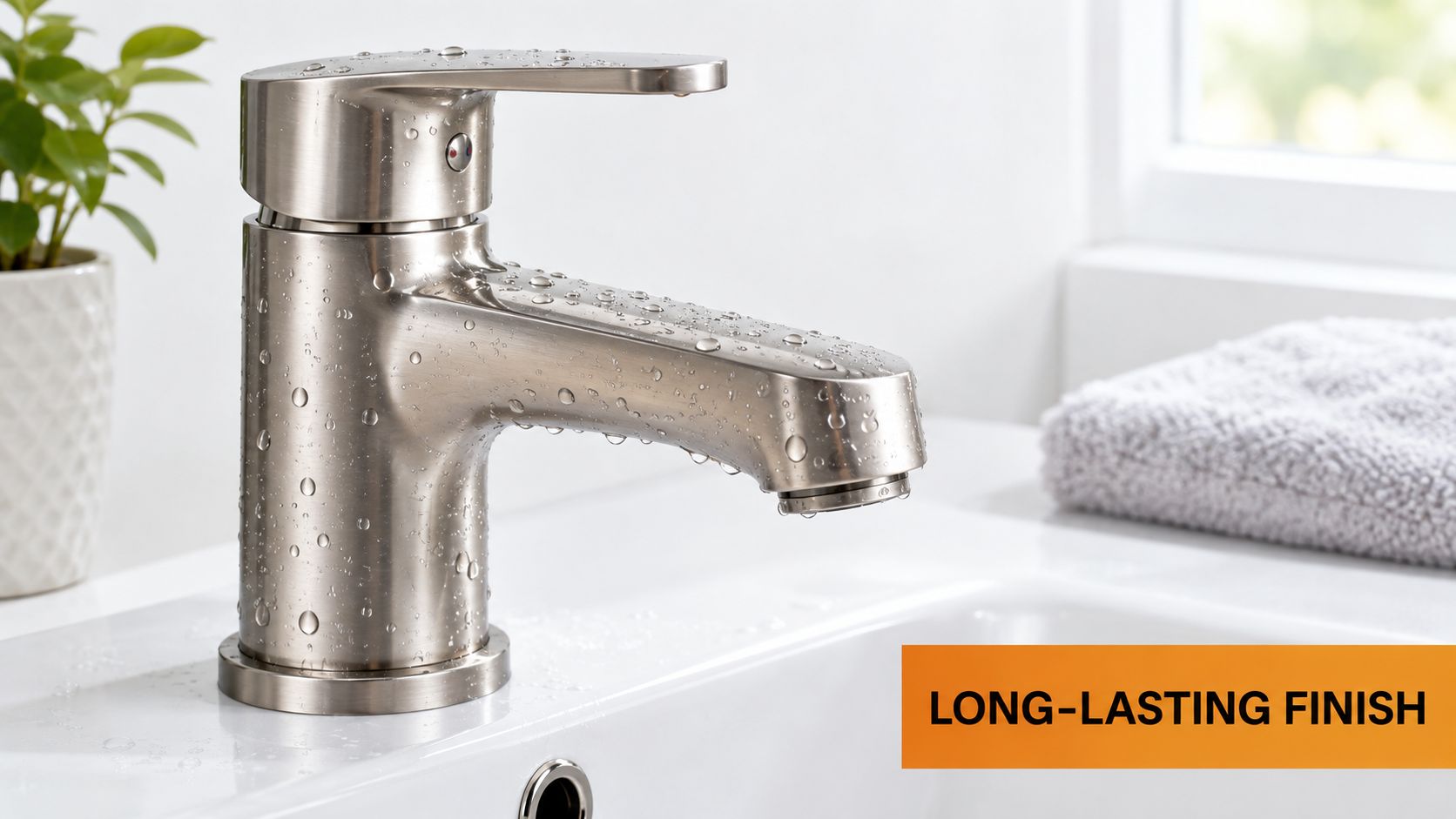
Brushed nickel gives a softer read. It sits comfortably with stone-look porcelain, warm whites, greige joinery and quieter schemes. It usually shows fingerprints and dried splash marks less harshly than polished surfaces, which can make daily upkeep feel easier.
Matte black creates contrast fast. In the right room it looks crisp and architectural. In a family bathroom with pale grout, hard water spotting or lots of competing fittings, it can demand more maintenance discipline than people expect.
Gunmetal and brass-toned finishes bring warmth. They can look excellent with timber, travertine-look tiles, marble veining and textured ceramics. The catch is undertone. Warm brass beside a cool grey tile can feel intentional and layered, or slightly off, depending on the vanity colour, mirror frame and even the shower screen trim.
A simple rule helps here. Busy tile often pairs best with quieter tapware. Quiet tile gives the tapware more room to speak.
Pairing finish with tile without creating tension
Tile and tapware should balance each other, much like choosing the right frame for artwork. A bold frame can sharpen a simple print. With a detailed print, the same frame can feel heavy.
- Gloss marble-look tiles often suit chrome, brushed nickel or softer brass tones, depending on whether the veining reads cool or warm.
- Concrete-look matt tiles usually sit well with black, gunmetal or brushed finishes because the surface character already feels grounded.
- Textured feature tiles benefit from simpler tap shapes and calmer finishes, so the eye is not pulled in too many directions at once.
- Small mosaics and penny rounds can carry more decorative energy, which means the tapware can be expressive without overwhelming the room.
This is also where performance enters the design conversation. A finish that looks perfect on a mood board may be the wrong choice for a high-use bathroom if it constantly shows soap residue, fingerprints or mineral spotting.
Material under the finish matters
The visible coating is only one layer. Underneath it sits the body of the tapware, and that body affects durability, water contact safety and legal installation.
In Australia, brass has long been common in tapware bodies, including dezincification-resistant brass in many applications. Lead content requirements are now much tighter for products used to convey drinking water. As noted in this overview of Australian bathroom tapware standards, new copper alloy tapware installed in plumbing systems that carry drinking water must meet low-lead rules from 1 May 2026.
That matters in practical terms. A basin mixer is not just a coloured fitting on top of a vanity. It is part of the drinking-water path. For renovators in Victoria, the smart question is not only, "Does this finish suit my tiles?" It is also, "Is this product compliant for where it will be installed?"
If you are comparing products that look similar on the shelf, check the technical documentation. A premium-looking finish does not automatically tell you what alloy sits underneath or whether the tapware is intended for potable water applications.
The finish shapes the look. The material underneath shapes what you can legally and confidently install.
Durability depends on use and care
Durability is partly about manufacturing quality and partly about your household habits. A polished surface can stay beautiful for years if it is cleaned gently and dried regularly. A tougher-looking finish can still wear poorly if it is scrubbed with abrasive products or allowed to build up scale around the base and aerator.
For a busy family bathroom, a brushed finish often makes day-to-day marks less obvious. In a guest powder room, a more dramatic finish may be easier to maintain because it sees less traffic.
Choose the finish for the room's workload, not just its colour story.
Sizing Spout Reach and Installation Constraints
The most expensive tapware mistake isn't usually choosing the wrong colour. It's buying a fitting that doesn't physically suit the basin, wall, bench or plumbing setup. A beautiful showroom choice can turn into tile cuts, splash issues and last-minute substitutions.
What to measure before you order
Start with where the water needs to land. Ideally, the stream should fall comfortably into the functional part of the basin, not right on the rim and not too close to the waste. If the spout is too short, you'll wash your hands against the back of the bowl. If it's too long, the stream can hit awkwardly and splash forward.
The next check is height. A high spout can look elegant, but paired with a shallow basin it may create mess. A lower spout can feel controlled and neat, but only if there's still enough room for handwashing.
Wall-mounted tapware needs earlier decisions
Deck-mounted tapware gives you some flexibility because the bench or basin carries the fitting. Wall-mounted tapware is less forgiving. The in-wall body, outlet position and handle set-out need to be resolved before tiling is complete.
That affects more than plumbing. It affects tile layout too. A centred spout should relate to the basin centreline, grout lines and any feature tile geometry. If you're using kit-kat mosaics, finger tiles or strong vertical joints, even a small set-out error becomes obvious.
If you're choosing wall-mounted tapware, ask your plumber and tiler to confirm the exact set-out against the actual basin, not the catalogue image.
A pre-purchase checklist for renovators
Bring this list to your plumber or supplier before paying a deposit:
- Basin dimensions: Confirm internal bowl size, rim thickness and basin height.
- Tap position: Check whether the tap sits on the basin, benchtop, wall, bath hob or floor.
- Spout reach: Make sure the water stream lands inside the working centre of the basin.
- Wall cavity depth: Ask whether the wall can physically accommodate the in-wall body.
- Bench and tile conditions: Confirm drilling locations won't clash with feature tile joints or edges.
- Valve compatibility: Verify the selected mixer or body suits the plumbing arrangement planned for the room.
- Licensed installation: Use a licensed plumber for final installation and compliance requirements in Victoria.
Where people often get caught
A vessel basin often needs a different spout height and reach from an inset basin. A thick stone top may affect how a deck-mounted fitting is installed. A freestanding bath filler may need planning below the floor surface, not just beside the bath.
This is also the point where one product mention is useful. If you're comparing modern bathroom fixtures, something like the Orbit Shower Mixer Matte Black sold by Tiles Mate Pty Ltd is the kind of product where finish choice, wall placement and tile coordination all need to be checked together before purchase.
Good tapware selection isn't just design taste. It's geometry.
Water Efficiency WELS Ratings and Victorian Compliance
You are standing in the showroom with two basin mixers that look almost identical. One suits your tiles, carries the right approvals and helps limit water use. The other may create trouble for your plumber, your final sign-off and your water bills. This is the part many renovators do not see until late in the project.
What WELS and WaterMark actually mean
In Australia, tapware is judged on appearance and performance. For Victorian homes, that practical side matters because a tap can look perfect on the bench and still be the wrong choice for legal installation.
WELS is the water efficiency label. It shows how much water a product uses, usually through a star rating and flow rate. A higher rating generally means lower water use, but the best choice still depends on where the tap will go. A basin mixer used for quick handwashing can usually be more water-efficient than a kitchen mixer that fills pots and rinses food.
The Australian Government notes that an unrestricted running tap can use more than 16 litres a minute, a dripping tap can waste more than 12,000 litres a year, and choosing more water-efficient products can reduce household costs over time, with national savings projected to be significant by 2030. It also recommends 4 or 5 stars for bathroom basin taps, 3 or 4 stars for kitchen sink taps, and states that the minimum water-efficiency standard for tapware moved to 3 stars from 17 June 2022 under the WELS framework, as outlined in its household water efficiency guidance.
WaterMark does a different job. It is the product certification scheme for plumbing and drainage items. If WELS is the fuel-use label on a car, WaterMark is the proof that the brakes and seatbelts meet the rules. For tapware sold or advertised in Australia, buyers should see WaterMark and, where required, WELS information shown with the product, as outlined in the WELS and WaterMark compliance protections.
WELS Star Ratings and Flow Guidance for Tapware
| Tap Location | Recommended WELS Stars | What It Means in Practice |
|---|---|---|
| Bathroom basin taps | 4 or 5 stars | Better suited to everyday bathroom use where saving water is usually the priority |
| Kitchen sink taps | 3 or 4 stars | A practical middle ground between water saving and kitchen tasks |
| Bath taps | May not require a WELS rating in some cases | Check the listing carefully because bath tap rules can differ |
How ratings affect design choices, not just bills
Style and compliance meet.
A wall mixer in brushed brass, a matte black basin set or a chrome kitchen mixer may all suit the room visually, but the finish does not change the approval requirements. The valve type does not override them either. You still need the right certification for the right application.
The WELS rating can also shape how the tap feels in use. A highly efficient basin tap often suits a compact vanity and splash-prone bowl because the flow is more controlled. In a kitchen, going too low on flow can feel frustrating if you regularly rinse trays or fill larger pots. Good selection is a balancing act between use, rating and room function.
The compliance details buyers often miss
Victorian renovators often assume every tapware item will carry the same labels. That is where confusion starts. Some bath taps may not require a WELS rating, so you cannot use the absence of a WELS label on its own to judge whether a product is acceptable.
Use a quick showroom check before you buy:
- Check the product listing: Confirm WELS details where they are required and look for WaterMark certification.
- Match the product to the room: Basin, kitchen, shower and bath fittings can sit under different labelling rules.
- Verify before ordering: If the listing is vague, ask the supplier or your plumber to confirm the licence details.
- Judge finish after compliance: A tap that works with your tiles still needs to suit Victorian installation requirements.
In practical terms, the right tapware choice is a three-part fit. It needs to suit the look of the room, the way the room uses water, and the rules your plumber must follow in Victoria.
Styling Care and Troubleshooting for Lasting Results
Once your tapware is the right type, the right size and the right compliant product, styling becomes much easier. This is the enjoyable part because the choices now sit on a solid practical foundation.
Pairing tapware with tile finishes
Warm brass-toned tapware can look beautiful against Calacatta marble-look surfaces because the veining often gives the finish something rich to bounce off. Concrete-look matt tiles usually suit black, brushed nickel or gunmetal because the overall effect feels grounded and architectural. In smaller decorative areas, shapes like herringbone and penny round can handle more expressive tapware because they already bring pattern into the room.
If you're working with textured outdoor pavers or slip-rated materials in adjacent wet zones, keep the indoor tap finish connected but not identical. The house should feel related, not copied room to room.
Simple care habits that preserve the finish
Most tapware lasts better when cleaned gently and dried regularly around the base and spout. The aerator also deserves occasional attention because debris or mineral build-up can affect how the water stream behaves.
A practical routine looks like this:
- After daily use: Wipe away water sitting around the base if your bathroom tends to stay humid.
- During weekly cleaning: Use a soft cloth and avoid harsh abrasive products on decorative finishes.
- If splashing increases: Check the aerator first, because a blocked aerator can distort the stream.
- If a tap starts dripping: Don't ignore it. A worn internal component or seal may need attention before the issue worsens.
If the tap turns smoothly but the flow looks messy, start at the aerator. If the handle feels rough or the drip continues when fully off, call a plumber.
When to fix and when to call someone
Homeowners can usually manage gentle surface cleaning and basic aerator maintenance. Once the issue moves inside the wall, into the cartridge, or into the plumbing connection, it's plumber territory. That's especially true in renovated bathrooms where access is tighter and surfaces are newly finished.
A final way to keep yourself steady in the decision process is to ask three plain questions before ordering: does it suit the basin, does it suit the tiles, and does it suit the rules? When all three answers are yes, tapware stops being a stressful detail and starts doing what it should do. It works hard, looks right and feels easy every day.
Tiles Mate Pty Ltd helps Melbourne renovators pull these choices together with bathroom tiles, mosaics, flooring and tapware-friendly finishes that can be matched by colour, texture, size and shape. If you're comparing marble-look porcelain, concrete-look matt surfaces or feature mosaics against your tapware options, visit Tiles Mate Pty Ltd to explore products, order samples and get practical guidance before you lock in the final scheme.