



Gunmetal Bathroom Tapware: The Complete Buyer's Guide
by Shivam Tayal 21 Nov 2026 0 Comments
The usual advice about gunmetal bathroom tapware is to choose it because it's softer than black and more interesting than chrome. That's a reasonable styling observation, but a poor purchasing specification. A colour name tells you nothing about the internal materials, coating quality, water efficiency or replacement parts you'll be living with.
Start with the product's construction and documentation, then decide whether its shade works with your tiles. That order matters especially in Melbourne renovations, where a mixer that looks right on a sample board can still be wrong for the basin, difficult to maintain or unsuitable for the planned installation.
What Gunmetal Tapware Really Means Beyond the Colour Name
Gunmetal is a colour category, not a material specification. It usually describes a smoky charcoal-grey surface with metallic depth. Some versions have warm brown undertones; others read blue-grey under cool lighting. Compared with matt black, gunmetal reflects more light. Compared with chrome, it looks quieter and less mirror-like.
Those differences explain its appeal, but not its quality. Two mixers carrying the same colour description can have different bodies, surface treatments, cartridges and water-use characteristics.
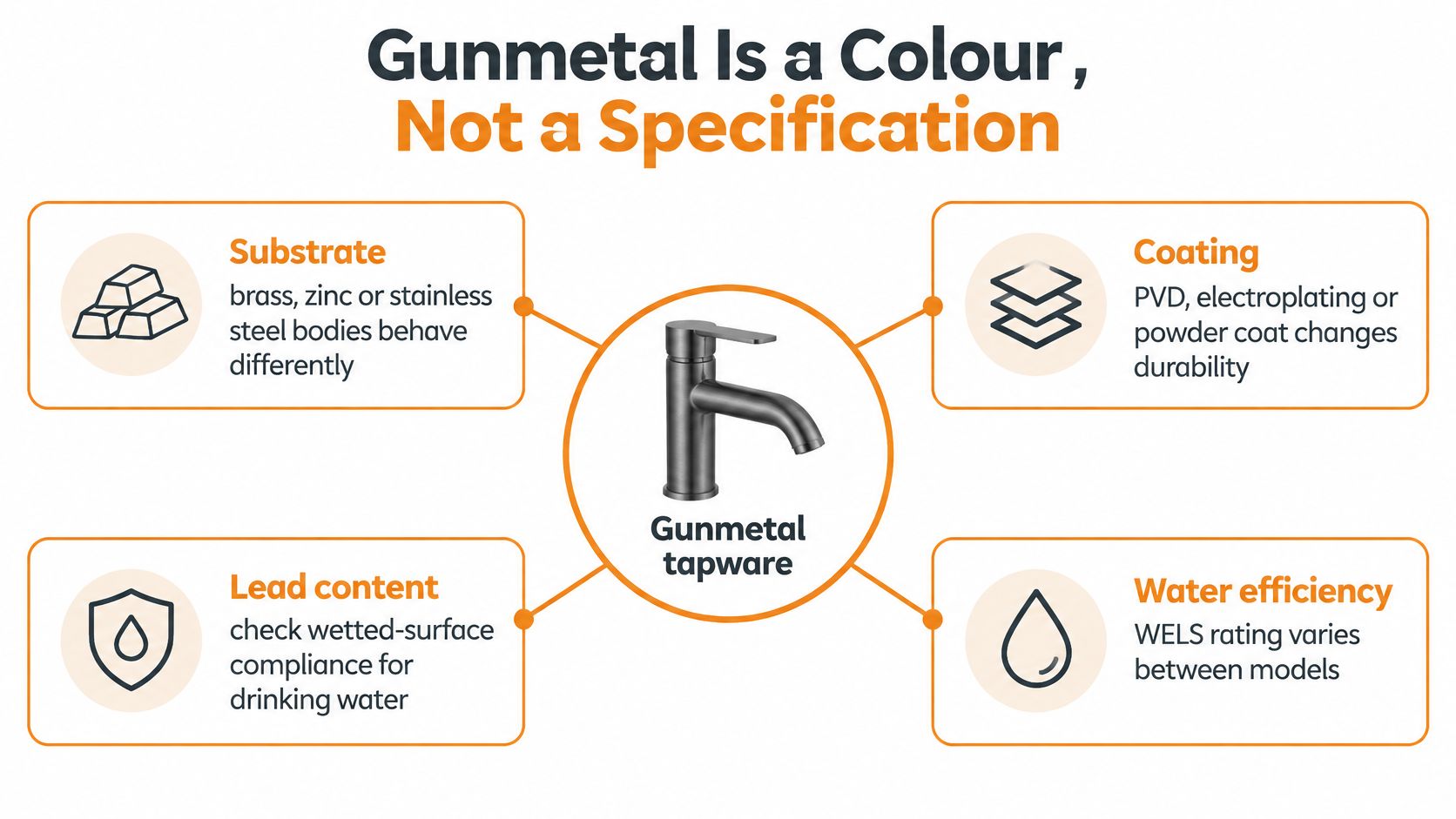
Separate the body from the coating
Think of the finish like paint on a car. The visible surface influences appearance and ageing, but it doesn't tell you what's underneath or whether the complete assembly meets its intended requirements.
Ask the supplier to identify both the substrate and the finish process:
- PVD: Physical vapour deposition is a coating process, not a guarantee that every product using it performs identically.
- Electroplating: Assess the complete plating system and written care requirements, rather than treating the word plated as a quality grade.
- Powder coating: Check where the coating is used and what the manufacturer excludes from its finish warranty.
- Proprietary painted finishes: Request a technical description. A branded colour name isn't an explanation of the coating.
PVD would be my starting point for a frequently used bathroom, provided the manufacturer backs it with clear care instructions and a meaningful finish warranty. I wouldn't pay a premium for the acronym alone.
The distinction is easier to see when the product is broken into its separate specification decisions.
Establish compliance before comparing shades
The NCC guidance on lead-free plumbing products defines lead-free copper-alloy plumbing products contacting drinking water as having a weighted-average lead content of no more than 0.25%, and sets 1 May 2026 as the requirement date for compliant new installations conveying drinking water.
That requirement concerns the wetted components, not the decorative surface. A basin mixer still carries potable water even if nobody normally drinks from it.
Buying rule: Don't approve a gunmetal mixer until the exact model has verifiable certification, an identified coating process and a written finish-care document.
How Gunmetal Compares with Chrome, Matt Black and Brushed Nickel
The finish that looks cleanest on a showroom display may not be the easiest to live with. Choose for the bathroom's daily use and cleaning routine, then compare the surface technology as well as the colour.
The table is a practical screening guide, not a laboratory ranking. Scratch resistance depends on the full finish system and how the tapware is used. Fingerprints may be less visible on one surface, while dried toothpaste or mineral deposits still stand out.
Bathroom tapware finishes compared on purchase-decision criteria
| Finish | Visual character | Water-spot visibility | Scratch resistance | Maintenance effort |
|---|---|---|---|---|
| Gunmetal (PVD) | Charcoal-grey with metallic depth and possible warm undertones | Pale deposits remain visible, especially on horizontal surfaces | A PVD coating typically offers better abrasion resistance than decorative plating, though sharp impacts can still mark it | Regular gentle wiping and drying |
| Gunmetal (electroplated) | Dark metallic grey, with tone and sheen set by the plating system | Dried residue contrasts with the dark surface | The plated layer can scratch or wear through with abrasive contact; performance varies by system | Gentle cleaning within the stated care limits |
| Chrome | Bright, reflective silver | Droplets and fingerprints are conspicuous in reflected light | A sound chrome-plated surface generally resists everyday scuffs, but can scratch or pit if abraded | Frequent light wiping keeps reflections clear |
| Matt Black | Flat, deep black with little metallic reflection | Pale toothpaste and mineral residue contrast strongly | Resistance varies by coating; painted or powder-coated surfaces can chip or scratch, exposing the substrate | Prompt removal of visible splashes |
| Brushed Nickel | Muted silver, often with a warmer cast | Brushed texture can make individual marks less obvious | Brushed surfaces can disguise fine scuffs, but the finish itself can still be scratched | Routine soft-cloth cleaning |
Chrome is a useful price-comparison baseline, but compare equivalent models from the same range. A premium chrome mixer can cost more than an entry-level gunmetal product. Compare the complete purchase, including the required in-wall body, trim, waste and any matching accessories. Colour alone does not determine the price.
Choose the compromise you can live with
Gunmetal provides more definition than brushed nickel and less stark contrast than black. That visual middle ground does not guarantee easier care. Pale residue can remain obvious on a dark spout, even when its finish has a brushed texture.
Matt black suits a flat, graphic silhouette, but toothpaste splashes show clearly if they sit until the next clean. Chrome also displays marks, though its reflective surface makes them noticeable in a different way.
Brushed nickel is a sound option when concealing everyday handling marks matters more than creating a dark accent. Compare the brushed nickel tapware guide with your vanity and tiles, especially if the palette uses cool greys. Judge the metal tone in the room's lighting, not from a product image alone.
- Choose gunmetal PVD for metallic depth when the specific product's finish suits your cleaning routine.
- Choose chrome when a comparable model offers better complete-project value.
- Choose brushed nickel when a softer silver finish fits the palette and everyday marks should be less prominent.
- Choose matt black for a flat silhouette if you are prepared to remove contrasting residue promptly.
Compliance Checks and Finish Care for Melbourne Conditions
Keep plumbing compliance and finish maintenance as separate checks. Certification doesn't make a coating immune to damage, and a convincing finish warranty doesn't establish drinking-water suitability.
Check the exact product before paying
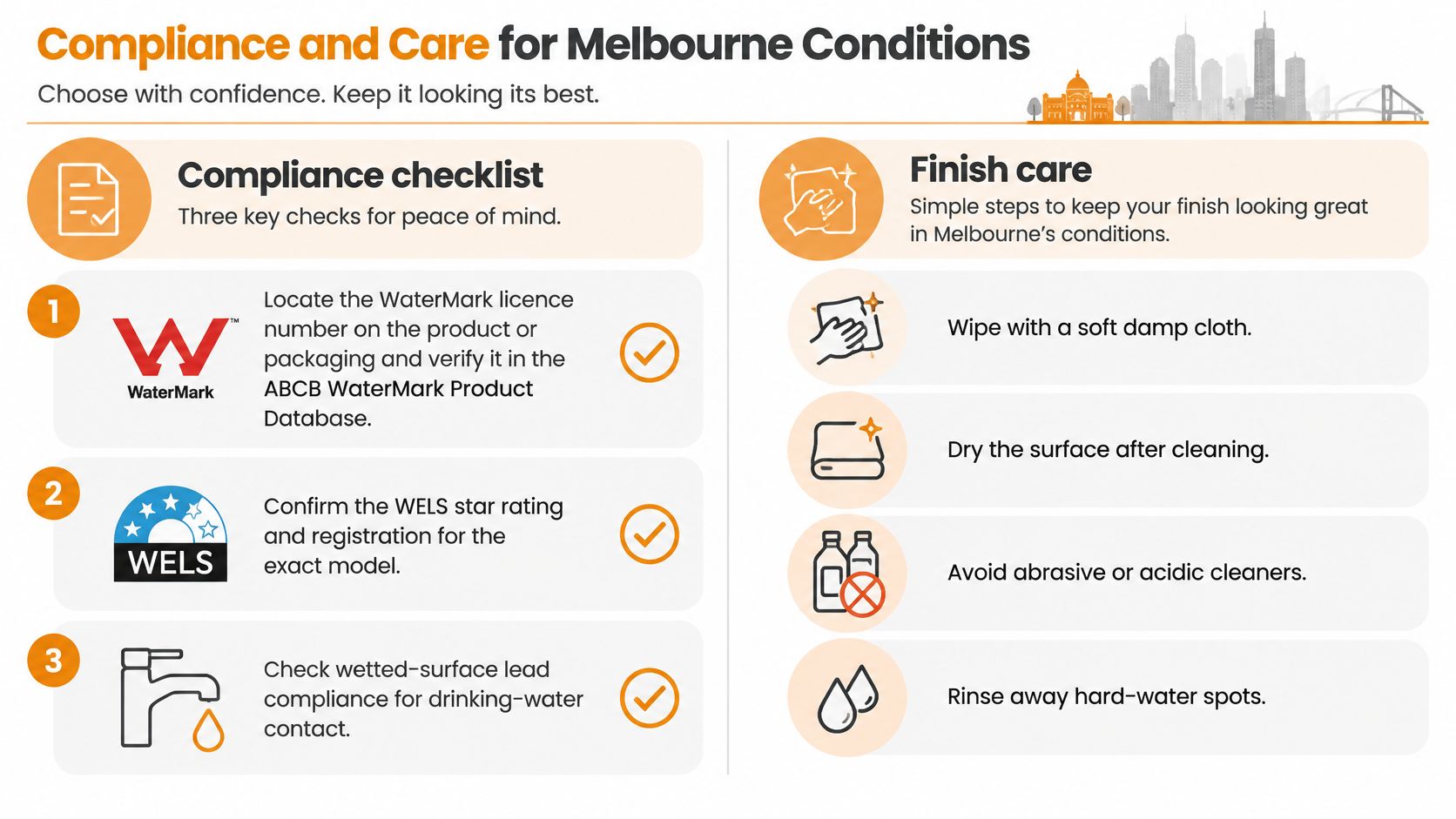
- Locate the WaterMark licence number. Find it on the product documentation or packaging, then verify the listing in the ABCB WaterMark Product Database. Don't accept a certification logo on a retailer's generic category page as the whole check.
- Match the supplied assembly. Confirm the model code, finish variant and cartridge assembly against the documentation. Ask for clarification if the carton, invoice and technical sheet use different identifiers.
- Record water performance. Australian buying guidance explains that WELS provides a star rating and litres-per-minute information at a standard pressure of 500 kPa, allowing regulated products to be compared on water use rather than appearance (Australian tapware buying guide). Record the actual model's rating and flow, rather than assuming every basin mixer in a range is identical.
- Confirm lead-free suitability for the scheduled installation. Obtain the relevant product declaration and have your licensed plumber confirm that the proposed assembly meets the applicable requirements. Don't assume discounted stock suits a new installation.
- Save the handover pack. Keep the invoice, model details, certification information, installation instructions, warranty and care sheet together.
Historical drinking-water guidance also distinguishes testing of water-contact products from the appearance of their external surfaces. The ABCB technical guidance on lead in plumbing products identifies AS/NZS 4020 as a principal standard for products used in contact with drinking water.
The practical checks and cleaning habits belong together in your project handover.
Respond to your water, not your postcode
Don't assume every Melbourne bathroom has the same water chemistry. Establish whether deposits form in your home and check the relevant water supplier's information before labelling the supply hard or soft. A white mark may also include soap or toothpaste residue, not just minerals.
Use a soft damp microfibre cloth, rinse away residue and dry the surface. Unless explicitly approved by the manufacturer, keep abrasive powders, scouring pads, strong acids, chlorine products and solvent cleaners away from the finish. Only test a cleaner on an inconspicuous area after confirming it's permitted.
Repeated aggressive spot-cleaning can change the sheen while the mixer remains mechanically functional. That's a surface-condition issue, but whether it's a warrantable defect requires assessment against the care instructions and warranty.
For broader material planning, Interiors by DeX's advice on moisture-resistant interiors in Chennai offers a useful parallel: consider wet exposure across adjoining materials, without treating another city's conditions as Melbourne water-quality evidence.
Before installation, photograph the finish and protect it during grout and silicone work. Specify locally obtainable cartridges, aerators, hoses and seals, and use this tapware selection guide when coordinating the wider fixture schedule.
Matching Tapware Size and Spout Style to Your Basin or Bath
The spout must deliver water into the bowl without sending it over the rim, and the handle must open without striking the mirror or splashback. Reach, outlet height and stream angle work together. A tall mixer isn't automatically a good match for a deep basin, nor is a compact mixer automatically right for a small one.
Don't order from a product photograph alone. Use the dimensioned drawings for the basin, mixer, benchtop and any splashback build-up.
Tapware sizing guide by fixture type
| Fixture type | Mounting style | Notes |
|---|---|---|
| Small cloakroom basin | Compact deck-mount or compatible wall-mount | Check the usable bowl area, rear ledge and hand clearance rather than relying on overall width |
| Standard vanity basin | Deck-mount or wall-mount | Position the outlet over the usable bowl and confirm full handle travel |
| Vessel / countertop basin | Tall deck-mount or wall-mount | A standard-height mixer may not clear the rim; check outlet elevation and reach together |
| Freestanding bath | Floor-mount bath filler or a suitable adjacent-wall arrangement | Coordinate pipework, bath position, rim height and access before closing the floor |
| Back-to-wall bath | Wall-mount bath set or a compatible deck-mounted arrangement | Confirm the spout clears the finished wall and bath rim without obstructing access |
| Wall-hung basin | Wall-mount mixer or a compatible basin-mounted mixer | Confirm basin fixing positions, concealed plumbing and service access before finishing the wall |
There's no defensible universal reach measurement for these categories. A bowl's slope, outlet angle and mounting position can change where the stream lands, even when the nominal basin size stays the same.
Avoid the expensive geometry mistakes
A standard-height mixer behind a vessel basin can leave too little space between the outlet and rim. Choosing a taller version solves clearance only if the spout also reaches far enough into the bowl. Otherwise, water lands on the rear slope and splashes towards the user.
A short-reach spout over a broad trough creates a different problem. The user must work close to the back wall, and the stream may hit an unfavourable part of the bowl. Trace the proposed stream path on a side-view drawing before approving the mixer.
Aim for a comfortable washing zone inside the bowl, not simply a spout positioned over the drain.
Measure from the proposed mounting centreline to that washing zone, then account for the outlet's stream angle. The drain is a useful reference point, but it isn't a universal minimum-reach rule.
For wall-mounted fittings, resolve the in-wall body depth before tiling. The plumber needs the finished wall face, including substrate, waterproofing where applicable, adhesive and tile, rather than just the framing line.
Use masking tape to mark the proposed outlet and handle positions on site. Open the vanity drawers, stand where you'll wash and check whether the fittings intrude into mirror, shelving or cleaning space.
Tile and Colour Pairings That Let Gunmetal Tapware Shine
Gunmetal works best when the tile gives its metallic surface something to contrast with. Matching every surface to the same charcoal value can make an expensive mixer disappear, while excessive gloss can introduce competing reflections.
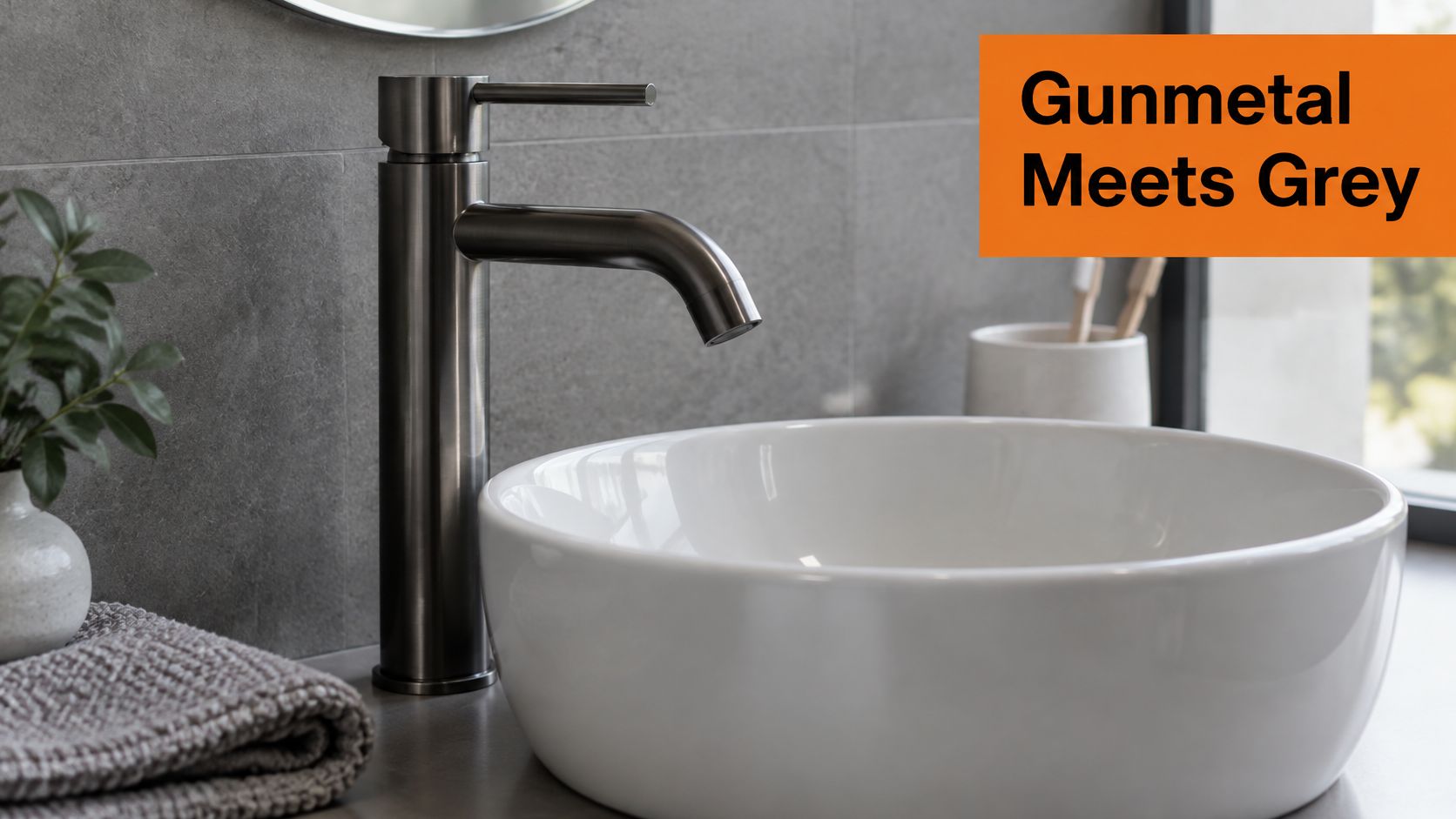
A restrained combination shows how the tapware can remain visible without dominating the room.
Tonal grey without a flat result
Pair gunmetal with mid-grey porcelain, then introduce a change of scale or texture rather than another strong colour. A quiet field tile and a kit-kat or herringbone feature can produce depth without making the vanity wall busy.
Choose grout close to the tile colour when you want the texture to remain subtle. Keep heavily textured surfaces away from the immediate splash zone if you don't want to clean residue from recesses around the mixer.
A tonal room still needs separation. A lighter basin, timber vanity or brighter wall surface helps the fittings remain legible.
Warm white with a darker anchor
Warm white and cream marble-look tiles give gunmetal a clearer outline. Calacatta- or Statuario-style porcelain can work well, but select the actual tile by its background colour and vein pattern, not the style name alone.
Lay the tapware sample over both the tile's background and its darkest vein. A brown-grey gunmetal finish may sit comfortably with warm veining, while a blue-grey finish can look disconnected beside a creamy background.
Use a restrained grout colour and softer wall sheen if you want the metallic fittings to supply the visual detail. The modern bathroom tile ideas guide can help compare broader arrangements before you settle on a feature wall.
This visual reference is useful for considering the relationship between fixtures, surfaces and lighting.
Dark backgrounds with deliberate separation
Against charcoal, black textured tile or richly patterned natural stone, gunmetal produces a layered metallic effect rather than the flat silhouette of matt black. Check that the chosen finish remains visible under the actual vanity lighting.
Contrasting grout can emphasise a mosaic, but it also introduces another pattern. Use it deliberately rather than assuming every dramatic bathroom needs a strong grid.
- Keep scale controlled. Hexagon, penny round and feather shapes can complement clean tapware lines, but don't combine every decorative format in the same sightline.
- Specify floor performance separately. Matt and lappato finishes are common residential bathroom choices, but a finish name alone isn't proof of suitability for the intended wet area.
- Compare physical samples. View tile, grout and metal together under daylight and the proposed artificial lighting.
For the floor decision, Trademaster Construction's guide to how to select bathroom floor tile is a useful companion to the palette exercise. Prioritise documented suitability and cleanability before deciding which surface looks best beside the mixer.
Misconceptions That Cost Renovators Time and Money
The expensive assumptions are usually small ones: that a colour will match across brands, that an attractive surface needs little care, or that a tap can be swapped without considering the concealed assembly. Challenge those assumptions before the order becomes difficult to change.
Appearance and durability myths
Gunmetal is just matt black with a different name.
Gunmetal has metallic reflection; matt black is intended to read as a flatter surface. Substituting one for the other changes how handles, spouts and shower fittings stand out against the wall. Say you select a black towel rail from a photograph beside a gunmetal mixer. Under vanity lighting, the mismatch may become more noticeable than it was on screen.
All gunmetal finishes are equally durable.
A finish description doesn't tell you how the coating was prepared, applied or supported. The useful question is what the supplier warrants for that exact product and which cleaning methods are excluded. Replacing damaged visible trim is inconvenient; discovering that compatible trim is no longer available can turn a cosmetic problem into a much larger plumbing job.
The practical consequence of both myths is the same: approve a physical finish sample and obtain model-specific documents, not just a colour name.
Maintenance and installation myths
Dark tapware hides water marks better than chrome.
Dark surfaces can disguise some handling marks while making pale deposits more obvious. The Austpek tapware trends guide provides a style-led starting point, but a finish choice still needs its own maintenance assessment. If you expect residue to remain between cleans, choose for that reality rather than relying on a showroom's spotless display.
I can install the tapware myself to save money.
Connecting regulated plumbing isn't the same as fitting a robe hook. The ABCB's guidance for buyers of new tapware reinforces the importance of suitable certified products and the plumbing compliance framework. Use a licensed plumber for connection to the water supply, and get the proposed fittings approved before walls or floors are closed.
Save money on avoidable rework, not on removing the person responsible for a compliant installation.
You can still prepare a useful specification yourself. Photograph existing connections, collect dimensioned drawings and nominate the desired outlet positions, then let the plumber resolve the connection and installation requirements.
Your Next Steps from Shortlist to Installation
Turn the decision into an order-ready schedule. Each fitting needs a model code, finish, mounting arrangement, required components and an agreed location. That's more useful to a plumber or builder than a folder of bathroom inspiration images.
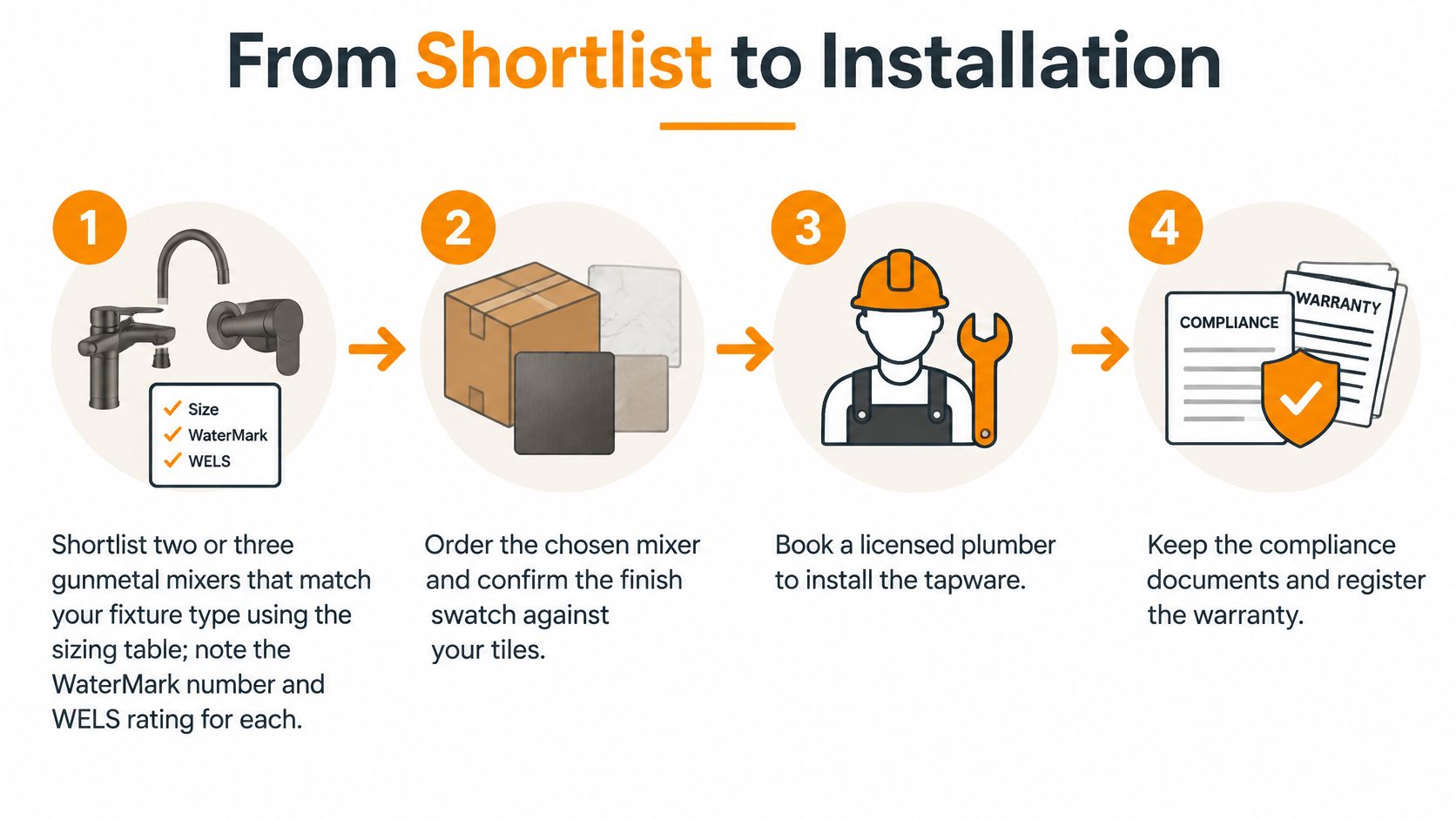
Work through the decisions in order
- Shortlist compatible assemblies. Compare mixers that suit the basin or bath geometry. Include any concealed body, trim, spout and waste needed to complete the installation, and record the certification and water-efficiency details.
- Resolve the surface palette. Compare a physical metal sample with tile and grout under the intended lighting. At Tiles Mate, we offer five samples for $15 and a free 15-minute design consultation available from home; our range includes tapware sets, sink mixers, wall mixers, spouts and taps, alongside oval, rectangle and round basins, back-to-wall and freestanding baths, showers, toilets and LED mirrors. Tile finishes include gloss, matt, honed and textured, while trade buyers can use TilesMate Pro for B2B pricing and personalised sourcing.
- Get the plumber's approval before ordering. Confirm the exact assembly, compliance documents, service access and installation sequence. Resolve concealed fittings before the tiler needs a finished-wall decision.
- Inspect deliveries before installation. Check model codes, colour consistency and visible surfaces. Keep protective packaging until the fittings are ready to install.
- Complete the handover. Store warranty information, care instructions and replacement-part identifiers somewhere the household can find them.
The installation sequence should remain simple enough to follow without relying on memory.
Keep local requirements local
If overseas renovation advice appears in your search, separate useful planning habits from jurisdiction-specific rules. Bear Valley Plumbing & Heating's discussion of bathroom remodel permits in Big Bear illustrates why approval questions belong early in a renovation, but it isn't Victorian regulatory guidance.
For help coordinating your selection, call 1300 680 580 or email sales@tilesmate.com.au with the basin drawing, proposed mixer and tile shortlist. Bring the dimensions as well as the inspiration images so the conversation can resolve fit, finish and installation details together.
Tiles Mate Pty Ltd offers bathroom tapware, tiles and coordinated fixtures to help you specify gunmetal as part of a complete bathroom, not an isolated colour choice. Visit Tiles Mate Pty Ltd to compare your options, arrange samples and book a design consultation before committing to the full order.