




Kitchen Sinks Melbourne: A Practical Buyer's Guide for 2026
by Shivam Tayal 25 Sep 2026 0 Comments
You are standing in a gutted Melbourne kitchen with the old sink on the lawn, the stone templater booked, and everyone suddenly asking the same question, which sink belongs in this room? That is the moment most reno regrets start. A sink is not the last cosmetic pick, it is the fixture that sets cabinet width, tap position, waste routing, and how the bench will be cut and sealed.
If you want a practical outside view on the planning side, the Five40 Remodeling Mesa kitchen guide is a useful reminder that a sink decision lives inside the whole kitchen sequence, not just the showroom sample.
Why Your Sink Choice Matters More Than You Think
A lot of homeowners treat kitchen sinks like a finish choice. In a Melbourne renovation, that is backwards. The sink sets the cabinet carcass, the tap position, the waste run, and the way the splashback finishes behind the mixer.
The sink locks in the room
Choose a deeper bowl, a second bowl, or a wide drainer, and you have already narrowed the cabinet and benchtop options before the stone is ordered. Put the waste on the wrong side, and the plumber ends up fighting the dishwasher line. Set the tap in the wrong spot, and the handle hits the window reveal or the tiled splashback.
Practical rule: pick the sink for the way you cook and clean, not for the way it looks in a catalogue.
That is why the sink belongs in the first round of decisions. A good showroom can show you finishes, but the real fit comes down to the rough-in, the waste, the bowl depth, and whether your benchtop and wall lines are square.
Usability beats showroom gloss
Homeowners want a sink that feels calm to live with. That means enough bowl depth to hide the mess, enough landing space to stage dishes, and enough clearance under the bench so the cabinetmaker and plumber are not improvising on install day.
The Five40 Remodeling Mesa kitchen guide makes the same point from a planning angle. A sink can look right and still fail if it forces awkward plumbing or steals usable bench space.
Choosing the Right Sink Material for the Way You Cook
Material choice is where people waste money fastest. Don't buy on finish alone. Buy on how hard the kitchen gets used, what the benchtop is made from, and how much maintenance you'll tolerate every week.
Stainless steel, the safe default
Stainless steel is the right call for rental properties, budget renovations, and laminate benchtops. It's easy to live with, easy to replace, and it doesn't need the same visual harmony that a heritage material does. The trade-off is obvious, it scratches, and it can sound a bit tinny when water or cookware hits the bowl.
Use it when you want straightforward function and you're not trying to make the sink the hero piece. Skip it if you're chasing a warm, furniture-like look in a period home, because it can feel too plain against detailed cabinetry.
Granite composite, the hard-working middle ground
Granite composite suits family kitchens and stone benchtops because it reads as solid, quiet, and more finished than plain steel. It's a strong choice if you cook often and want the sink to disappear visually into the room. The caution is simple, drop a cast-iron pot and you may chip it.
Use it in a busy home where durability matters and the sink gets used all day. Don't use it if the household is rough on cookware or you're looking for a zero-worry surface.
Fireclay and copper, when style really matters
Fireclay is the right choice for heritage Victorian homes, shaker cabinetry, and a more classic apron-front look. It needs the right cabinet support and a proper waste choice, so don't force it into a tiny carcass. Copper belongs in period restorations and statement laundries, but you need to accept patina, surface reaction to acids, and a finish that changes with use.
For buyers sanity-checking quotes around Truganina, Moorabbin, or Scoresby, treat the material price as only part of the job. The install, cutout, clip system, and plumbing usually matter more than the sticker on the bowl.
| Kitchen Sink Materials Compared | Best For | Watch Out For | Price Band (AUD) |
|---|---|---|---|
| Stainless steel | Rentals, budget renos, laminate benchtops | Scratching, noise | Low to mid |
| Granite composite | Family kitchens, stone benchtops | Chipping from heavy impact | Mid |
| Fireclay | Heritage homes, shaker cabinetry | Cabinet size, support, waste selection | Mid to high |
| Copper | Period restorations, statement laundry rooms | Patina, acid reaction, maintenance | High |
Undermount, Topmount, or Flush
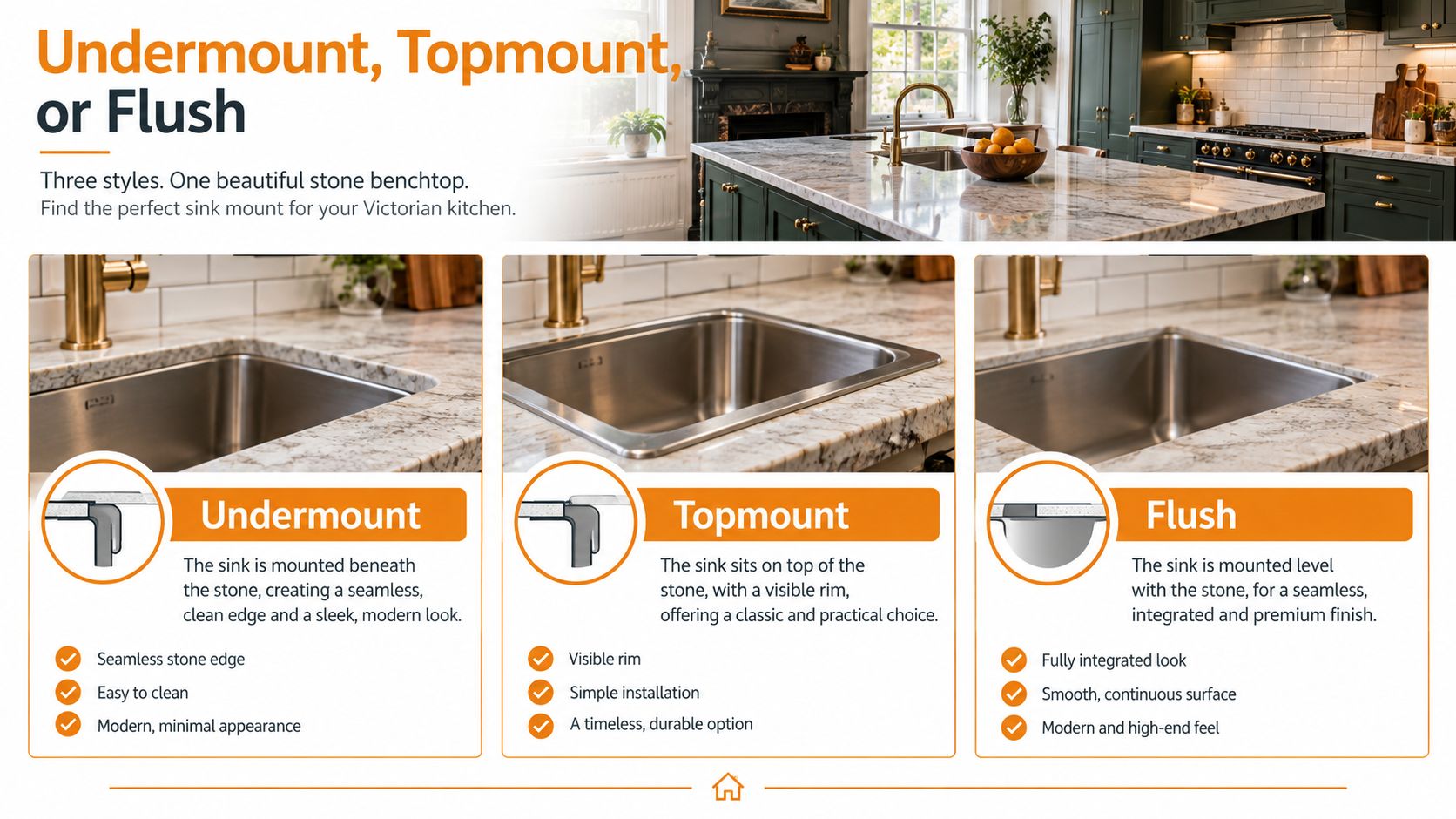
The mounting style changes how the sink works day to day. It affects cleaning, the stone cut, the install tolerance, and how much grief you get if the cabinetry or walls are slightly out.
Undermount is the cleanest daily use option
Undermount is the best pick if you want easy wipe-downs and a clean bench line. Crumbs and spills go straight into the bowl, which is why it suits engineered stone and Caesarstone-style tops so well. The trade-off is the exposed cut edge, plus higher stone labour when the cutout and finish need to be done properly.
Use it on a proper renovation with stone benchtops and a decent cabinet run. Skip it on cheap laminate or a rushed job.
Topmount is the tradie's friend
Topmount, or drop-in, is cheaper and far more forgiving. It suits laminate and timber, and it handles cabinets that are a bit out of square without turning the install into a problem. In an older Melbourne place with uneven walls or a tired carcass, it is the safer call.
Flush mount is premium, but unforgiving
Flush mount sits level with the stone and looks sharp when the templating is right. It needs precise cutting and careful waterproofing, because mistakes are hard to hide once the slab is cut. Choose it only if the stonemason is confident, the cabinetry is square, and the splashback line is already sorted.
If the wall is wonky, the sink will not fix it. The stone installer will show you the problem on install day.
For tile and edge detail planning, the kitchen tiling design guide is a useful reference point for how the sink zone should finish against the rest of the wall.
Sizing Your Sink to Your Benchtop and Cabinet
Read the spec sheet like a tradie, not like a brochure. The first thing to check is cabinet width, because the bowl might fit the bench cutout and still fail under the carcass once the waste, clips, and tap gear are accounted for.
Measure the space that matters
Start with the internal cabinet width, then check the cutout size, not just the overall sink size. A 600mm cabinet is tight and forces compromises. Step up to a 700mm or 800mm base and you open the door to wider single bowls and less awkward plumbing.
Practical rule: always measure the cabinet from inside face to inside face, then check whether the waste outlet lands clear of drawers, braces, and the dishwasher line.
You also need to check the benchtop depth. The bowl can't steal the full front-to-back run once you allow for the front lip, back edge, tap landing, and any overhang. If you're adding a waste disposal unit, measure that housing too, because it changes what can sit underneath without conflict.
Don't ignore tap and drainer landings
A sink with a big flange or wide rim eats into usable bench space fast. So does a tap hole too close to the bowl, especially if you want a pull-down mixer with real reach. The drainer also has to sit comfortably inside the bench depth, otherwise water runs where it shouldn't and the join starts working against you.
| Sink Type | Min Cabinet Width | Typical Cutout (mm) | Recommended Benchtop Depth |
|---|---|---|---|
| Single bowl | 600mm to 700mm | Varies by model | 600mm or more |
| 1.5 bowl | 700mm to 800mm | Varies by model | 600mm or more |
| Double bowl | 800mm or more | Varies by model | 600mm or more |
| 1.75 bowl | 800mm or more | Varies by model | 600mm or more |
Matching Bowls and Configurations to Real Kitchens
A double bowl can look neat on paper and feel cramped in daily use. It splits the work zone, and that becomes obvious the first time you try to wash a roasting tray or a baking tin.
Single bowls suit the way many homes actually cook
A single bowl is the right call for apartments, narrow terraces, and anyone who regularly washes large pots by hand. You get one clear working zone, which matters in a tight kitchen or when the bench space is already under pressure. If you roast, bake, or batch cook, a wide single bowl usually beats a split layout that looks smarter than it works.
1.5 bowls are the compromise we see in 700 to 800mm family kitchens
A 1.5 bowl gives you a prep area without giving up a place to soak cookware. In a family kitchen, it works well when one person is washing while another is rinsing or prepping. The trade-off is simple, the smaller side can feel useful, but the main bowl still has to do most of the heavy lifting.
Double bowls suit specific habits, not every home
A double bowl makes sense only if your routine really depends on separating wash and rinse tasks. That can work in a busy family kitchen, but it cuts the usable depth of each side. In a compact Melbourne kitchen, that trade-off usually costs more than it gives back.
For island layouts, the island sink placement ideas are worth checking if you are deciding whether the sink should sit central, offset, or alongside the dishwasher.
For adjacent finishes, kitchen tiling design matters because the bowl position changes where splash and grout lines end up.
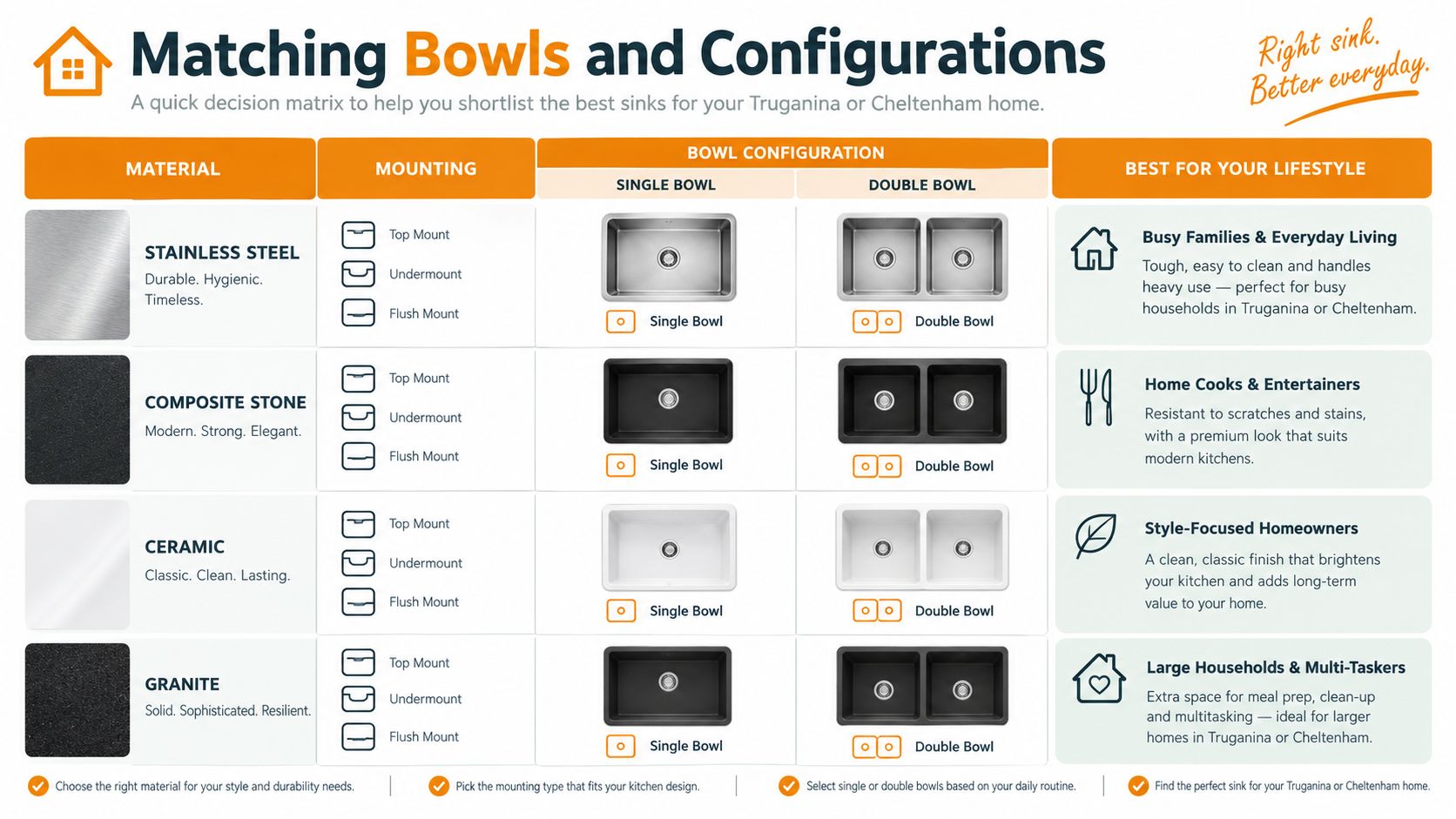
If you cook every day, choose usability first. If you entertain more than you prep, symmetry starts to matter a bit more.
Tapware, WELS Ratings, and Drainage That Actually Work
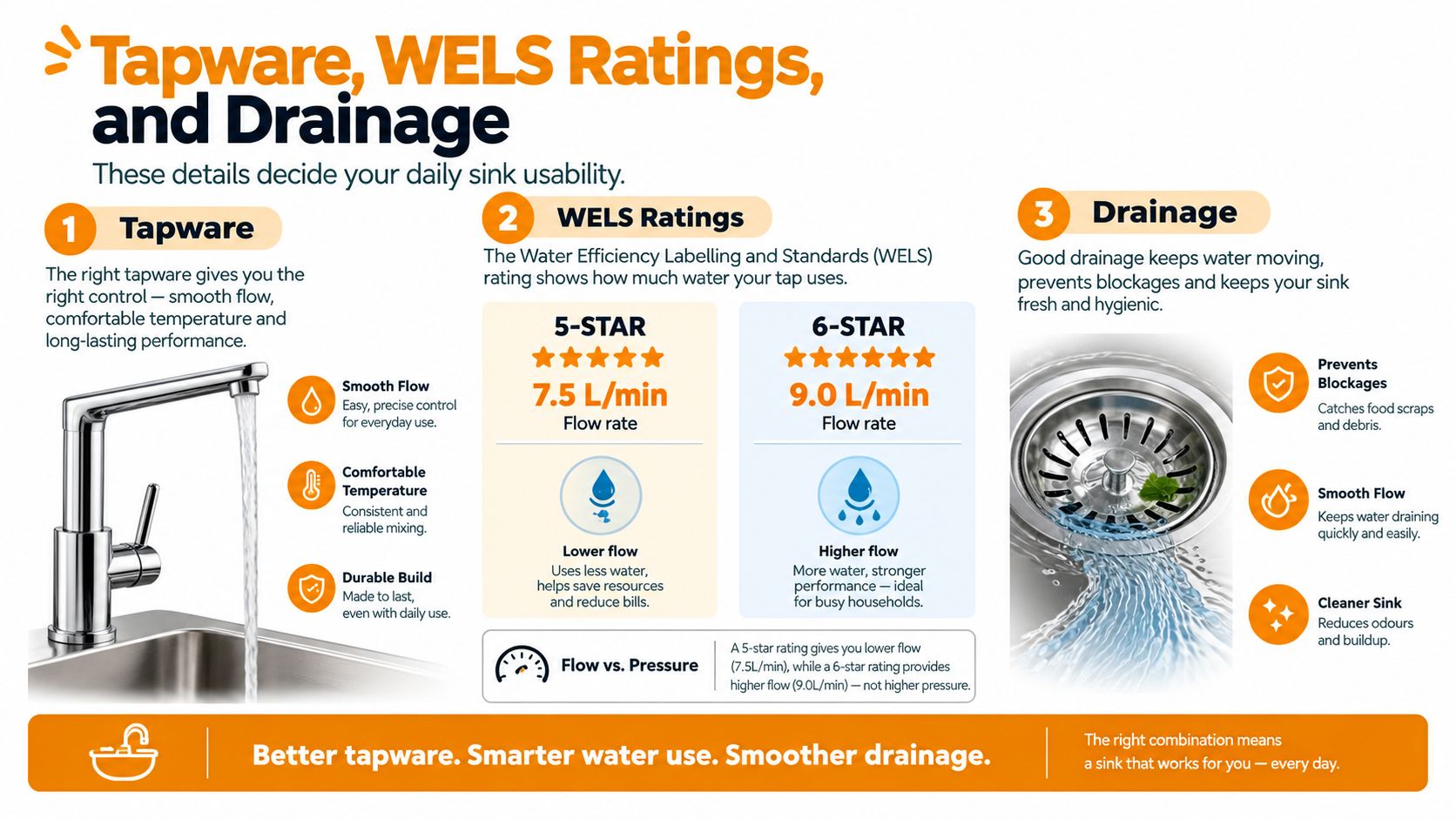
Tapware is where a good sink turns into a good kitchen. A shallow mixer with poor reach makes every job harder, even if the bowl itself is excellent.
Flow matters more than the badge on the box
In Australia, new kitchen tapware has to meet water-efficiency rules. Internal cold-water and single-mixer taps over kitchen sinks must stay within a maximum flow rate of 9 litres per minute, and new homes generally need at least 3-star WELS-rated tapware for kitchen sinks, which is why the tap choice has a bigger effect on daily use than bowl size alone (water-efficiency standards for kitchen tapware). The practical point is simple, a tap can be efficient and still feel weak if the spout height and spray pattern are poor.
Drainage needs to be planned, not guessed
Australian plumbing drainage sizing treats a kitchen sink as a heavier-load fixture than a bathroom basin. A single or double sink is assigned 3 fixture units, equivalent to about 11.36 L/min (0.19 L/s), and a kitchen sink can vary from 0.5 L/s to 1.3 L/s depending on system design (ABCB sanitary plumbing and drainage sizing report). That's why waste lines, traps, and dishwasher connections need proper sizing and proper installation, not a guess from a cabinet drawing.
Use tapware selection guidance to compare spout reach and mixer styles before you commit, because the sink and tap need to work as a pair.
Sourcing, Delivery, and Installation in Melbourne
The easiest mistake is buying the sink too late. In Melbourne, the sink should be ordered before final stone templating, not after, because the cutout and waste position need to be fixed before the slab is cut.
Know where to buy and when to book trades
Trade suppliers in Truganina and Brooklyn are usually the fastest path if your plumber or builder already has an account. Retail showrooms in Moorabbin and Richmond are better when you want to see finish and bowl shape in person. Online stores can work too, but only if you're certain about dimensions and lead time.
Delivery changes with the address
Inner-city terraces often need tail-lift access and a crew that can carry the sink carefully through a narrow entry. Apartments are more likely to be kerbside-only, which means someone has to be there to take possession. Stocked sinks can move quickly, while imported fireclay often sits on a much slower ordering cycle, so don't lock your install date until the sink is in hand.
Use the plumber at the right time
Any work that alters the drainage or water connection needs a licensed plumber under Victorian practice, so don't leave that call until the benchtop is already on site. If you're also lining up tile work, the professional tiling services guide helps you sequence wall finishes so the sink, splashback, and plumbing all land together.

Order the sink early, confirm the template with the stonemason, and get the plumber booked before anyone starts cutting stone.
For plumbing coordination, the kitchen plumbing services page from Good Boy Plumbing is a useful reference if you want a sense of how the rough-in should be handled around the sink, waste, and tap.
Your Pre-Purchase Checklist Before You Commit
Walk into the showroom with measurements, not hope. If you can't answer the basic fit questions, you're not ready to pay a deposit.
Check these before you sign
- Cabinet width: confirm the internal width, not the brochure width.
- Cutout tolerance: ask how much room the sink needs beyond the nominal size.
- Benchtop depth: make sure the bowl, flange, and tap land cleanly.
- Bowl configuration: single, 1.5, double, or 1.75, choose for use, not symmetry.
- Tap holes: confirm the count and position before ordering the mixer.
- Waste kit: check the outlet size and whether it matches the plumber's plan.
- WELS tapware: make sure the tap matches the water-efficiency target for the build.
- Clips and template: confirm the sink comes with the fixing hardware and any cutout guide.
- Spare parts: ask how replacement clips, wastes, or accessories are handled later.
- Warranty pathway: if you're buying granite composite, ask who handles pitting or finish issues.
A smart buyer also checks stock depth, because the quote doesn't matter if the model is out of stock for weeks. Add the tap, basket waste, plumbing rough-in, and second-trade callout before you compare prices. If the first number you see is the deposit, you're already looking at it wrong.
Tiles Mate Pty Ltd helps Melbourne renovators choose finishes that actually suit the room, not just the sample board. If you're comparing kitchen materials, splashback details, or the flooring around a new sink zone, visit Tiles Mate Pty Ltd and get practical guidance before you commit.