


LED Mirror with Demister: Buyer's Guide for Melbourne
by Shivam Tayal 26 Oct 2026 0 Comments
At 7 am in a Melbourne bathroom, the shower's stopped but the mirror is still clouded. You wipe a clear patch with your hand, only for it to fog again while you're trying to shave or get ready. An LED mirror with a demister can make that routine easier, but it works best when you choose it for the room's layout and ventilation, not just its list of features.
What an LED Mirror With Demister Actually Does
A mirror like this combines three things. LED lights, set around the edge or behind the glass, illuminate the face and vanity. A thin demister heating pad bonded behind the mirror warms a section of the glass. A control, such as a touch switch, wall switch or sensor, lets you turn the lighting and heating functions on and off.
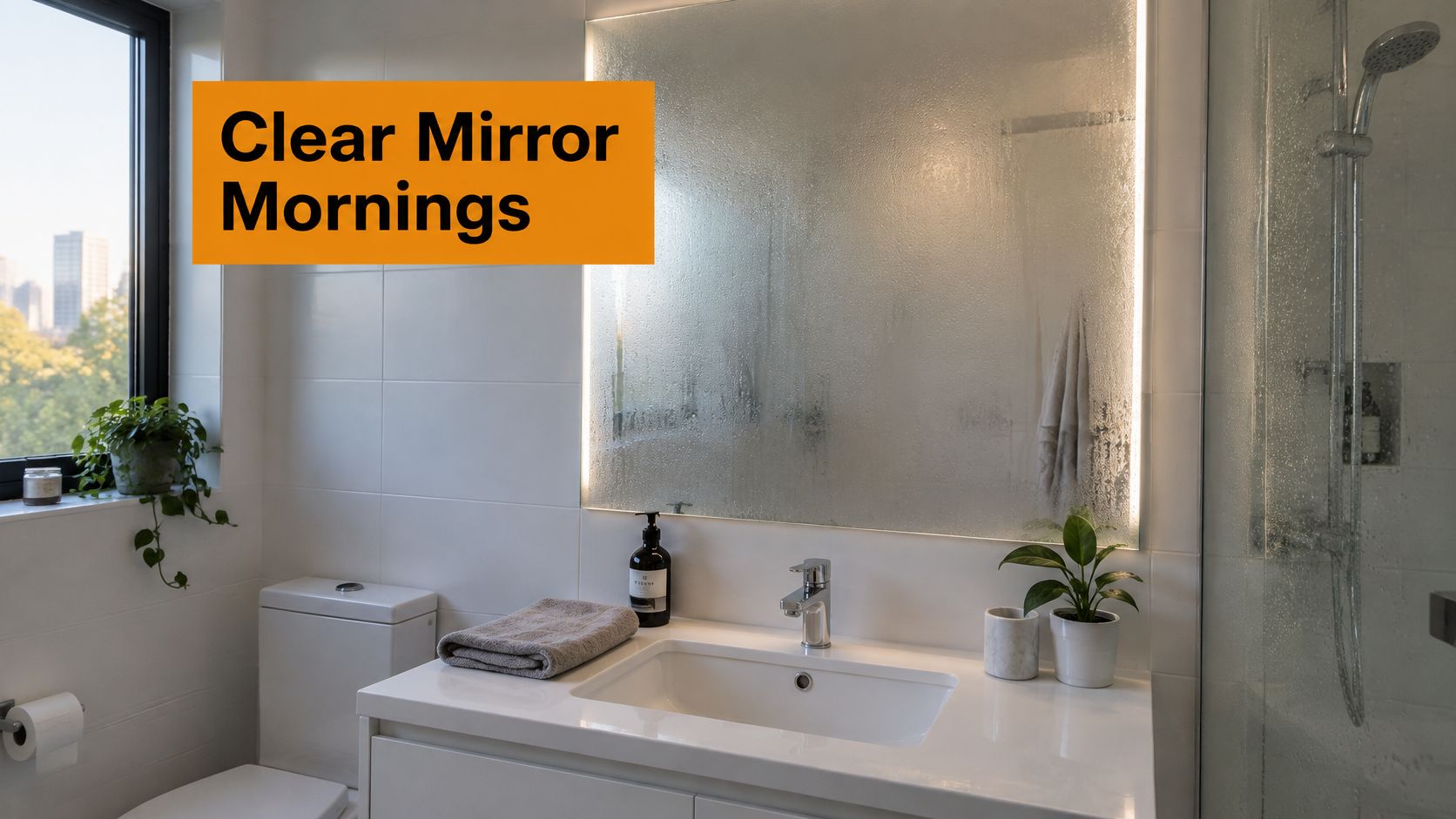
Think of the demister like a car's heated rear window. It warms the glass that needs to stay clear, rather than heating the entire cabin. In the bathroom, the pad warms the mirror surface so condensation is less likely to form there. It won't turn the room into a sauna, and it won't remove steam from the air.
The LED lighting can help with close-up tasks. Light from around the mirror can reduce the shadows an overhead fitting casts under the brow and chin, making it easier to see your face while shaving or applying makeup. When the glass stays clear, you can use that light without stopping to wipe away condensation.
LEDs also use less energy than older halogen lighting. Australian government guidance says lighting typically accounts for around 5%–10% of an average household's electricity budget, while LEDs use about 75% less energy than halogen lamps and last approximately 5–10 times longer, according to Australian government household lighting guidance. These figures describe LED lighting generally, not a particular mirror. The actual cost depends on its wattage, how long you use it, its controls and whether the demister runs at the same time.
The limit to remember: A demister helps keep the glass clear. It doesn't dry the bathroom or replace an exhaust fan.
Before comparing products, decide which benefit matters most in your bathroom: useful face lighting, a clearer mirror after showers, or both.
Key Specs to Check Before You Buy
Start by comparing the details that affect the mirror's fit, safety and everyday use. A specification table makes it easier to spot differences beyond appearance.
| Spec | Typical range | What to choose for a bathroom |
|---|---|---|
| IP rating | IP44 is typical for bathroom mirrors | Confirm zone suitability with an electrician, not the label alone |
| Supply and wiring | 220–240 V, fixed wiring | Hardwired by a licensed electrician; avoid plug-in use in wet areas |
| Demister output | About 150 W/m² of pad area | Match the rating to the mirror size and cover the viewing area |
| Colour temperature | 3000–6500 K | Choose warm light for a softer feel or neutral to daylight tones for grooming |
| Colour rendering (CRI) | 80 minimum; 90 or above premium | Choose 90 or above for accurate makeup and skin tones |
| Dimming | Stepless dimming or none | Use a dimmer rated for the LED driver |
| Sensor type | Touch, motion or wave | Touch for simple operation; motion or wave for hands-free use |
| Fog-free area | Pad size from narrow to full width | Choose a full-width pad covering the viewing zone, not just the centre |
Read the rating in context
An IP44 rating is a useful specification to look for, but it doesn't confirm that a mirror can go in any position in the bathroom. The shower or bath location, the proposed mounting point and the product's installation instructions all matter. Get an electrician to assess the position before you order.
For the same reason, don't treat a mirror's 220–240 V supply as permission to connect it yourself. Check whether it requires fixed wiring and have a licensed electrician handle the installation. A plug connection isn't a shortcut around wet-area requirements.
Match light and heating to your routine
Colour temperature describes whether the light looks warm or cool. 3000 K gives a warmer feel, 4000 K is a neutral everyday option, and 5000–6500 K gives a daylight-like appearance that some people prefer for detailed makeup. If skin-tone accuracy matters, check the colour rendering index too. A CRI of 90 or above is a useful target for grooming.
A demister rating is meaningful only alongside its pad dimensions. Check that the heated zone covers the part of the mirror where you'll look. For lighting controls, confirm that any dimmer is compatible with the mirror's LED driver. Choose touch controls for straightforward operation, or a motion or wave sensor if you want hands-free switching.
If two mirrors look similar, compare these first: zone suitability, pad coverage and colour temperature. They'll tell you more about whether the mirror will work in your room than a long list of optional features.
How Demister Pads Work and What They Cost to Run
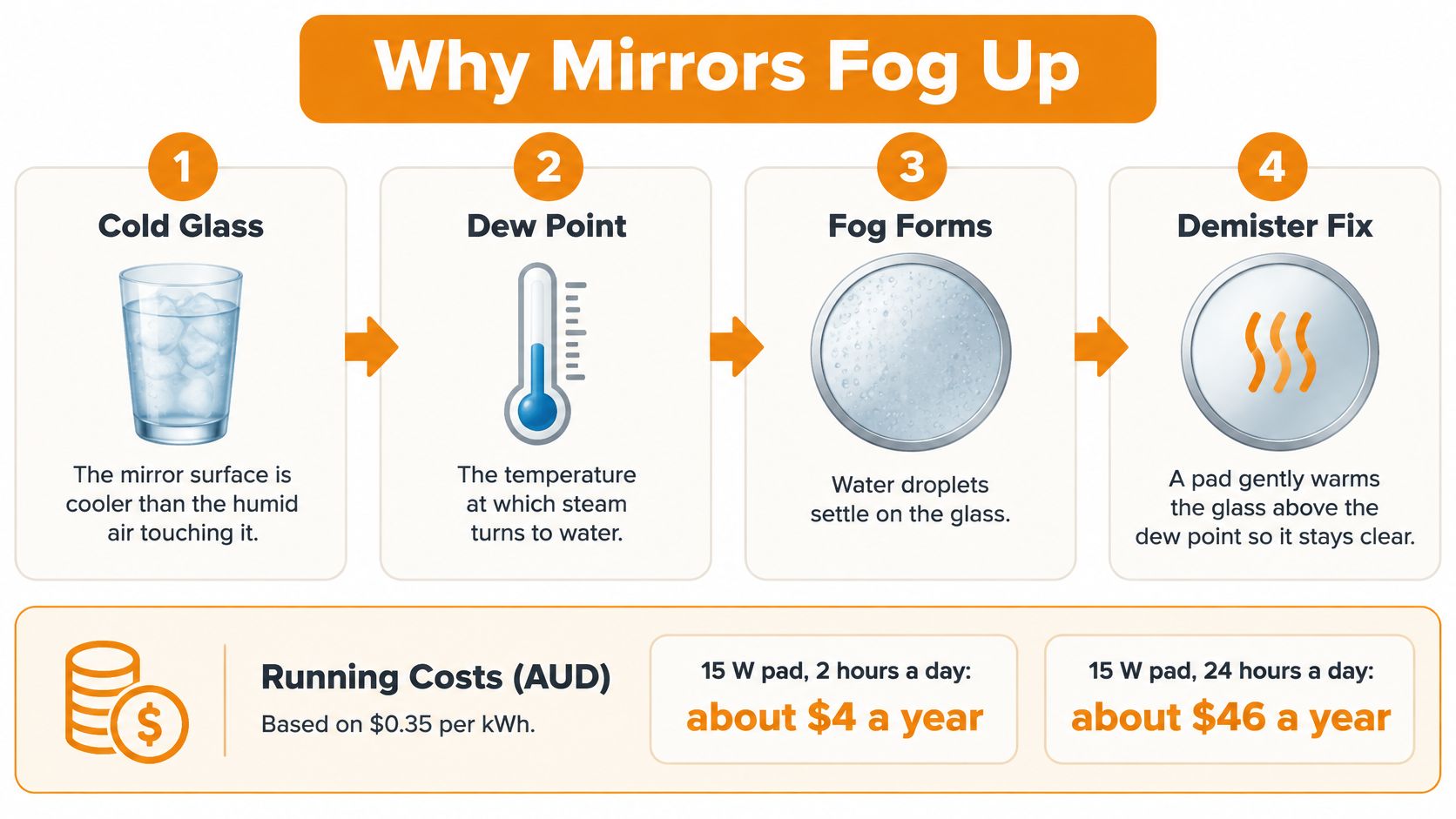
An iced drink gives a simple example of condensation. Water appears on the outside because the glass is colder than the humid air touching it. In a bathroom, steam meets a cool mirror instead. The dew point is the temperature at which water vapour in the air turns into liquid water on a surface.
A demister pad behind the mirror warms the glass locally, helping keep it above the dew point. It doesn't heat the bathroom. Think of the process in five stages:
- Shower steam raises the humidity in the bathroom.
- Humid air meets the cooler mirror.
- The pad warms the glass from behind.
- The warmer surface reduces condensation forming on it.
- The mirror stays clearer while the pad is operating.
The exact pad size matters. Published 240 V examples in an Australian demister range provide a practical benchmark of about 150 W/m². The demister pad specifications and power examples include pads ranging from 36 W to 108 W.
| Pad size | Rated power | Energy per 30-minute run |
|---|---|---|
| 600 × 400 mm | 36 W | 0.018 kWh |
| 600 × 600 mm | 54 W | 0.027 kWh |
| 600 × 800 mm | 75 W | 0.0375 kWh |
| 600 × 1200 mm | 108 W | 0.054 kWh |
A 600 × 800 mm, 75 W pad running for 30 minutes a day over 30 days uses about 1.1 kWh. That's energy used by the demister alone; the LED lighting has its own consumption. Your actual use will change with the model and how long you run it.
Switch the pad on before the shower or as you start it, rather than waiting until the glass is already fogged. A separate switch or timer can make it easier to control how long the pad runs. Pair it with the exhaust fan where possible, especially in a room that holds steam. A demister is a condensation-control tool, not a replacement for bathroom ventilation.
For a visual explanation of condensation and demister operation, watch this overview:
Sizing and Styling a Mirror for Your Bathroom
Match the mirror width to the vanity, not the full wall. A mirror that's much wider than the basin can look out of scale, while one that's too narrow may leave the grooming area feeling cramped.
- 600 mm vanity: Choose a mirror around 450–600 mm wide.
- 750 mm vanity: A 600–750 mm mirror usually fits the basin zone.
- 900 mm vanity: Consider a 750–900 mm mirror.
- 1200 mm double vanity: Use one wide mirror around 1000–1200 mm, or position two separate mirrors over the basins.
Set the mirror centre around 1500–1600 mm from the floor as a starting point, then adjust for the tallest regular user. Check that the position works for everyone who uses the basin, and that the light won't be blocked by a cabinet door or nearby fitting.
The shape affects how the mirror sits in the room. An arch softens a space with straight tile lines. A pill shape can suit a narrow wall or small powder room, while a rectangular mirror works well in a minimal layout. If you need storage, consider a shaving cabinet rather than a plain wall mirror. For more on choosing a mirror for your space, see this guide to bathroom mirror styles and selection.
Size the demister pad to the mirror's viewing area. A pad that's too large for a small mirror uses more power than needed; one that's too small can leave the sides fogged. When checking how high and where to mount the mirror, this practical guide can help you avoid common bathroom mirror installation mistakes.
In a compact Melbourne bathroom, the basin may sit close to the shower screen. Measure that position before fixing the vanity, because the mirror's final location affects the electrical assessment. A useful price reference is that Blue Leaf Bathware & Tiles listed a Remer Arch 500 mm LED mirror with demister at AU$599 in 2026, according to its Remer bathroom mirror listing. Use it as a specific comparison point, not a guide to every model's price.
Wiring, Wet Zones and Specifying for Victorian Projects
Two bathrooms can take the same mirror, yet only one may be allowed to keep it. The deciding factor is where the mirror sits relative to the bath or shower, because the electrician assesses the position before approving the product. In plain language, distance from the water matters as much as the product label.
AS/NZS 3000:2018 divides bathroom areas into electrical zones, which work like concentric rings around the water source. Zone 0, inside a bath or shower, requires equipment rated for immersion. Zones 1 and 2 sit around those areas and call for suitable splash protection, while ordinary switches and outlets are restricted. The exact boundaries and permitted equipment depend on the room's layout and installation, so a general rule of thumb cannot approve a particular mirror position.
Confirm the electrical details
Many illuminated demister mirrors use a 220–240 V supply, fixed wiring, earthing and a means of disconnection. Circuit protection is not a guess for the installer: the electrician must confirm the RCD protection the circuit requires under AS/NZS 3000, which sets requirements for the design, selection, installation and verification of electrical equipment in installations. Have a licensed electrician install and test the mirror. A plug-in unit or a DIY adaptation is not equivalent to a compliant fixed installation.
An IP44 rating means the unit is protected against solid objects over 1 mm and water splashes. That rating alone does not establish that the mirror suits a specific bathroom zone. The electrician weighs the shower or bath position, the mounting location, the wiring method and the circuit protection together before signing off.
Use a trade-ready checklist
Before ordering, collect the product documents and check the details that affect fitting and future maintenance:
- Electrical specification: Confirm the supply, fixed-wiring requirements, earthing and means of isolation.
- Zone suitability: Give the electrician the mirror's IP rating and proposed position.
- Demister sizing: Check the pad's wattage and dimensions against the specification sheet.
- Installation instructions: Confirm cable entry, pad coverage, mounting requirements and access to the driver for servicing.
- Warranty and parts: Ask how the warranty applies to the LED, driver and demister, and whether spare parts are available.
- Project pricing: For multi-unit work, check whether trade pricing applies.
Get the documents first, reserve the cable route and isolation point, and order the mirror before waterproofing and tiling are finalised. Coordinate the electrical rough-in with the wet-area programme; this overview can help you explore waterproofing for bathroom renovations. For broader sequencing, use this guide to plan a bathroom renovation. Then book a licensed electrician for connection and testing.
Keep the mirror's model number and electrical specification on the project file. That gives the next electrician clear information if the unit needs repair or replacement.
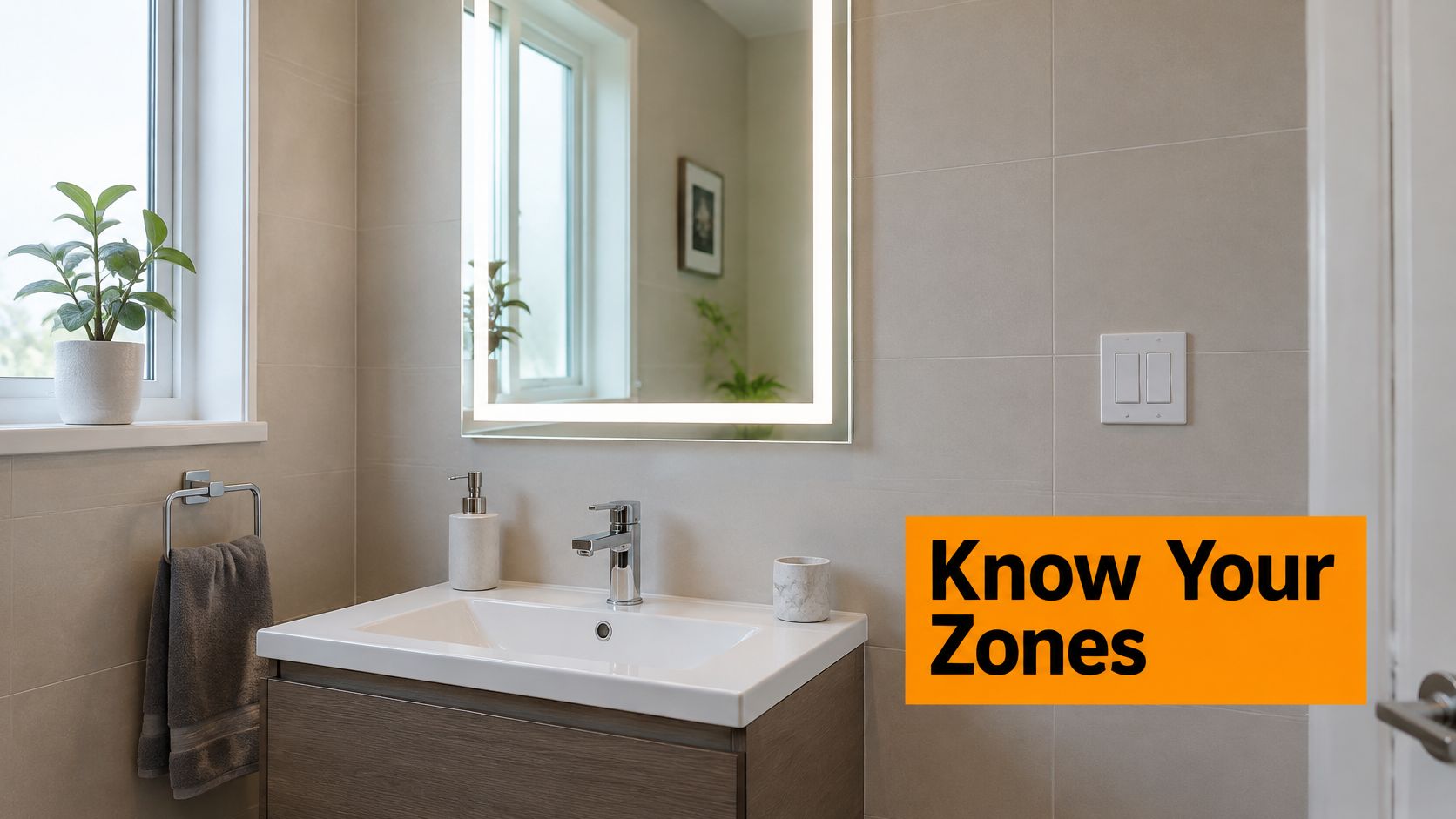
Ventilation, Cleaning and Fixing Common Faults
A demister warms the mirror glass. It does not remove moisture from the air, so the exhaust fan still does the heavy lifting. Bathrooms without an openable external window usually need mechanical exhaust ventilation, and even rooms with windows benefit from extraction because lingering humidity feeds mould and moisture damage.
Run a simple routine: switch the demister on before the shower, run the exhaust fan during the shower and for a stretch afterwards, then turn the pad off. The fan clears humid air while the pad keeps condensation off the glass. Each one covers a job the other cannot.
Clean the glass with a glass cleaner and a soft cloth. Spray the cloth rather than the mirror edges so liquid cannot creep into the silver backing, and skip abrasive pads that scratch the finish. If damp patches keep appearing on nearby walls, this wall mold guidance for Connecticut homeowners covers general surface cleaning, though recurring damp in a bathroom usually points back to ventilation.
| Symptom | Likely cause | Fix |
|---|---|---|
| Fogging at the edges | Pad smaller than the mirror, or fan not running | Run the fan and switch the pad on earlier; check that the pad covers the viewing area |
| Pad does not heat | Tripped RCD, timer off or switch off | Reset the RCD and check the timer; call a licensed electrician if it trips again |
| Patchy or cold spots | Damaged pad or moisture behind the glass | Stop using the mirror and have an electrician inspect it |
| LED flickers or dims unevenly | Incompatible dimmer or failing driver | Use a dimmer rated for LED; have an electrician replace the driver |
| Sensor does not respond | Dirty sensor, wrong distance or low sensitivity | Wipe the sensor, adjust sensitivity and check the mounting height |
| Dark spots in the silver | Moisture through a failed edge seal | Replace the mirror; the seal can't be repaired reliably |
Stop using the mirror if you see exposed wiring, smell burning or feel heat at the edges. Leave the unit sealed and call a licensed electrician.
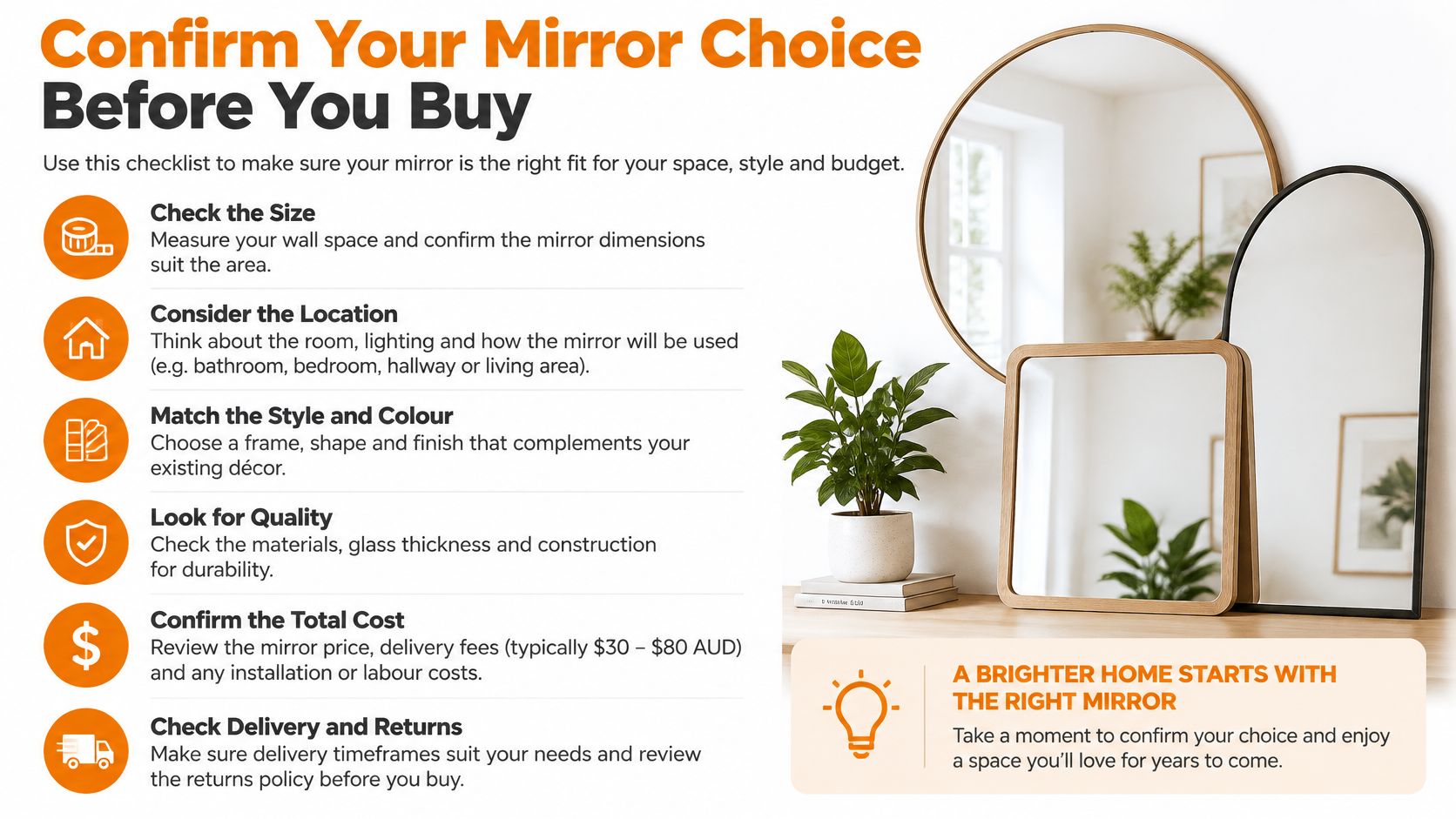
Confirm Your Mirror Choice Before You Buy
Run through this checklist before paying. It puts placement and compliance ahead of styling extras.
- Measure the proposed mirror position from the shower or bath edge and identify the electrical zone.
- Confirm that the IP rating and mounting instructions suit that position.
- Match the demister pad's size to the mirror's width and height.
- Choose a colour temperature and CRI that suit daily use.
- Check that the dimmer and sensor work with the driver and suit the people using the mirror.
- Book a licensed electrician and reserve the cable route before tiling.
- Confirm that the exhaust fan can run during and after showers.
An IP44 label alone doesn't prove a mirror suits every position. An IP44 mirror may be suitable at a vanity but still be unsuitable closer to a shower screen, depending on the zone and installation details. The Australian demister mirror installation guidance reinforces why the electrician needs the exact room layout, product instructions and electrical details before assessing the installation.
If you're comparing designs, Tiles Mate lists arch, pill and rectangular LED mirror shapes, along with shaving cabinets and wall mirrors. As a Melbourne tile store, Tiles Mate provides personalised advice from inspiration to installation. Bring your measured mirror position and vanity width when you compare bathroom cabinet options, so the storage, mirror and basin layout work together.
Write down the mirror measurements and proposed zone, then compare two mirrors against the checklist before ordering.
Tiles Mate Pty Ltd offers LED mirrors alongside tiles and bathroom fittings, with personalised guidance from initial inspiration to final installation. Bring your vanity width and measured mirror position, then visit Tiles Mate Pty Ltd to explore options for your Melbourne bathroom project.