




Subway Tiles: A Complete Guide for Melbourne Homes
by Shivam Tayal 14 Oct 2026 0 Comments
You're standing in a showroom with three sample boards in your hands, trying to work out why one white tile looks crisp, one looks cold, and one seems to vanish under the lights. That's the subway tile decision in Melbourne. It isn't just about colour, it's about how the tile behaves in a kitchen splashback, a bathroom, a laundry, or a wet area that has to survive steam, cleaning, and daily wear.
Why Subway Tiles Keep Coming Back in Melbourne Renovations
The reason subway tiles keep showing up in Melbourne projects is simple. They're practical, they suit a lot of homes, and they don't fight with the rest of the room. In a terrace, a villa unit, or a new build in the west, they can look quiet and tidy on day one, then still make sense when the tapware, cabinetry, or paint changes later.
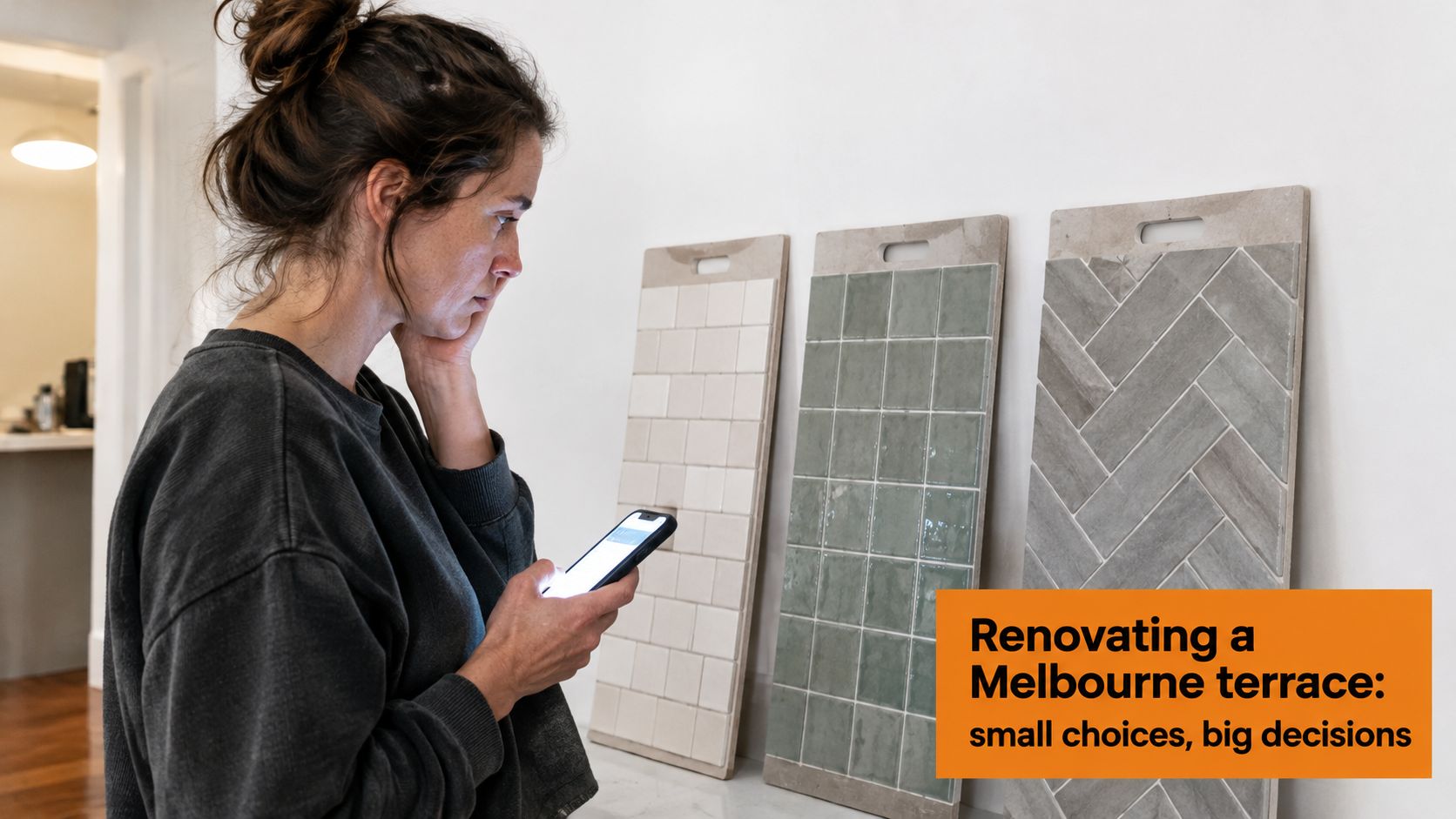
The decision is bigger than colour
A lot of people start with “white or not white”. That's too narrow. You need to decide on format, finish, layout, room, and whether the wall is a simple feature surface or part of a wet-area system that needs proper membrane, grout, and substrate work. If you skip those questions, you end up choosing with your eyes and fixing problems later with your wallet.
Practical rule: a subway tile should be chosen like a system component, not a paint swatch.
That's why I push homeowners to think in layers. The tile body, the grout joint, the adhesive, the waterproofing membrane, and the substrate all matter more than the rectangle shape itself. In a Melbourne renovation, that matters even more because bathrooms and laundries get regular temperature shifts, cleaning products, and repeated moisture exposure.
What this guide helps you decide
You'll get a clear answer on which subway tile suits a kitchen splashback, which finish is worth the cleaning effort, which layout looks calm versus busy, and when a glossy wall tile is the wrong choice underfoot. You'll also get the questions to ask your tiler before you sign off on anything.
If you're comparing backsplash styles while also trying to keep the room coherent, a useful external reference is the guide to backsplash styles. Use it for visual planning, then come back to the wet-area reality. The pretty board matters, but the installation details matter more.
Where Subway Tiles Actually Came From
The Australian story starts underground, not in a boutique showroom. Sydney's Museum Station and St James Station formed the first phase of Sydney's underground railway project, with construction beginning in 1916 and Museum Station opening to the public on 20 December 1926. Their interiors used cream and green glazed ceramic tiles on platforms and concourses, because the material was durable, easy to clean, and reflective enough to brighten dim spaces. Museum Station's Sydney heritage record shows that the logic behind subway-style wall tiles was already established in Australia nearly a century ago.
Why that history matters in a Melbourne home
This isn't trivia. It explains why the format keeps working in homes. The same traits that suited public transport interiors, washability, brightness, and hard-wearing ceramic surfaces, are exactly what you want behind a cooktop or in a bathroom. Melbourne households don't need ornament for its own sake. They need surfaces that cope with cleaning, steam, and everyday use.
Victorian readers also have their own landmark. Flinders Street Railway Station has extensive Edwardian and 1950s wall-tile work, and Victoria's Heritage Council describes it as having the most extensive use of Edwardian and 1950s wall tiles of any station or building in Victoria. The station's pale blue and green tiles in the main booking hall were later replaced with pink granite, while Campbell Arcade, designed in 1949 and opened in 1955, still retains salmon-pink wall tiles, a pink-and-black terrazzo floor, pink granite columns, and chromed steel shopfronts. Victoria's heritage record for Flinders Street Station makes the point clearly, subway-style ceramic wall treatments have deep local roots.
The lesson is straightforward. Subway tiles work because they solve practical problems first and look good second. That's still the right order.
Sizes, Materials and Finishes Explained
Most renovators make one mistake here. They treat size, material, and finish like they're the same decision. They're not. A 75x150 ceramic tile, a 75x300 elongated tile, and a slim finger-format tile all change the room in different ways. Gloss, matt, honed, and textured finishes do the same.
Size changes the room more than homeowners expect
Classic subway proportions still read clean and familiar. Longer formats feel calmer and more modern, especially in a small Melbourne kitchen where you want the splashback to stretch the wall rather than break it up. Narrow finger tiles add rhythm and tension. That can work well in a powder room, but it can feel too busy if the room already has a lot going on.
My view: if the room is small and visually busy already, do not add a fussy format just because it is trendy.
Ceramic and porcelain are not interchangeable. The porcelain tile guide is worth reading if you are weighing body type and finish, because porcelain generally suits harsher use conditions better, while ceramic is often easier to justify on walls where the load is lighter. I would tie the material choice to the room, not to a catalogue photo.
Finishes compared
| Finish | Light reflection | Best for | Watch out for |
|---|---|---|---|
| Gloss | High | Kitchens, compact rooms, darker walls | Shows water spots and uneven grout more easily |
| Matt | Low to moderate | Calm bathrooms, modern interiors | Can look flat if the room lacks light |
| Honed | Soft, controlled | Refined feature walls, layered interiors | Needs careful cleaning habits |
| Textured | Variable | Accent walls, tactile designs | Can hold grime if overused in wet zones |
Gloss is still the safest default where you want easy wipe-downs and a brighter feel. Matt works when the room already has enough light and you want the tile to sit back. Honed gives a softer, more architectural result. Textured should be used with restraint, because too much surface relief can become a cleaning job you resent.
For white cabinets and a tidy kitchen palette, the guide to backsplash styles is a useful visual reference. It helps you compare how different finishes sit against joinery before you order samples.
Layout Patterns That Change the Whole Room
The layout pattern changes the room more than many buyers realise. Two people can buy the same subway tile and end up with very different results just by changing the bond. That's why pattern choice should be treated as a design and labour decision, not an afterthought.
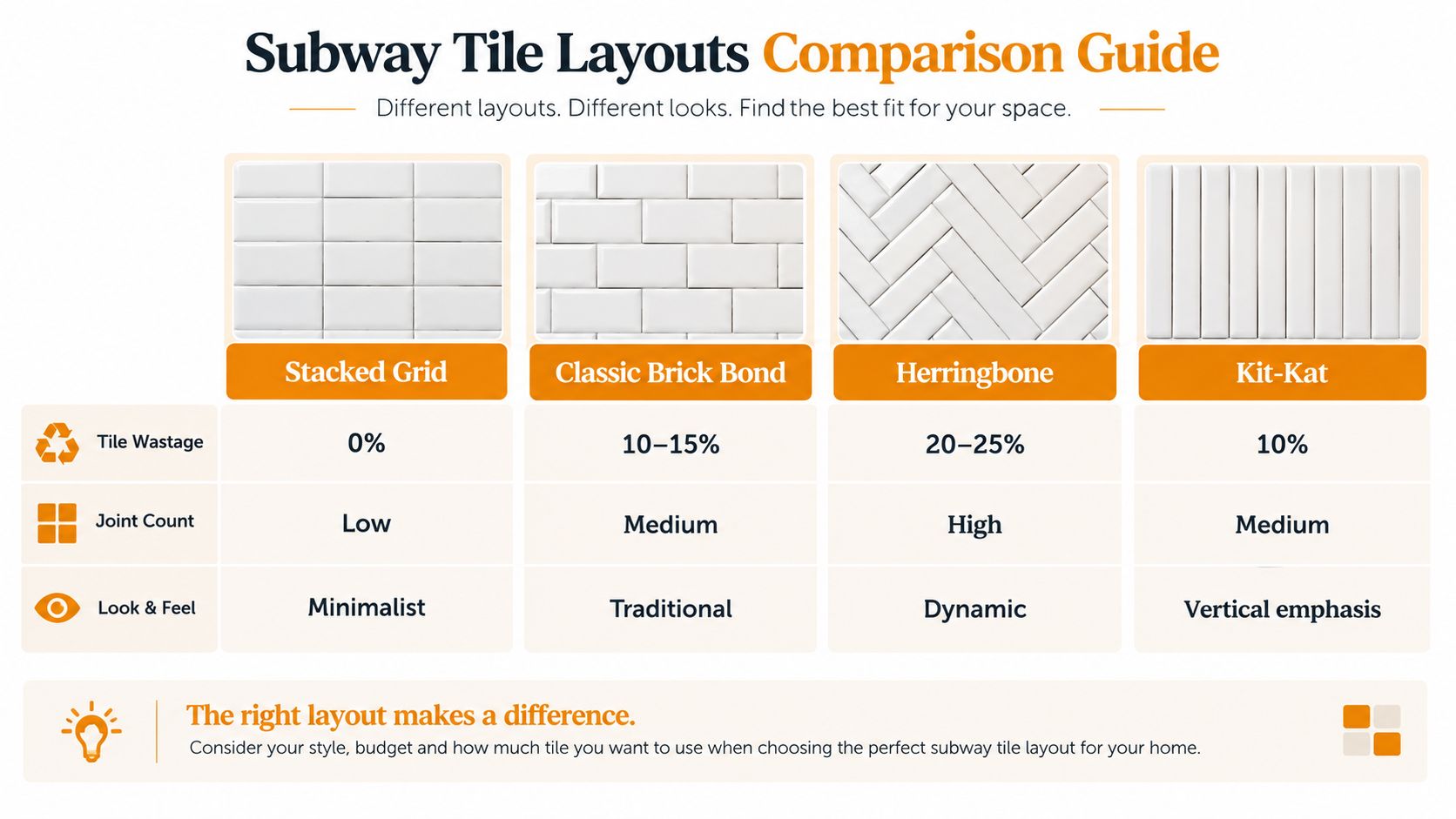
The four layouts most people actually use
Stacked lines up cleanly and feels modern. It works well in newer homes, minimalist kitchens, and bathrooms where you want the room to look orderly. It also keeps the wall visually calm, which helps if the cabinetry or benchtop already has movement.
Classic brick bond is the forgiving default. It hides minor irregularities better than a stacked layout and suits most older Melbourne homes. If you're unsure, this is usually the safest call.
Herringbone adds energy and direction. It looks brilliant on a splashback or feature wall, but it asks for more cuts at edges and corners, so labour rises and waste rises too. If you want movement, this is the pattern that delivers it.
Kit-kat changes the wall into a texture field. It's a strong choice when you want vertical emphasis and a more tactile finish, but the joint count climbs fast, which changes both cost and cleaning effort. On a small wall, that's fine. On a large wet-area run, it can become busy.
Grout and waste are part of the pattern choice
Narrow formats naturally create more joint length, so the wall carries more grout and more visual interruption. That isn't a problem if you want texture. It is a problem if you expect one uninterrupted plane.
Rule of thumb: the more complex the bond, the more you should allow for cutting, extra material, and installation time.
If you're planning herringbone or a more complicated offset, budget 8-12 per cent extra material. That's the sensible allowance for the extra cuts and offcuts, especially around power points, windows, and rangehood edges. A simple stacked wall wastes less, reads cleaner, and often looks more expensive than it is.
The subway tile pattern guide is a good cross-check if you're stuck between brick, herringbone, and stacked. Use it to narrow the visual field before you commit to a box count.
Room by Room Applications in Australian Homes
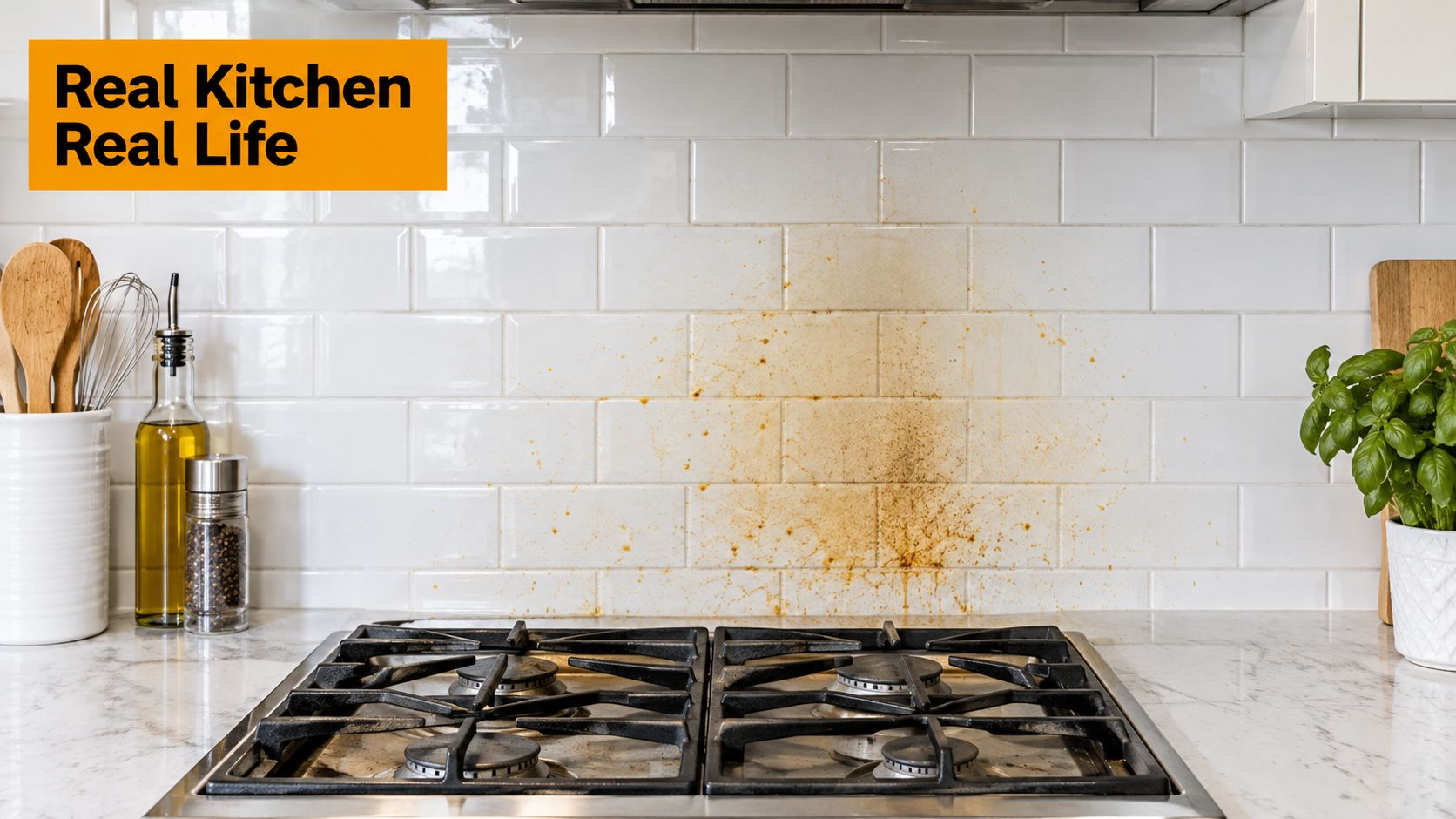
A good subway tile in the wrong room is still the wrong decision. I see this most in people who choose one finish for the whole house, then act surprised when the kitchen feels greasy, the bathroom feels slippery, or the laundry becomes hard to maintain. The room matters.
Kitchen splashbacks need easy wipe-downs, not drama
Behind a cooktop, the job is simple. Stop grease and splatter from staining the wall, and make cleanup painless. A smooth gloss or smooth matt finish is the right call most of the time because it wipes down quickly and doesn't trap residue in surface texture.
What matters most is the relationship between the bench, the cooktop, and the rangehood. The tile should read as part of that working zone, not as decoration pasted on afterwards. In a Melbourne kitchen, where people cook for real, the splashback has to cope with steam, oil, and repetitive cleaning.
Bathrooms and laundries need a system, not a product
AS 3958:2023 covers background preparation, bonded fixing, and grouting for wall, floor, mosaic, and panel tiles, including wet areas, screeds, renders, and flexible underlays. That's the right frame for bathrooms and laundries. The tile is only one part of the build. The membrane, adhesive, substrate, movement joints, and grout all affect how the room performs. You can read the current standard through the AS 3958:2023 product page.
For bathrooms, don't assume a nice tile surface fixes a bad wet area. It doesn't. If there's a membrane issue, the tile job can look perfect and still fail underneath. If you're updating an existing Melbourne bathroom, the Dublin bathroom tiling advice is worth a look as a practical reference point for wall-tile thinking, but the local waterproofing system still has to suit Australian conditions.
Outdoor and pool-adjacent spaces need a separate decision
Once water moves outside, the slip question becomes different again. Small formats can help where drainage or edges matter, but no shape on its own makes a tile safe. Treat outdoor and pool-adjacent selection as a slip-rated product decision, not a colour choice.
The point is simple. Decide room by room, and don't force one subway tile to do every job in the house.
Slip Resistance and Wet Area Safety
Too many buyers still pick a bathroom tile by finish name alone. They hear “matt” and assume it means safe. That's not how Australian wet-area safety works. The surface has to be tested for the actual use condition, not guessed from the showroom sample.
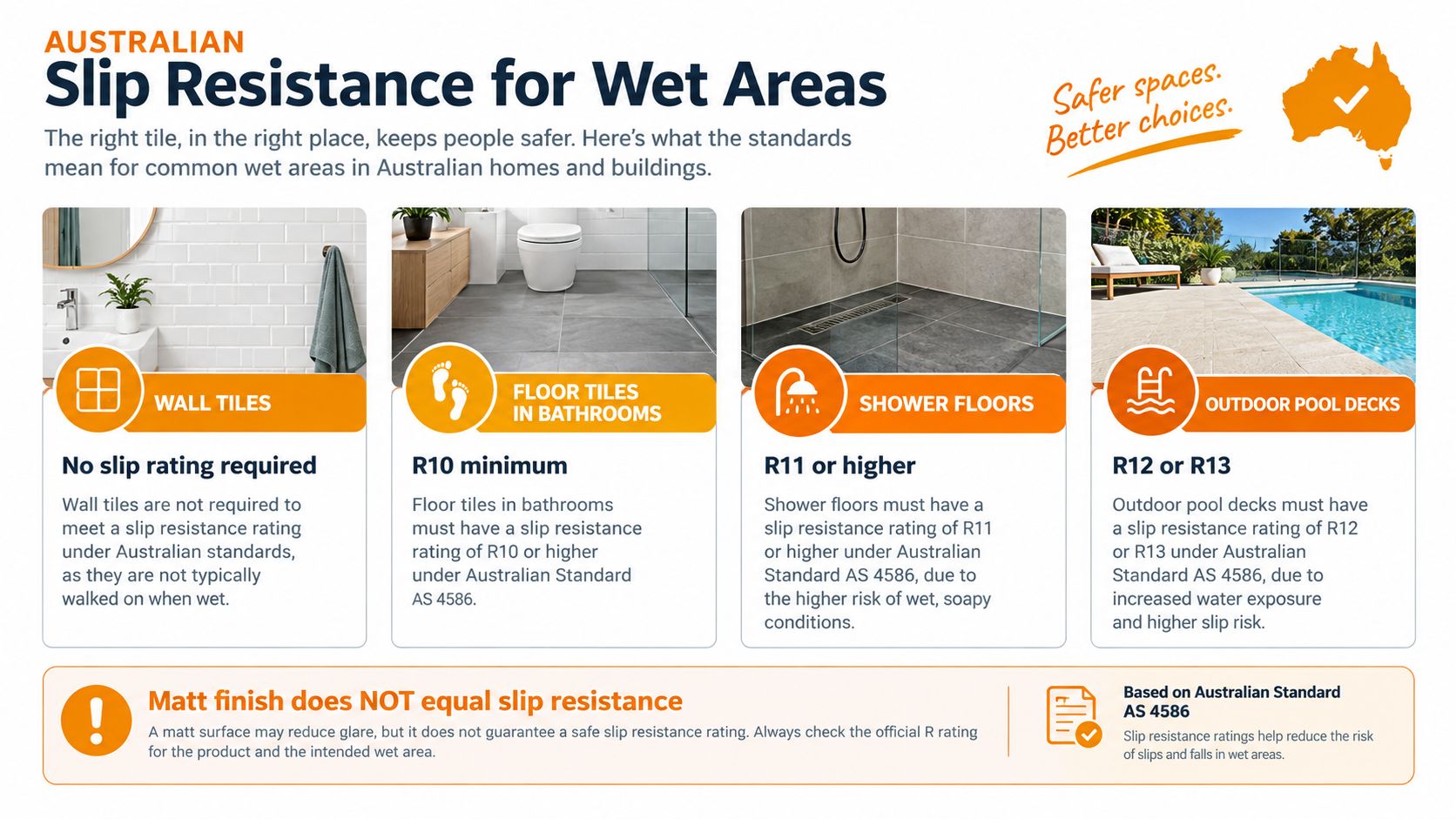
Wall tiles and floor tiles are different products in practice
A glossy subway tile can be excellent on a bathroom wall and completely wrong on a shower floor. That's normal. Walls don't need the same underfoot friction that floors do, and the wrong assumption creates risk. CSIRO identifies the pendulum method in AS 4586 Appendix A as a way to classify wet slip resistance, and it also separately identifies ceramic tile testing under AS 4459. CSIRO's surface testing guidance is the right place to start if you want an objective check.
For many residential bathroom floors, P4 is a commonly cited minimum benchmark, while shower zones need higher resistance. But don't stop at the letter or number. Match the report to the actual room, because a rating only means something when it lines up with the way the space is used.
Don't buy the surface finish, buy the tested performance.
Cleanability still matters
More texture can improve grip, but it can also hold soap, mineral deposits, and grime. That's the trade-off many homeowners ignore. A floor that feels safer on day one can become a maintenance burden if the profile is too aggressive for your cleaning routine.
The shower floor tile guide is useful if you're trying to separate wall decisions from floor decisions before you commit. Keep the logic simple. Use subway tiles where the tile belongs on a wall or splashback. Use a properly rated floor tile where feet and water meet.
What to ask before you buy
- Ask for the test report: Don't accept a finish description as proof of slip resistance.
- Match the room: A wall tile approval doesn't transfer to a floor automatically.
- Check maintenance realities: Cleaning residue and wear change traction over time.
- Separate zones: Shower floors, bathroom floors, and walls need different answers.
That's the safest way to buy. It's also the least regretful.
Buying Samples, Pricing and Pack Sizing
Most bad tile decisions happen before the tile even reaches site. Someone buys from a single screen view, skips samples, and then discovers the tile looks different under warm LEDs than it did in the showroom. Don't do that.
Start with samples, then compare on a clean basis
If you're choosing between finishes, order sample packs and take them home. Tiles Mate offers a $15 pack of five samples, which is enough to compare surface reflectivity, colour cast, and grout pairing in your own light. A tile that looks balanced at midday can look icy at night, so check it under the same lighting you'll live with.
When you compare pricing, use the same unit every time. Compare per m² with per m², or per box with per box. If a porcelain option is listed at one rate and a ceramic option at another, convert both to the same basis before you judge value. That stops you from being misled by packaging differences.
Measure for the room, not just the wall
Take photos before you measure. Capture the full wall, the benchtop edge, any windows, any power points, and the transition to adjoining surfaces. That gives the retailer and tiler enough context to estimate cuts and waste properly. It also helps avoid the classic mistake of buying enough square metres but not enough full boxes for the actual layout.
Tiles Mate also offers a free 15-minute design consultation, which is useful if you need to sanity-check a finish, pattern, or room pairing before you commit. For trade buyers, TilesMate Pro adds B2B pricing and personalised sourcing, which suits builders and designers who need repeatable supply rather than one-off browsing.
Questions worth asking any Melbourne retailer
- Is the price shown per m² or per box?
- What wastage allowance should I use for this layout?
- Is this tile intended for walls, floors, or both?
- Can I see the slip or wet-area documentation for the exact product?
- What grout width do you recommend for the format I'm buying?
If the answers are clear, you're probably dealing with someone who understands the job, not just the sale.
Common Questions Before You Commit
Subway tiles aren't out of style. They keep returning because the format is useful, and useful design survives trend cycles. What changes is the surface treatment, the colour, the layout, and the room they're used in.
White grout stays clean best when you treat it like a maintenance item, not a permanent promise. Seal it where appropriate, clean it regularly, and don't choose an aggressive grout colour just to avoid upkeep. In kitchens, a smooth tile with a sensible grout line is usually easier to live with than a statement finish you'll regret scrubbing.
A $15 sample pack is enough to choose between finishes if you're disciplined about testing. Put the samples on a bench, tape them to the wall, and view them morning and night. That's a better decision method than staring at a rendered product image on a laptop.
Per-box labels only make sense once you know the coverage. Read the box, check the square metre coverage, and then compare it to your measured area plus waste. Do that once properly and you won't have to guess twice.
Tiles Mate Pty Ltd supplies subway tiles, samples, and practical guidance for Melbourne renovations, including wet-area decisions, finish selection, and layout planning. If you want to compare products, check pricing, and get straightforward advice before you commit, visit Tiles Mate Pty Ltd and work through the options with your room in front of you.