



Stone Mosaic Guide: Materials, Patterns & Melbourne Tips
by Shivam Tayal 13 Oct 2026 0 Comments
You're standing in a showroom or on a laptop at 10 pm, comparing stone mosaic samples for a bathroom, kitchen splashback, or pool edge, and the choices start to blur together. One sheet looks refined, another looks rustic, and every product description promises durability, style, and easy care. The central question is simpler, what will genuinely suit your space, your budget, and Melbourne's wet-area rules?
Stone mosaic sits in a different category from plain tile because it combines material, pattern, and installation method in one surface. It can be architectural, decorative, and highly practical at the same time, but only when the stone type, finish, slip performance, and substrate are matched properly.
What Makes Stone Mosaic Different from Regular Tiles
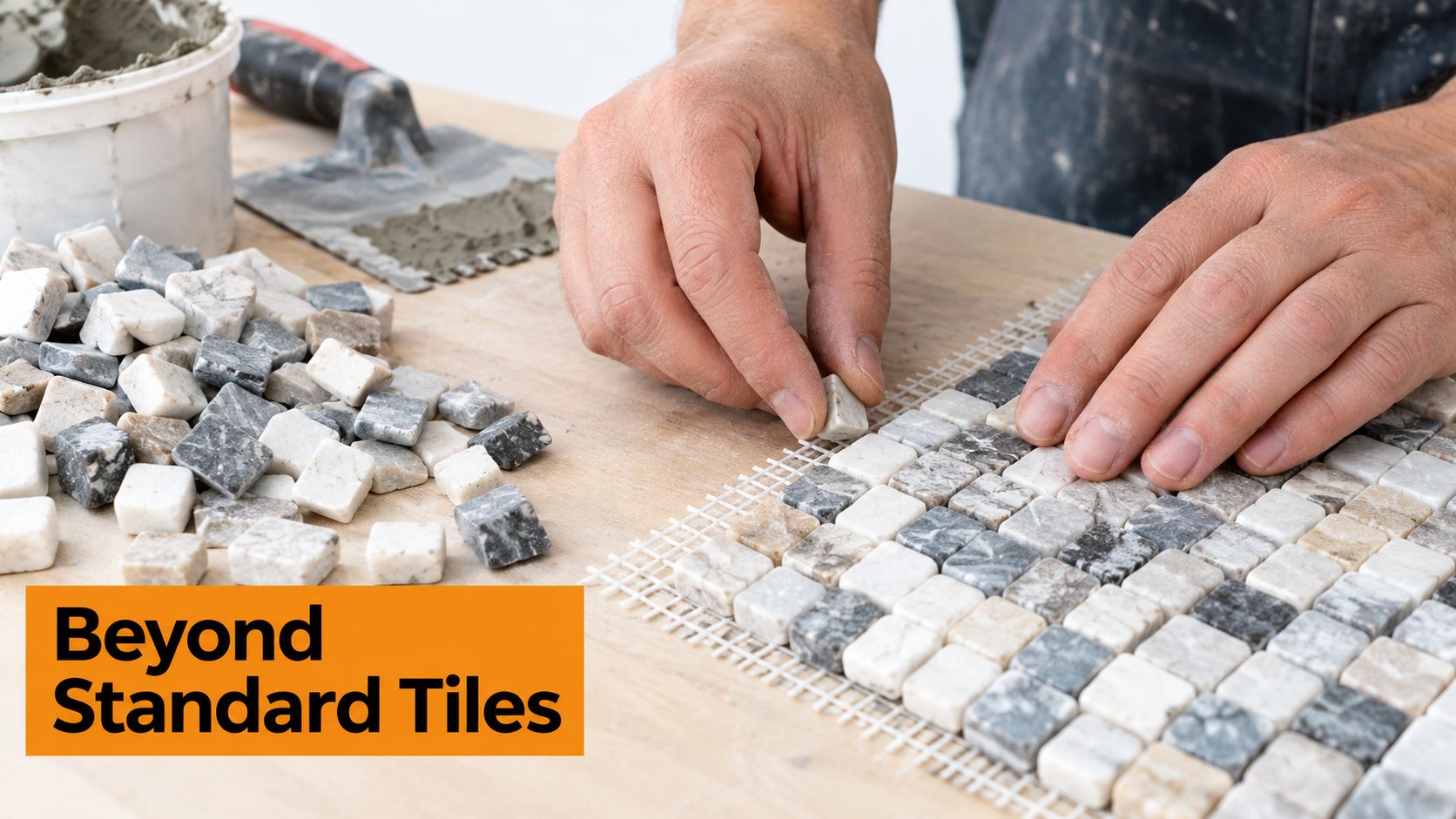
A lot of homeowners start with the same assumption, a mosaic is just a smaller version of tile. That's close enough for shopping, but not for planning. A stone mosaic changes how a surface behaves because the many small pieces, joints, and edges work together as a finished system, not just a decorative face.
Craft, not just coverage
Australia already has a strong example of that idea in the Shellal Mosaic. Australian signallers discovered it on 17 April 1917 during the Second Battle of Gaza, and the floor itself dates to AD 561–562, from the reign of Justinian I. It used approximately half a million tesserae and belonged to a Byzantine church floor, which says a lot about how mosaics can carry both design and history in one surface. The Australian War Memorial now keeps it in its permanent collection and describes it as an extraordinary example of Byzantine art, a reminder that mosaic is as much cultural artefact as building finish. The Shellal Mosaic at the Australian War Memorial
That long life matters for modern buyers. A church floor that survived excavation, wartime removal, transport, and museum installation shows the basic strength of stone-based decorative surfaces. It also explains why people still choose mosaics when they want a finish that feels crafted rather than mass-produced.
Scale changes the story
At the other end of the spectrum, Canberra's Parliament House forecourt shows how mosaic can operate on a civic scale. The forecourt mosaic covers 296 square metres, was fabricated during 1986–1987, and uses more than 90,000 granite setts. Parliament House describes it as a symbolic reminder of more than 65,000 years of Aboriginal and Torres Strait Islander presence in Australia, which gives the surface meaning beyond pattern alone. Parliament House Forecourt Mosaic
That range, from an ancient church floor to a modern civic pavement, is why stone mosaic deserves careful material choice. It's not just “small tiles.” It's a surface language, and the message changes with the stone, the layout, and the way it's installed.
Natural Stone Options, Marble, Travertine, Granite and More
Natural stone mosaics aren't interchangeable. Two sheets can look similar in a showroom and perform very differently once they're exposed to water, traffic, and cleaning products. That's why the first decision should be based on how the stone behaves, not just how it photographs.
Marble, travertine, granite and limestone
Marble is the classic choice when you want clear veining and a more formal look. It suits bathrooms, feature walls, and splashbacks where visual richness matters, but it usually asks more of the owner in sealing and maintenance. If you like a calm, elegant surface and don't mind a bit more care, marble fits well.
Travertine feels warmer and more textured. It often works well where you want an earthy finish with movement, especially in spaces that lean relaxed rather than polished. It needs careful installation because its texture and natural variation can affect how the surface reads once it's grouted and sealed.
Granite brings a tougher, denser character. It's often the practical choice when you want a hard-wearing finish with more visual variation and less concern about day-to-day wear. That makes it attractive for floors and exterior-adjacent zones.
Limestone gives a softer, more muted look. It's useful when you want colour consistency and understated texture instead of dramatic veining.
Practical rule: choose the stone for the way you'll live with it, not for the sample board alone.
How to compare them without getting lost
A showroom sample can hide a lot. Marble can look almost identical to limestone in a small piece, and travertine can read smoother or rougher depending on lighting and finish. The safer approach is to compare porosity, surface texture, sealing needs, and visual movement side by side.
If you're browsing product ranges, the natural stone mosaic tiles guide is a useful starting point for seeing how different stone families present in mosaic form. The main thing to remember is that stone choice affects more than colour. It affects cleaning, slip feel, stain risk, and how confident you'll feel using the space every day.
Choosing Patterns and Formats for Your Space
Pattern changes how a room feels before colour does. A small bathroom can feel busier, longer, or wider depending on the layout, while a feature wall can either calm down or sharpen the whole space. With stone mosaic, the pattern is part of the design, not a finishing detail.
Start with the room, then pick the shape
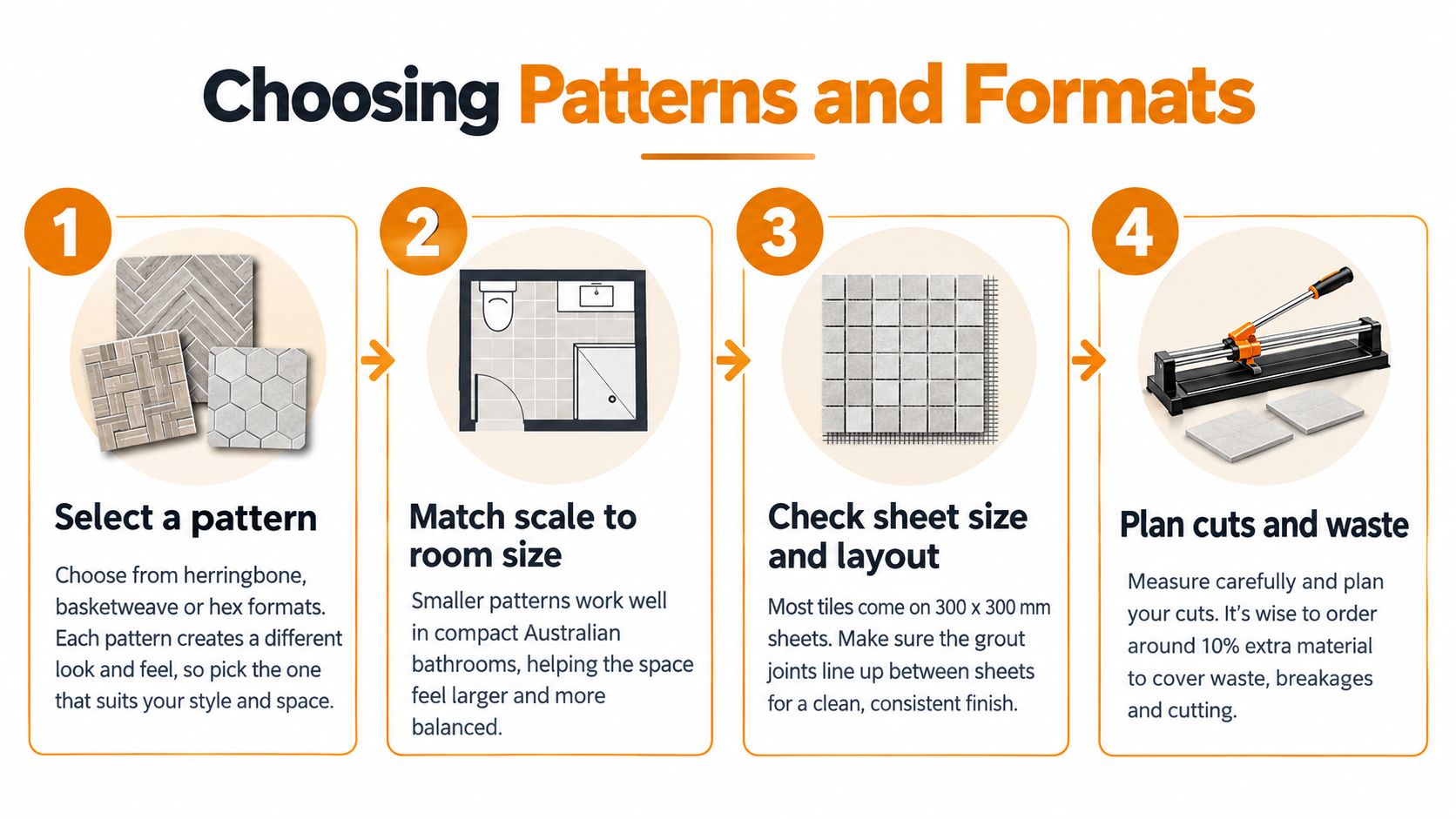
Herringbone gives movement and direction, so it's useful when you want a floor or wall to feel more energetic. Basketweave reads more traditional and can soften a space that already has strong lines. Hexagon formats sit between classic and contemporary, depending on stone colour and grout contrast.
Smaller formats can suit compact Australian bathrooms because they follow curves and falls more easily. That's especially useful around drains, built-in benches, and shower floors where the surface has to do real work. Bigger-looking patterns can overwhelm a tight space if the joints become too visually loud.
Think about sheet size and grout density
Mosaic sheets are usually mounted for easier installation, but the sheet size still matters because it affects alignment and cutting waste. If the pattern repeats awkwardly at the room edge, the finished floor can look slightly off even when the work is technically neat. The herringbone stone mosaic guide shows how one pattern can feel dynamic without becoming chaotic.
Design note: more grout lines can help with grip and drainage, but they also increase cleaning work.
That trade-off matters in kitchens and wet areas. A denser pattern can be a smart visual choice, but only if you're happy with the maintenance that comes with it. In a large open space, a quieter pattern may be the better long-term decision because it lets the stone itself do the talking.
Best Applications, Showers, Kitchens, Pools and Outdoor Areas
Stone mosaic shines where shape, slope, and texture all matter at once. It can look brilliant in a shower floor or pool surround, but it can also become a nuisance if you choose the wrong finish for the wrong surface. The safest approach is to match the application to the performance requirements first, then choose the look.
Where it works well
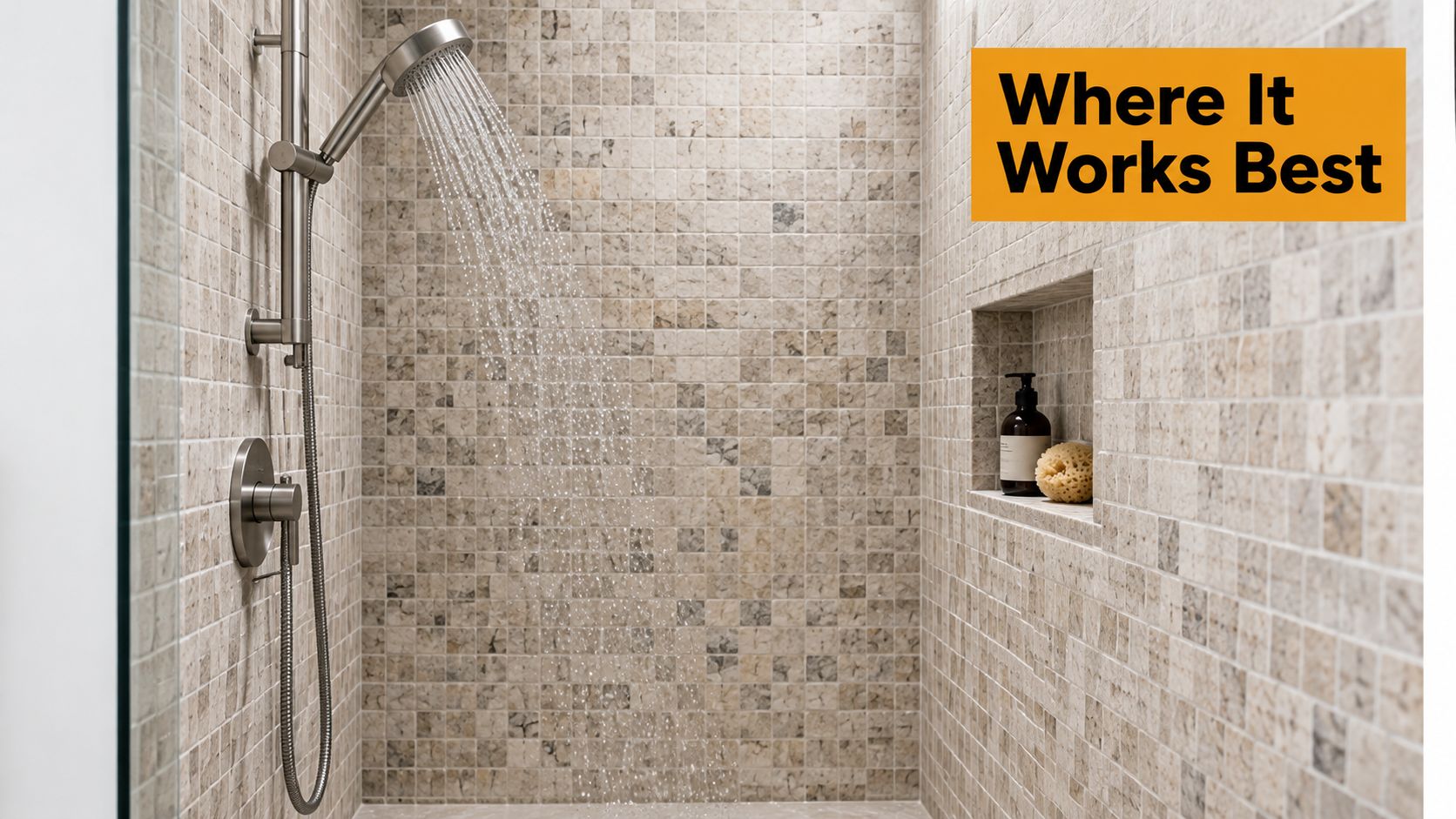
In showers, stone mosaic can help follow falls and add traction through the extra jointing. That doesn't make it automatically safe, but it does make it easier to build a functional wet floor when the finish has been tested properly. In kitchens, it can suit splashbacks and smaller accent areas where cleaning is manageable and the surface doesn't need the same barefoot slip performance as a shower.
For pool surrounds and outdoor zones, the finishing decision becomes even more important. Melbourne weather, water exposure, cleaning products, and general foot traffic all affect how the surface feels in use. A polished stone that looks elegant in the showroom may be far too slick once it's wet.
Where caution matters most
Australian guidance separates waterproofing from slip resistance, and that distinction matters more than most product descriptions admit. AS 4586 is the reference point for slip testing of new pedestrian surface materials, while AS 3740 covers domestic wet-area waterproofing and AS 4654 covers external above-ground waterproofing. Australian Tiling Standards overview
A surface can look appropriate and still fail the real test, how it behaves when wet, soapy, or contaminated.
That is why polished or highly smooth natural stone needs extra scrutiny in bathrooms, laundries, balcony edges, and around pools. If you're specifying for a Melbourne home, ask for the installed finish, not just the product family. The grout, slope, texture, and maintenance condition all affect the final result.
Installation Standards and Waterproofing Compliance
A beautiful stone mosaic can still fail if the layers underneath are wrong. Substrate prep, adhesive choice, and waterproofing all need to work together, especially in wet areas where small problems become expensive quickly. That's why Australian compliance isn't an admin hurdle, it's part of making the surface last.
The checks that matter before tile goes down
AS 3958:2023 covers substrate preparation, bonded fixing, grouting, and mosaic panels in Australia. For natural stone mosaics, that matters because the stone may vary in porosity, thickness, and moisture sensitivity, so a generic ceramic-tile approach isn't always safe. AS 3958:2023
Before installation starts, the substrate should be flat, clean, and compatible with the adhesive system. Uneven or contaminated backgrounds can create voids, weak bond zones, cracking, and debonding, especially because mosaics rely on lots of small pieces and many grout joints. Waterproofing is separate, so tiling should begin only after the membrane has been installed, cured, and inspected.
What to ask your installer
If you're hiring a tiler in Melbourne, ask for the following in plain language:
- Substrate condition: how flat and clean is the base before the mosaic goes down?
- Adhesive compatibility: is the adhesive suitable for both the stone type and the wet-area substrate?
- Open time and bed thickness: are the manufacturer's requirements being followed?
- Grout and sealing plan: what joint width and sealing approach are specified for this stone?
A practical installation resource like Massachusetts mosaic tile experts can be useful if you want to see how experienced installers think through layout and fixing decisions, even though the compliance framework here is Australian.
For product selection, the wall tile adhesive guide is worth checking alongside the stone itself. The main point is simple, document the stone, the location, the adhesive, the grout joint width, and the sealing needs before you order. That reduces the chance of discovering a mismatch after the sheets are already on site.
Maintenance, Longevity and Cost Considerations
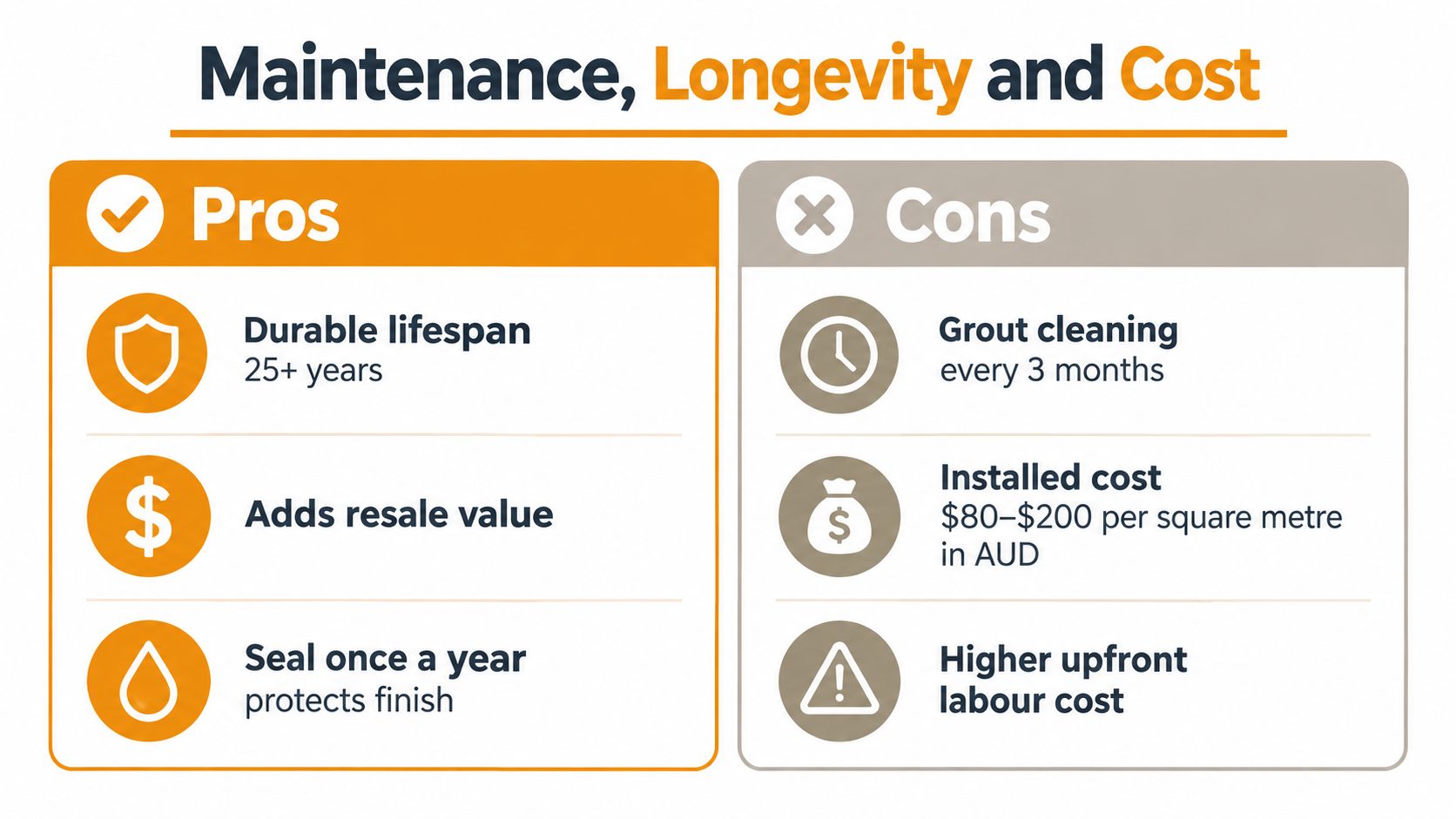
Stone mosaic is often chosen for how it feels in the room, but the ongoing cost is shaped by care, repairs, and waste as much as by the purchase price. A well-chosen mosaic can last a long time, yet it still needs attention if you want the finish to stay clean and stable. That's the part many glossy guides skip.
Care, repair, and real-world upkeep
Different stones need different sealing and cleaning routines. That's not a weakness, it's a consequence of choosing a natural material with visible character. In humid bathrooms or hard-water conditions, grout and surface care matter just as much as the tile face because build-up tends to show in the joints first.
For pool-adjacent cleaning questions, a practical reference on remove calcium buildup on pool tile helps reinforce a useful habit, regular maintenance matters more than harsh scrubbing after neglect has built up. The same idea applies to mosaic surfaces generally.
Cost and sustainability together
Stone mosaic usually carries higher upfront labour because the pieces are smaller, the layout takes longer, and cutting needs more care. That's normal. What matters more is the total project cost, including waste, spare material, and future repairs.
Sustainability is where a lot of people get misled. A natural material can still have a poor outcome if the order is oversized, off-cuts are discarded carelessly, or damaged sheets are not separated properly. Recent Australian construction-waste reporting identifies concrete, masonry, and tiles among commonly discarded building materials, and it warns that claimed landfill diversion can diverge sharply from actual recovery in some projects. Australia's Waste D Opportunity 2025
Useful budgeting habit: order carefully, keep spare sheets for future repairs, and ask where clean stone waste actually goes.
That approach usually does more for environmental performance than a vague claim that stone is “natural” and therefore sustainable.
How Tiles Mate Can Help with Your Stone Mosaic Project
A good sample changes the conversation fast. Hold the stone in daylight, under bathroom lighting, and beside your benchtop or cabinetry so you can see how the colour and texture really behave. The $15 sample pack is most useful when you order a few options you're genuinely considering, not just the safest-looking one.
The free 15-minute design consultation is best used with measurements, photos, and a short list of questions about finish, pattern, and installation conditions. Trade buyers can also use TilesMate Pro for exclusive B2B pricing and personalised sourcing support, which is useful when a project needs matching batches or coordinated stone across multiple areas. Tiles Mate Pty Ltd also offers delivery across Melbourne, so it can suit homeowners and trades planning a local renovation timeline.
If you're comparing natural stone mosaics in Melbourne, Tiles Mate Pty Ltd gives you a practical way to check samples, ask about suitability, and line up the finish before you commit to the full order. That saves time, reduces guesswork, and makes it easier to choose a surface that fits both the room and the rules.
If you're planning a bathroom, kitchen, balcony, or poolside project, start with the stone sample, not the photo. Visit Tiles Mate Pty Ltd to compare natural stone mosaics, check local options for Melbourne conditions, and get advice before you order.