




Mosaic Tiles for Melbourne: A Practical Guide
by Shivam Tayal 11 Oct 2026 0 Comments
You're in a Melbourne showroom with a bathroom plan on your phone, a kitchen splashback still undecided and a pool area that needs a surface you can trust under wet feet. One display catches your eye, with neat penny rounds in one sheet. Another uses marble-look pieces that seem to change colour under the lights. Both are called mosaics, but they won't behave the same way once they meet adhesive, grout, water, cleaning products and a Victorian building site.
A mosaic is therefore more than a decorative pattern. Format, material, substrate, grout joints and slip testing all influence whether it suits a shower, feature wall, splashback or pool surround. The choices become much clearer when you separate appearance from performance and ask what the finished surface must do.
Standing in Front of the Mosaic Wall
A renovator in Truganina might start with a simple question: should the bathroom floor use soft penny rounds or a marble-look hexagon? The better question is whether the chosen sheet suits the floor's falls, the intended barefoot use, the substrate and the amount of cleaning the household will accept.
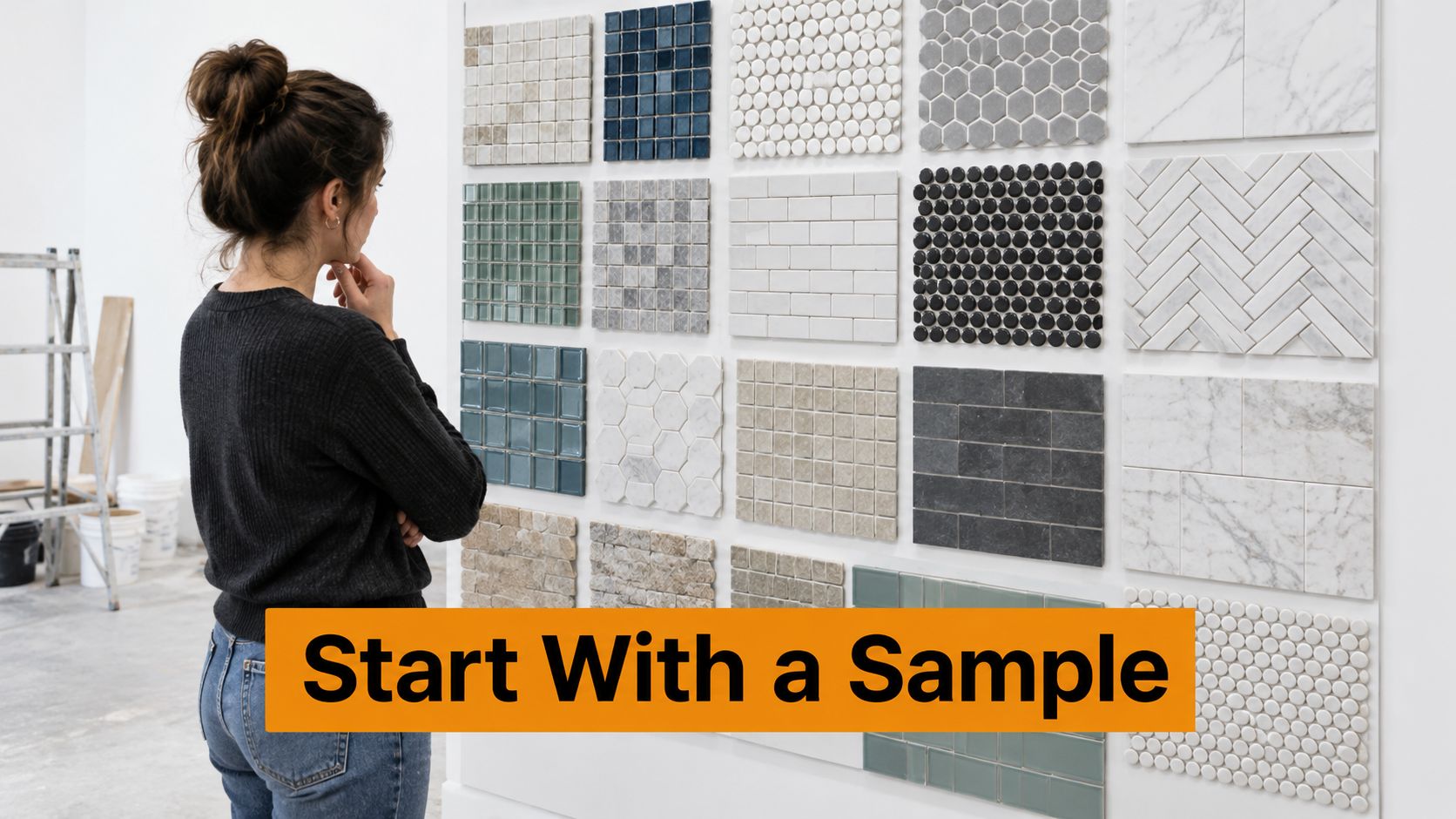
The same thinking applies in a working kitchen. A glass mosaic may reflect light across a narrow splashback, while a textured stone sheet can bring warmth beside timber cabinetry. In a pool area, however, a beautiful finish still needs the right tested slip performance, edge detailing and cleaning plan. A mosaic can follow curves and changes in level neatly, but small pieces don't remove the need for sound construction.
A useful starting point: choose the job before choosing the pattern. A shower floor, kitchen wall and pool surround have different technical demands.
You'll also need to consider how the sheets are assembled, how the joints will be grouted, whether the surface is glazed, honed, textured or porous, and what lies underneath. Melbourne's changing weather matters most in external areas, where drainage, movement and contamination can affect how a surface performs over time.
For ideas about using a decorative surface to establish a room's character, the guide to feature wall tiles offers a useful design reference. Keep the practical questions beside the style questions, and you're less likely to order a product that looks right on a sample board but struggles in the finished space.
The short video below gives a visual introduction to mosaic layouts and installation thinking before you compare specific formats.
By the time you request a quote, you should know the application, the likely exposure to water, the type of traffic and the finish you're prepared to maintain. Those answers narrow the field far more effectively than choosing by colour alone.
What a Mosaic Tile Actually Is
A mosaic is a surface made from small pieces of tile, stone, glass or another hard material. Each piece is commonly called a tessera, a term that also describes the small coloured pieces used in historic mosaic work. In retail products, manufacturers usually arrange the pieces into sheets so the installer can handle a group of tiles rather than placing every piece separately.
The sheet may use a mesh backing, a paper face or another temporary carrier. The installer still has to bed the pieces evenly into adhesive, align the sheets and preserve consistent joints. A sheet isn't a guarantee of a perfect installation. If the substrate is uneven or the adhesive coverage is poor, the finished surface can show lippage, hollow spots or irregular grout lines.
Why small pieces change the job
Small formats offer a practical advantage on curved or sloping surfaces. A large rigid tile may bridge a change in plane, while a mosaic sheet can flex around a gentle curve or break into smaller sections along a shower fall. That makes mosaics useful on shower floors, curved walls, niches, steps and rounded columns.
The trade-off is the number of joints. A mosaic usually creates more grout coverage than a large-format tile, which changes the visual rhythm and the cleaning routine. Grout colour can make the individual pieces stand out or soften the overall pattern. Joint width, sheet alignment and the transition between sheets also become part of the design.
Small pieces improve flexibility, but they don't correct a poor substrate. The surface underneath still needs to be flat enough, stable enough and prepared for the selected adhesive system.
Mosaics have also lasted because they record more than decoration. The Shellal Mosaic was created in 561–562 CE during the Byzantine period and contains approximately 500,000 tesserae. Australian and New Zealand troops discovered it on 17 April 1917 during the Second Battle of Gaza, and it was installed in the Australian War Memorial in Canberra in 1941. Its history connects Byzantine art, wartime acquisition and Australian memorial culture, although its removal from a conflict zone remains controversial as possible looting. The ABC's account of the Shellal Mosaic shows why mosaic surfaces can carry religious, political and military stories across centuries.
Australia also uses mosaic at civic scale. The Forecourt Mosaic at Australian Parliament House, also known as Possum and Wallaby Dreaming, was created by Michael Nelson Tjakamarra between 1986 and 1987. Its pavement measures 14 metres by 14 metres, covering 196 square metres, within an art-and-craft programme involving more than 85 Australian artists and craftspeople and more than 70 artworks and craft commissions. The Australian Parliament House collection information places the work within a national collection of more than 6,000 works.
Common Mosaic Formats and Materials
The most suitable format depends on the surface, not just the pattern. A mesh-mounted porcelain sheet may be practical for a bathroom floor, while a delicate glass mosaic may be better reserved for a wall or a carefully specified pool application.
Sheet mosaics are the general-purpose option. They arrive in organised panels, often with repeating squares, rectangles, kit-kat pieces or other regular shapes. They work well on feature walls, splashbacks and many floors, provided the product has a suitable tested finish. Watch the joins between sheets, because a repeated pattern can reveal every alignment error.
Penny rounds create a softer, more traditional appearance. The many curved edges give a bathroom floor or powder-room wall a tactile, patterned look. Their small size can help with falls, but the numerous joints need deliberate grout selection and regular cleaning.
Hexagons introduce a stronger geometric character. Marble-look hexagons can suit a vanity wall, while porcelain versions may be more practical in a wet area. The exposed corners demand careful cutting around wastes, thresholds and wall edges, so the layout should be planned before installation.
Marble and natural stone mosaics bring variation that printed surfaces may not reproduce. Carrara, Calacatta-look and other pale designs can work beside warm timber or brushed metal, but natural stone needs product-specific sealing and maintenance advice. A honed surface may feel different from a polished one, and stone can retain residue more readily than a smoother glazed product.
Glass mosaics are useful where reflected light matters, especially on splashbacks, feature strips and selected pool applications. They can make a narrow area feel brighter, but the adhesive and grout colour influence the final appearance. Translucent pieces can also show the substrate or adhesive beneath them, so the installer must use a compatible system.
For a related look at ceramic-based small-format options, porcelain mosaic tiles can help you compare appearance with the practical requirements of a porcelain surface.
| Format | Best fit | Watch out for |
|---|---|---|
| Sheet or mesh mosaic | General walls, splashbacks and suitable floors | Sheet alignment, adhesive coverage and repetitive joins |
| Penny round | Soft bathroom patterns and powder rooms | Cleaning effort and careful cutting around wastes |
| Hexagon | Graphic feature walls and selected floors | Corner cuts, layout planning and grout visibility |
| Marble or natural stone | Refined walls, niches and feature areas | Sealing, staining, variation and maintenance |
| Glass | Splashbacks, feature strips and selected pool surfaces | Adhesive compatibility, reflection and substrate visibility |
A sample viewed under showroom lighting can't answer every technical question. Confirm the intended use, surface finish and test documentation before treating a format as suitable for a wet or external location.
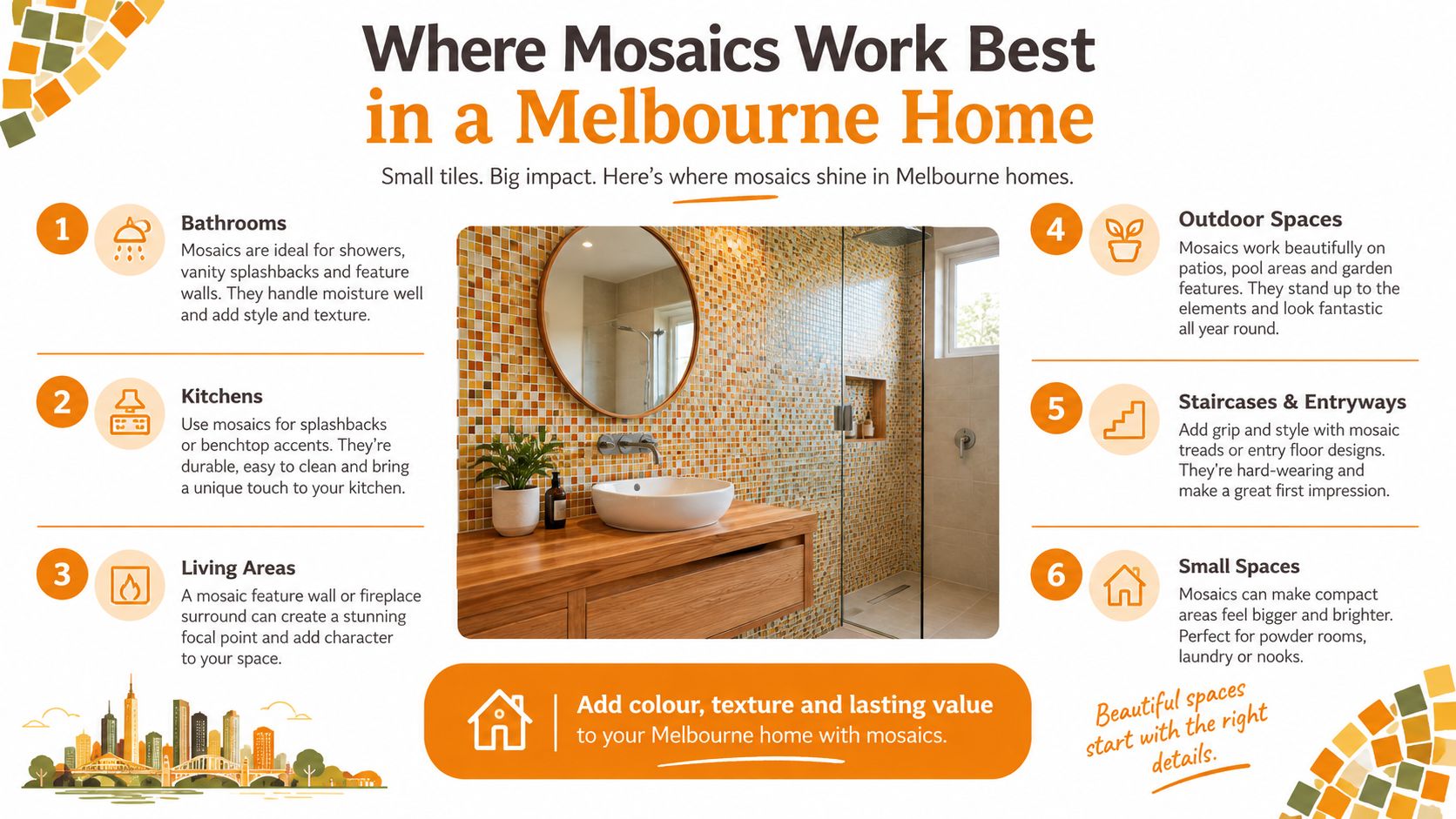
Where Mosaics Work Best in a Melbourne Home
Mosaics earn their place when their small scale solves a practical or visual problem. They can add detail to a compact room without requiring every wall to carry a bold pattern, and they can break across curves or falls more easily than rigid large-format pieces.
Splashbacks and laundries
A kitchen splashback usually prioritises wipeability, colour and how the surface sits beside cabinetry. Glass can reflect light in a darker kitchen, while stone or porcelain can provide a quieter, more grounded finish. Keep grout maintenance in mind around cooktops and sinks, where grease, food residue and water marks collect.
In a laundry, a restrained sheet mosaic can protect a wall behind a trough or establish a small feature zone. Choose the adhesive and grout for the substrate and exposure rather than assuming a wall application has no technical requirements.
Shower floors and bathroom walls
A shower floor needs falls that direct water to the waste. Small sheets can follow those changes in level with less bridging than large tiles, but the installer still has to set out the sheets and maintain even bedding. The mosaic format helps with geometry, not with membrane continuity or poor drainage.
For a vanity wall, marble-look hexagons, penny rounds or a narrow glass strip can create a focal point. Full bathroom walls and floors need a more disciplined approach because colour variation, grout density and cleaning effort become much more noticeable across a larger area.
Pools and outdoor spaces
Pool interiors and surrounds combine water, barefoot traffic, cleaning chemicals, drainage and strong daylight. A product that looks suitably textured may still need verified testing for the actual use case. Pool coping, steps and transitions deserve the same attention as the broad field area.
Outdoor entertaining areas can use mosaics on selected walls, steps or outdoor kitchen splashbacks, while larger pavers may be more practical across the main walking surface. In Melbourne, check how rainwater drains, where leaves collect and how the surface will be cleaned before selecting a highly textured or porous finish.
Use mosaic where the small format earns its keep. A feature strip may deliver the character you want without turning every square metre into a high-maintenance grout surface.
Think in zones. A small powder room may tolerate a more expressive marble mosaic because the floor area is limited. A pool deck needs a decision based on wet barefoot traction and cleaning, not on whether the pattern looks attractive beside the water.
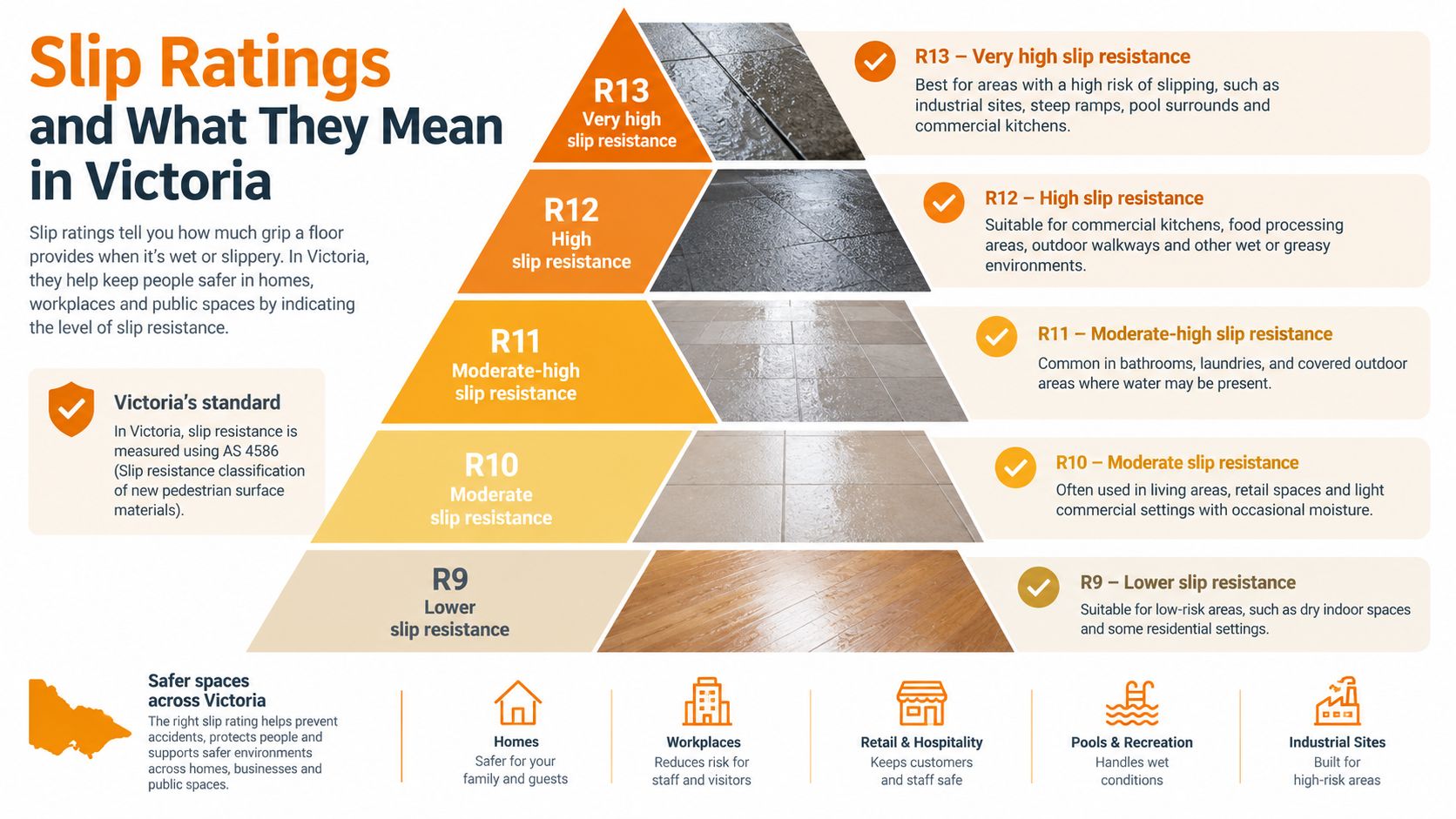
Slip Ratings and What They Mean in Victoria
Slip resistance is where many mosaic selections go off track. The word “non-slip” on a product page doesn't tell you which test was used, what contact condition it represents or whether the result suits your room.
Under AS 4586, the wet pendulum system classifies new pedestrian surfaces from P0 to P5, while barefoot ramp testing uses A, B or C. The scales measure different conditions and aren't directly interchangeable. The wet pendulum system models shod contact, while barefoot ramp testing addresses barefoot use.
The scale runs from P0, the highest slip risk, to P5, the lowest risk within the wet pendulum classification. Barefoot results run from A through C, with C representing the strongest classification in that system. A bathroom walked on with footwear and a pool entry used barefoot don't present the same test scenario.
Match the evidence to the room
For a typical domestic bathroom floor, Australian consumer guidance commonly points to P3 or R10 as a practical starting point, but the product certificate and actual exposure still matter. Shower floors, pool entries and pool surrounds require closer attention to barefoot testing, drainage and contamination. Water, soap residue, oils and poor cleaning can reduce real-world grip even when a new product has a strong test result.
For pool decks and comparable outdoor zones, pool deck traction solutions provide useful background on traction treatments beyond tile selection. The principle is the same: identify how people contact the surface before choosing a performance claim.
Ask the supplier for:
- The exact classification: Request the P result, R result or barefoot class rather than accepting “anti-slip”.
- The tested finish: Confirm that the test relates to the actual surface, not a different colour, glaze or texture.
- The intended exposure: State whether the area is an internal bathroom, shower, balcony, pool surround or external path.
- The installed assessment pathway: For an existing surface, AS 4663 is the relevant in-situ assessment pathway.
Mosaic joints may alter the underfoot feel, but they don't replace product-specific testing. A more textured surface can also collect limescale, soap and dirt, so traction and cleanability need to be considered together.
Waterproofing, Membrane and Installation Realities
Mosaic tiles don't make a bathroom waterproof. The waterproofing membrane beneath the tile system provides the primary barrier, while tiles and grout are generally water-resistant rather than waterproof.
That distinction matters because a mosaic has many joints. More grout lines can change cleaning and surface texture, but they can't compensate for a failed membrane, a poorly sealed penetration or a shower floor that doesn't fall correctly to the waste.
Victoria's wet-area requirements connect to the NCC and AS 3740, including treatment of shower floors, wall-to-floor junctions, penetrations and other wet-area interfaces. Before tiling begins, ask who installed the membrane, which system was used, whether the substrate was prepared correctly and what documentation is available for the builder or certifier.

Details that protect the finished surface
A shower floor needs a continuous fall to the waste, with no low points where water can sit. Wall-to-floor junctions, internal corners, movement zones and changes between materials need the correct sealant or movement treatment. Cement grout isn't a flexible joint, so it shouldn't be used where the construction requires movement accommodation.
Use this pre-tiling checklist:
- Inspect the substrate: It should be stable, clean and suitable for the selected adhesive.
- Confirm the membrane: Check coverage at corners, junctions, penetrations and the shower floor.
- Check the falls: Water should have a clear path to the waste without ponding.
- Confirm compatibility: Match adhesive, grout, sealer and tile material.
- Plan movement joints: Use flexible sealant where the construction requires it.
- Retain documentation: Keep product details and membrane records with the project file.
If moisture has already appeared outside the shower or below a wet area, find leak detection help before removing tiles or sealing over the symptom. For installation guidance that covers substrate preparation and laying practice, see these porcelain tile installation tips.
Buying Smart and Living with Mosaic Long Term
A careful purchase starts before you compare colours. Measure the area by length and width, separate walls from floors, and record openings, niches, wastes and changes in material. Ask whether the price is shown per square metre or per box, then check how much area each box covers.
Small formats create more cutting and sorting than a simple rectangular wall. Buy enough material for the layout, cuts and future repairs, but have the installer or supplier confirm the appropriate allowance for the particular pattern. Keep a spare labelled piece or sheet after installation, especially when the product has natural variation or a limited production run.
A buyer-ready check
- Order samples first: A $15 pack of five samples from Tiles Mate lets you compare colour, texture and grout relationships in your own lighting before committing. Confirm the current offer and availability when ordering.
- Use design advice early: A free 15-minute design consultation can help relate the mosaic to cabinetry, stone, tapware and daylight rather than judging it on a showroom wall alone.
- Read the box carefully: Check coverage, batch information, recommended applications, finish and maintenance instructions.
- Ask for test evidence: For floors, request the relevant slip classification and confirm the tested surface matches the selected product.
- Plan trade purchasing: Builders, tilers and other trade buyers can investigate TilesMate Pro for B2B pricing and personalised sourcing.
- Keep the paperwork: Store the product description, test certificate, installation instructions and maintenance recommendations with the renovation records.
Natural stone mosaics usually need sealing advice specific to the stone and finish. Don't apply a generic sealer without checking compatibility, because the wrong product can change the colour or leave a residue. Glass mosaics normally need a suitable non-abrasive cleaning method, while aggressive scrubbing can dull surrounding finishes or damage sealants.
Melbourne bathrooms can develop hard-water marks, soap film and residue around wastes and shower edges. Clean regularly with a product compatible with the tile, grout and sealant, and don't allow deposits to build in textured joints. Around pools, follow the manufacturer's cleaning advice and pay attention to areas where leaves, dirt and treatment residues accumulate.
Good maintenance protects more than appearance. A clean grout profile helps preserve the surface's intended texture and keeps small problems visible before they become installation problems.
If a commercial or hospitality area already has worn grout, staining or damaged surfaces, expert tile restoration for hospitality can provide context on restoration approaches. Residential owners should still follow the tile and sealer manufacturer's instructions, particularly for natural stone.
Tiles Mate Pty Ltd can help Melbourne renovators compare mosaic formats, materials, finishes, samples and wet-area requirements for bathrooms, kitchens and outdoor projects. Visit Tiles Mate Pty Ltd to review the range, arrange samples or request practical design guidance before you order.